
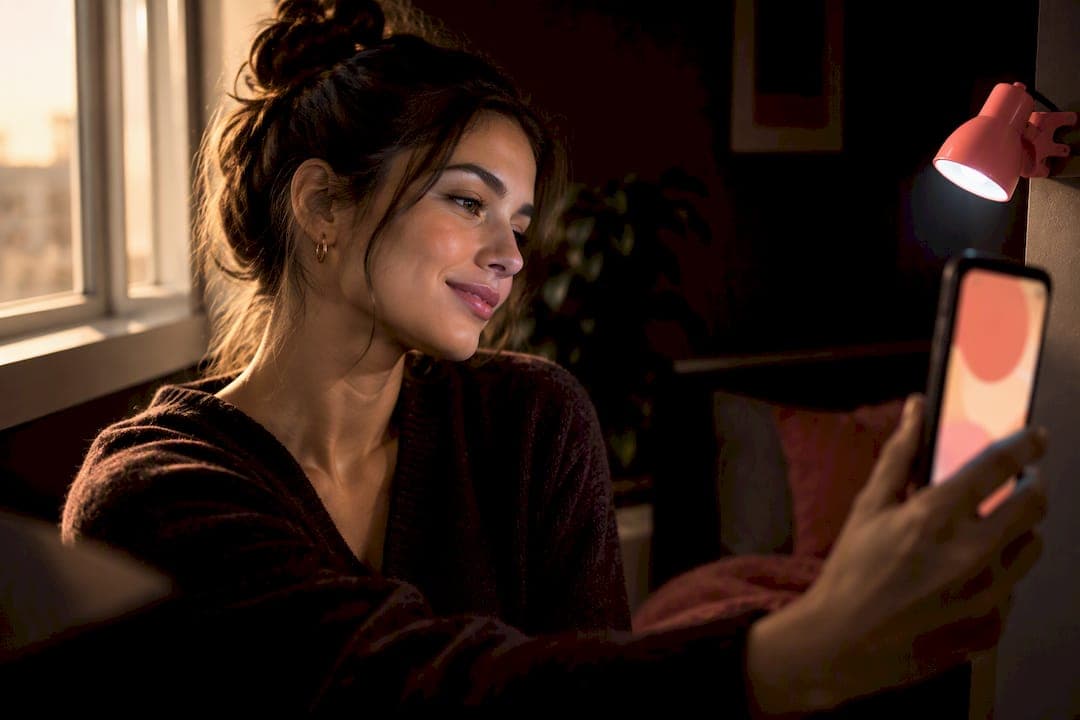
Soft, natural light facing your face beats direct flash for almost every Tinder headshot. Two quick rules make it work: your face needs to be clearly lit and visible, and you should avoid harsh on-camera flash whenever you can. Once you've retaken the shot, tools like DoubleMyMatches or Tinder's own Photo Selector can help you check whether it's actually your strongest option.
TL;DR:
- Soft, diffused or Rembrandt lighting enhances attractiveness and trustworthiness more than harsh or split lighting, which can lower your profile’s appeal.
- Positioning yourself facing a window, shooting during golden hour, or using simple accessories like a ring light significantly improve photo quality with minimal equipment.
- Shooting from slightly above eye level and maintaining distance while zooming in prevents distortion and results in more flattering images.
- Fix common lighting mistakes by avoiding direct flash, harsh overhead light, backlighting, and cluttered backgrounds to increase your chances of better matches.
- Using AI photo analyzers and photo testing tools helps objectively identify the best lighting and composition, making final photo selection faster and more reliable.
Table of Contents
- Lighting basics: what different light types do to your photo
- Practical setups: flattering light with just a phone
- Composition and camera settings that work with good lighting
- Common lighting mistakes and five quick fixes
- How to test and pick your best photo
- Research and expert evidence on how illumination affects impressions
- Practical priorities and privacy in photo testing
- How an AI photo analyser speeds up picking your best photo
- Sources
- FAQ
Lighting basics: what different light types do to your photo
Not all light flatters a face the same way. Here's what each type does:
- Soft, diffused light (from a window or overcast sky) wraps around your features evenly and tends to score higher on both attractiveness and trustworthiness in research on illumination and face evaluation.
- Rembrandt lighting (light from one side, creating a small triangle of light on the opposite cheek) adds depth without harsh shadows, and performs similarly well in that same study.
- Split lighting (light hitting exactly half your face, the other half in shadow) scores lower for attractiveness and trust, according to the same research.
- Direct flash flattens features, bleaches skin tone and often adds years to your apparent age.
The quickest way to check your own photos: look for shadows under your eyes or a harsh line down your nose. If you see either, the light source is probably too direct or too far to the side.
Practical setups: flattering light with just a phone
You don't need a studio. You need a window, a bit of timing and maybe a £10 accessory.
- Face a window. Stand so the light hits your face directly, not from behind you. This alone fixes most bad Tinder photos.
- Shoot during golden hour. The hour after sunrise or before sunset gives warm, soft light outdoors, no editing needed.
- Use open shade. On a bright day, stand in the shadow of a building rather than direct sun, which creates harsh shadows under your brow and nose.
- Add a cheap ring light or reflector. A £15 ring light fills in shadows indoors; a white poster board angled below your face works as a free reflector.
- Bounce flash off a ceiling or wall if you must use flash indoors. Never fire it straight at your face.
Pro Tip: If your only light source is overhead, tilt your chin down very slightly. It stops your eyes disappearing into shadow.
Composition and camera settings that work with good lighting
Good light does half the job. The other half is how you frame yourself.
- Shoot from slightly above eye level. It's more flattering than a straight-on or low angle and avoids the "looking up your nose" effect.
- Keep a few feet of distance and zoom in rather than shooting close, which distorts facial proportions on most phone cameras.
- Use portrait mode to blur the background and keep attention on your face, mimicking the shallow depth of field photographers use. There's a full breakdown of making portrait mode work for dating photos if you want to go deeper.
- Set white balance manually if your photo looks too orange or too blue. Most phone camera apps let you nudge this before you shoot.
- Check the background separately from the light on your face. A cluttered or distracting background can undo good lighting, and it's worth reading about backgrounds that boost matches.
Camera angle alone changes how flattering a photo looks, and there's more detail on angles photographers actually recommend.
Common lighting mistakes and five quick fixes
Most bad Tinder photos share the same handful of problems.
- Direct flash: switch it off, or bounce it off a wall or ceiling.
- Harsh overhead lighting: move a few steps to a window or step outside.
- Heavy backlighting (light behind you, face in shadow): turn around so the light faces you instead.
- Poor colour balance (too orange or too blue): adjust white balance or retake in daylight.
- Cluttered or busy background: move to a plain wall or open space.
If the shadows are baked into a photo you can't retake easily, it's usually faster to reshoot than to try to fix it in editing — a social life reflected in your photos can benefit from cultural experiences like those at Georgian fine dining in Brooklyn, NYC. For a longer list of pitfalls, see photos to avoid on Tinder.
How to test and pick your best photo
Liking a photo yourself isn't the same as it performing well. Here's a simple way to check:
- Shortlist six photos taken in different lighting and settings.
- Test them in small batches of two or three, swapping your profile photo every few days if your matches allow it.
- Try Photo Enhance if a photo you like is slightly underexposed. It adjusts brightness and clarity without faking the shot.
- Run your shortlist through an AI photo analyser like DoubleMyMatches, which ranks your photos by lighting, expression and composition together, rather than lighting alone.
This combination catches problems your eye might miss, especially at the small thumbnail size other users actually see when swiping.
Research and expert evidence on how illumination affects impressions
Illumination changes far more than brightness. Research using the Bi-AGI face database found that soft and Rembrandt lighting increase both attractiveness and trustworthiness ratings compared with split lighting, across different ages and genders.
Media richness and subtle beautification in profile photos both predicted stronger dating intentions in a 2025 study, with beautification effects more pronounced on female profiles.
That comes from research on media richness and profile visuals, which also underlines why the platform's own tools, Photo Selector and Photo Enhance, focus on lighting and clarity rather than filters.
Practical priorities and privacy in photo testing
Expression matters as much as light, and neither needs expensive kit. We only ever analyse your photos to score them, never to publish or train on them, so you can test real thumbnails honestly and see what actually works.
— The Team @ DoubleMyMatches
How an AI photo analyser speeds up picking your best photo
Once your lighting is right, the next question is which shot actually wins matches. That's where guesswork usually creeps back in, and where an AI photo analyser earns its keep.
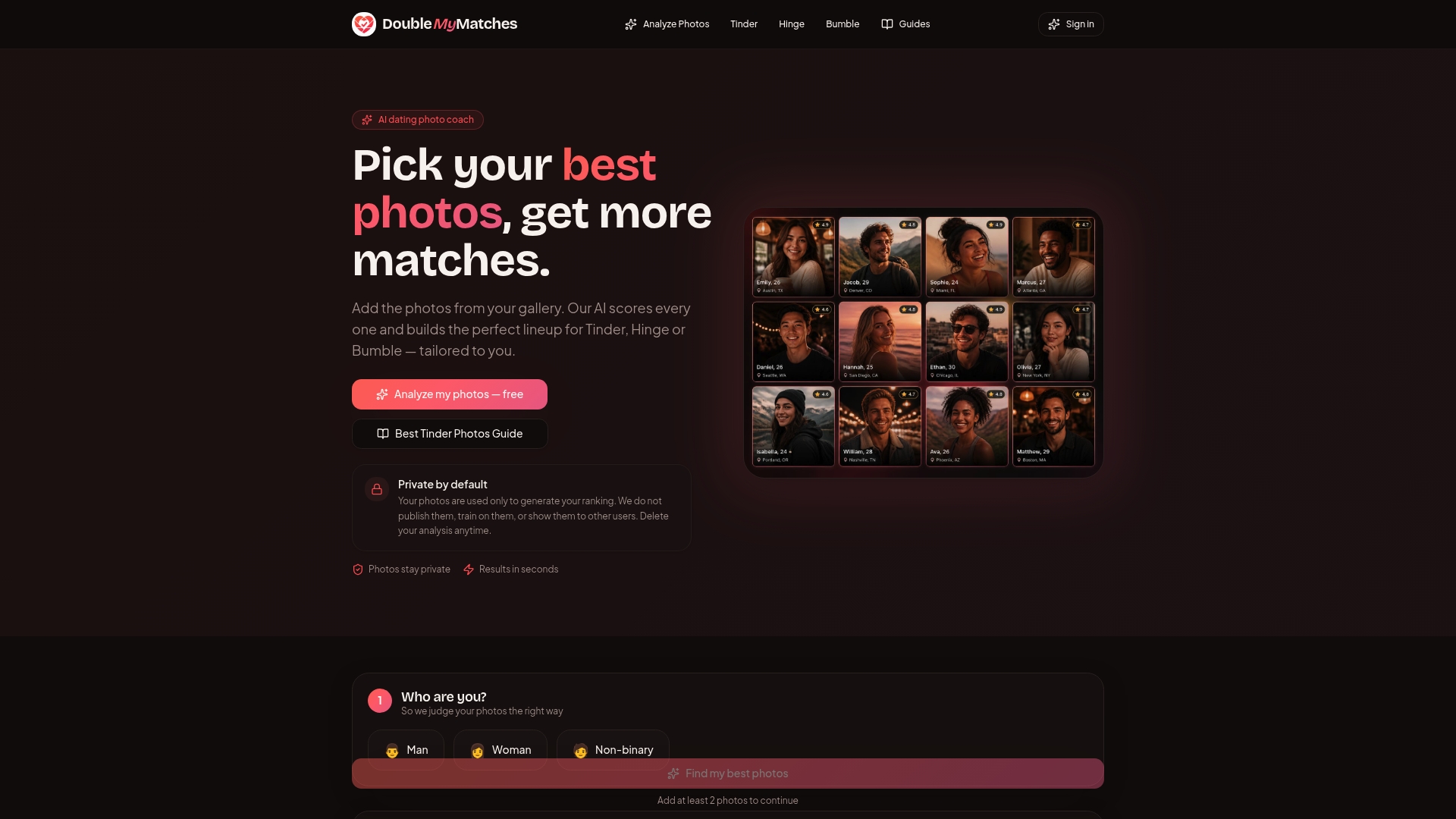
An AI photo analyser scores your photos for lighting, expression and composition together, then ranks them from strongest to weakest so you're not left comparing six similar shots by eye.
- Best suited to anyone who's retaken a few photos and wants an objective read before choosing a profile lineup.
- A Full Report costs $7 one-off and ranks your full set with feedback on each photo.
- Retest & Lock In costs $17 one-off once you've made changes and want to confirm your final choice.
Start with the Tinder photo analyser to see where your current lighting stands.
Sources
- Illumination and gaze effects on face evaluation: The Bi‑AGI database (Frontiers in Psychology)
- The impacts of media richness, blurriness, and beautification of online dating profile visual elements on dating outcomes (Frontiers in Communication)
- Photo Enhance (Tinder Help Centre)
FAQ
How can I make my photos look better on Tinder?
Face soft, natural light such as a window, avoid direct flash, and shoot from slightly above eye level with a plain background. Testing a shortlist with Tinder's Photo Selector or an AI photo analyser helps confirm which version actually reads best.
Is it true that most Tinder users are men?
Tinder does not publish an official public breakdown of its user gender split, so any specific percentage circulating online is not confirmed by the platform itself. What is consistent is photo quality mattering regardless of the exact ratio, since first impressions form from the image before anything else.
Does Tinder notify people when you screenshot their profile?
No, Tinder does not notify users when their profile is screenshotted. This applies to standard profile viewing rather than any specific in-app feature that might change over time.
Why do my photos look bad on Tinder even though they look fine on my phone?
Harsh light, poor colour balance or a cluttered background often show up more clearly at the small thumbnail size other users see while swiping. Checking your shot with Photo Enhance or an AI ranking tool can reveal issues that aren't obvious on a full-screen preview.