
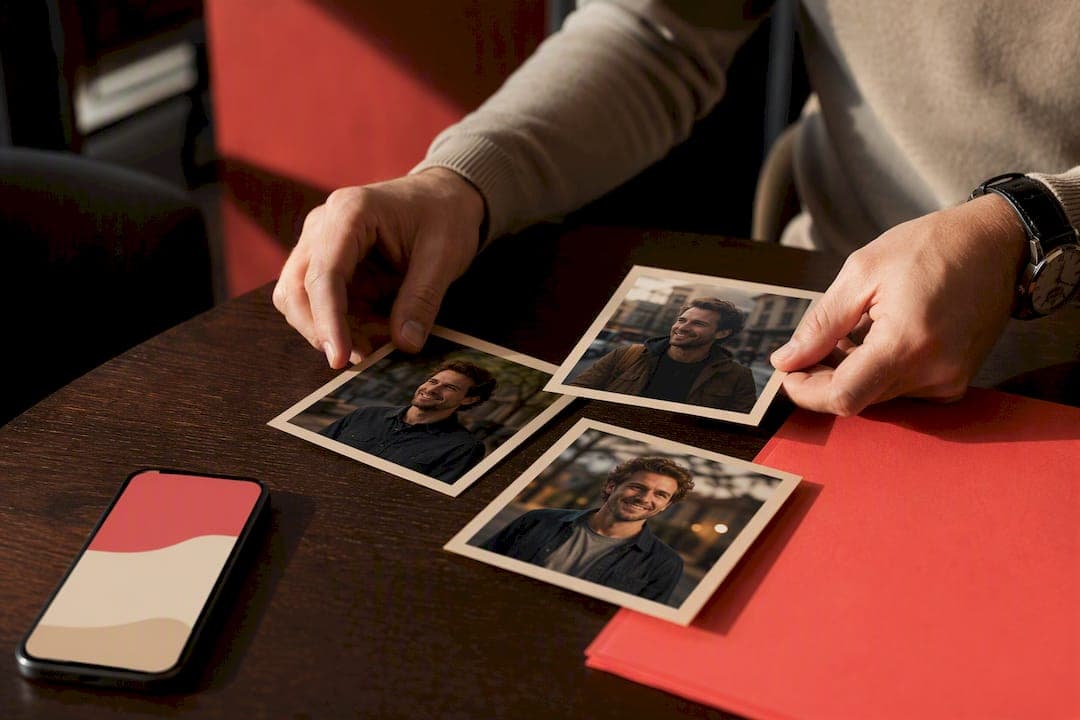
For most singles who want fast, private and objective help boosting match rates, AI photo analysis is the practical choice over a traditional photographer. It leans on visual-primacy research, DoubleMyMatches processes your photos once and discards them, and you get a reordered gallery with per-photo feedback in minutes, not weeks.
TL;DR:
- AI photo analysis is most effective for ranking existing photos when you want private, quick, objective feedback on which images currently attract the most swipes.
- The technology scores photos based on lighting, expression, composition, eye contact, and background, providing a ranked gallery and specific improvement tips.
- Heavy filtering and over-editing tend to decrease trustworthiness despite increasing attractiveness scores, so authenticity remains key.
- An analysis report costs significantly less and is delivered faster than a professional photoshoot, which often takes weeks and hundreds of pounds.
- AI evaluation cannot generate new images or fix poor source photos; it works best when genuine, unedited shots are already available.
Table of Contents
- Photographer vs AI for dating photos: how the analysis works
- What the research says about photos and first impressions
- When AI analysis is the right choice for your profile
- How to turn AI feedback into more matches
- Privacy, data safety and what to ask before you pay
- Real outcomes: photographer galleries versus AI-optimised ones
- Cost and time: photographer versus AI analysis compared
- Where AI photo analysis falls short
- Choosing between a photographer and AI tools for your situation
- A note from the team
- How DoubleMyMatches helps: try it privately, today
- Sources
Photographer vs AI for dating photos: how the analysis works
AI dating-photo analysis looks at the same things your matches notice in the first two seconds, just without the bias. The model scores each photo you upload against a set of measurable attributes, then hands you a ranked gallery and specific feedback on why each shot lands where it does.
Here's what gets evaluated on every photo:
- Lighting: whether it's flattering, natural, and free of harsh shadows or overexposure
- Expression: genuine smile versus stiff or guarded posture
- Composition: framing, crop, and how much of you is actually visible
- Eye contact and gaze: whether you're engaging the camera or looking away
- Background: clutter, distraction, or context that adds (or subtracts) appeal
The output is a numeric score per photo, a best-to-worst ranking, and short notes explaining the reasoning behind each placement, right down to which shot should sit in position one versus position four. Because you upload, the system processes privately, and it discards the images afterwards, nothing sits in a training set or ends up published anywhere.
Ranking matters more than most people assume. On Tinder, Hinge, or Bumble, your first photo is doing almost all the work before anyone reads a word of your bio, which makes AI photo analysis for dating apps less about vanity and more about sequencing. Get the order right and the rest of your gallery has to do far less persuading. For a deeper look at how the scoring mechanics work, it helps to understand that the tool isn't judging beauty in the abstract. It's judging what tends to earn a swipe.
Pro Tip: Upload your entire gallery in one pass rather than testing photos one at a time. The ranking only means something when the AI can compare your shots against each other, not just against a generic average.
What the research says about photos and first impressions
Photos do almost all the heavy lifting in online dating, and the evidence for that is stronger than most people expect. Eye-tracking research on multimodal dating profiles found that pictures attract initial attention far more reliably than profile text, and that more attractive images hold that attention longer. Your bio matters eventually. Your first photo decides whether anyone gets that far.
This is why the "beautify everything" instinct backfires. A study on media richness and beautification found that moderate enhancement can lift positive impressions and dating intent, but visibly heavy editing tends to undercut trust the moment it looks staged. A separate experiment on beauty filters reached a similar conclusion from another angle: filtered male profiles saw a rise in attractiveness ratings but a drop in trustworthiness, even though the attractiveness gain often outweighed the trust cost in overall dating intention.
The pattern across both studies is consistent: authenticity-focused adjustments beat obvious retouching almost every time.
That's the design principle worth remembering:
- Small, real improvements (lighting, framing, expression) build trust and attraction together
- Heavy filtering can spike attractiveness scores while quietly damaging credibility
- Profile photo variety matters too, since research on mobile dating apps found most users gravitate toward the same handful of staged self-presentation styles, which makes a distinctive, honest photo stand out more than a polished but generic one
Good AI feedback should nudge you towards authenticity, not away from it.
When AI analysis is the right choice for your profile
AI analysis fits best when you want an objective read on photos you already have, not a brand-new photoshoot. If you've got a gallery of real, unedited shots and you're unsure which ones to lead with, this is exactly the situation it was built for.
It's especially useful when:
- You've got a tight, limited gallery and need to know which four or five photos actually deserve a spot
- You want to test different lead photos quickly without waiting weeks for new content
- You're not sure if a photo helps or hurts because friends and family are too polite to tell you the truth
- You want private, judgement-free feedback rather than asking people who know you to rank your looks
It's not the right tool if you need staged editorial images or heavy retouching, since that's a styling and photography job, not an analysis one. Run through this quick checklist before you decide:
- Do I already have real candidate photos to rank?
- Do I want results back in minutes, not weeks?
- Do I care more about privacy than about a studio experience?
- Am I optimising what I have rather than creating something new?
Three or four "yes" answers means AI analysis is the sensible next step.
How to turn AI feedback into more matches
A report is only useful if you actually act on it. Here's the routine that gets results:
- Run the analysis on your full gallery, not just your current top pick. Self-selection is famously unreliable. Research on personal photo choice shows people are poor judges of which of their own photos actually flatters them most, which is precisely why an external, objective read outperforms gut instinct.
- Place your top two scored photos first. Visual primacy means your opening shot absorbs most of the attention before anyone scrolls further.
- Make the small fixes the report flags. These are usually simple: crop tighter to your face, swap artificial light for daylight, remove sunglasses that hide your eyes, or choose the take where your smile looks unguarded rather than posed.
- Run the new order for 7 to 14 days and track matches before changing anything else. That window is long enough to see a real signal but short enough that outside noise (day of week, app algorithm shifts) doesn't muddy the result.
If matches improve, keep the order and repeat the process next time you add photos. If they don't, it usually means the fix was cosmetic rather than structural, so re-run the analysis on a wider set of candidate shots rather than tweaking the same four repeatedly.
Pro Tip: Don't change more than one variable at a time. If you swap your lead photo and rewrite your bio in the same week, you won't know which change actually moved the needle.
For step-by-step detail on sequencing a gallery for maximum effect, optimising profile photos for more matches is worth a read once you've got your first report back.
Privacy, data safety and what to ask before you pay
One-time processing is the standard worth insisting on. A photo gets analysed, scored, and then discarded, never stored for training, never published, never reused. That's how DoubleMyMatches handles every upload.
Before paying anyone for photo feedback, ask directly:
- How long are my photos stored, and what's the deletion timeline?
- Are my images ever used to train the underlying model?
- Is payment and receipt data handled separately from the photos themselves?
- Can I get written confirmation of the deletion policy, not just a verbal assurance?
If a service can't answer these plainly, treat that as a reason to walk away.
Real outcomes: photographer galleries versus AI-optimised ones
A professional photoshoot and an AI report tend to produce genuinely different kinds of results, because they're solving different problems.
A photographer typically delivers a small set of polished, well-lit images, often in one or two outfits, shot in one location, over an hour or two. The images look consistently good. What a studio session can't tell you is which of those polished shots will actually outperform the others on Tinder, Hinge, or Bumble, because that's a matching-behaviour question, not a photography one. Two equally well-lit photos from the same session can perform very differently once real swipers see them.
AI analysis works the other way round. It doesn't create new images. It takes whatever photos you already have, including casual ones from a night out, a holiday, or a friend's phone, and tells you which ones are quietly working against you. Singles who've run their existing galleries through this kind of scoring often discover their instinctive favourite photo scores near the bottom, while a candid shot they'd never have chosen sits at the top for eye contact and genuine expression. That's the value of external, objective ranking over gut feeling: it catches blind spots a studio session was never designed to test.
The two aren't mutually exclusive. A good photoshoot gives you better raw material; AI analysis tells you what to do with it.
Cost and time: photographer versus AI analysis compared
The gap between these two options is largest on cost and turnaround, not necessarily on final photo quality.
A dating-focused photography session in the UK commonly runs from around £150 for a casual outdoor shoot to several hundred pounds for a styled studio session with multiple outfit changes and retouching. Add booking time, travel, and the wait for edited images back, and the full process from enquiry to usable photos often stretches to one or two weeks, sometimes longer if the photographer has a waiting list.
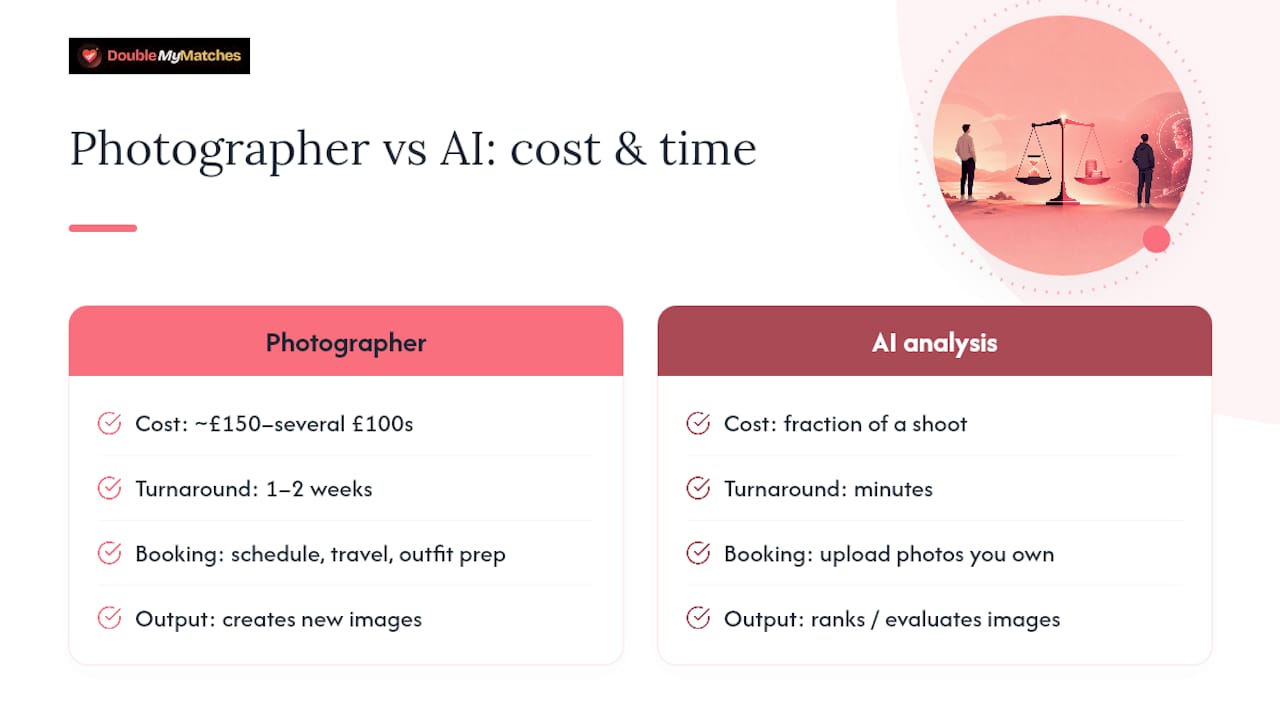
AI photo analysis flips both variables. A report typically costs a fraction of a single photoshoot booking and returns results in minutes rather than days. There's no studio to book, no outfit to plan, and no waiting on an edit turnaround. You upload photos you already own and get an answer immediately.
The trade-off is what each actually produces. A photographer creates new images from scratch. AI analysis evaluates and ranks images you already have. If your existing gallery is genuinely thin, a photoshoot adds raw material a ranking tool can't invent. If you've already got a reasonable stock of casual, real photos and simply don't know which ones to lead with, paying for new photography solves a problem you don't actually have.
Where AI photo analysis falls short
No scoring model is perfect, and it's worth knowing the boundaries before you lean on one entirely.
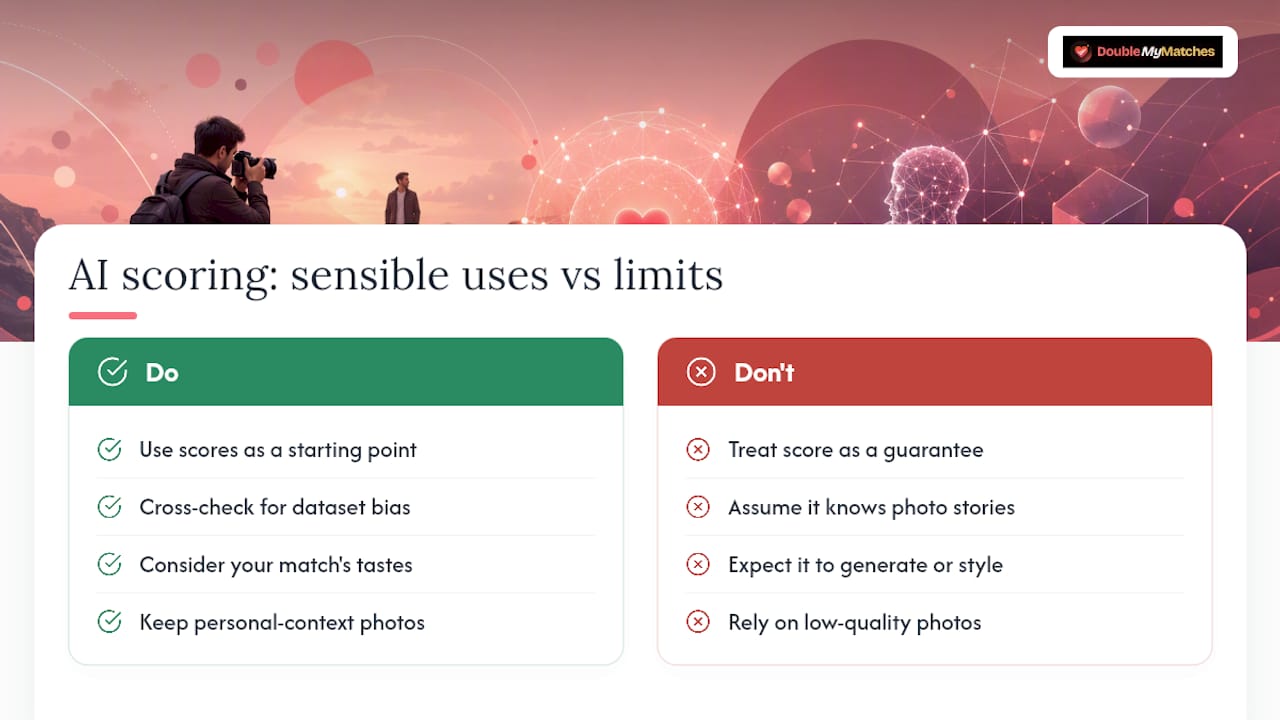
AI models are trained on patterns from large datasets of what tends to perform well, which means they can carry the same biases present in that data, including preferences shaped by conventional beauty standards that don't reflect every match preference equally. A score is a strong statistical signal, not a guarantee, and it can't account for the specific tastes of the exact person who's about to see your profile.
The tool also can't judge context it wasn't shown. It scores what's in the frame, not the story behind it, so a photo that means something to you personally (a shot with a pet you've since lost, or a trip that mattered) might score lower than a generic gym mirror selfie, even though it would land better with the right match. Numeric scores are a strong starting point, not the final word.
There's also a scope limit worth being upfront about: analysis tools rank and give feedback on photos you already have. They don't generate new images, style outfits, or fix genuinely poor source material, like a blurry, low-resolution photo with no usable lighting. If every photo in your gallery has that problem, no ranking system can rescue it. That's a photography gap, not an analysis one.
Choosing between a photographer and AI tools for your situation
The right choice depends on what you actually have and what you're trying to fix, not on which option sounds more premium.
If your problem is raw material, meaning you genuinely don't have enough decent, recent photos of yourself, a photographer solves that directly. A session gives you new options in varied settings and outfits, which is useful if your camera roll is mostly group shots or years-old photos.
If your problem is selection, meaning you've got plenty of real photos but no idea which ones actually work, AI analysis is the faster and cheaper fix. It solves the exact question a photoshoot can't answer: which of these already-decent photos will a stranger swipe right on?
Budget and timeline matter too. If you need results this week and don't want to spend hundreds of pounds, AI analysis is the realistic option. If you've got time, budget, and a genuine shortage of usable photos, book the photographer first, then run the results through analysis afterwards to find the strongest order. Doing both, in that sequence, tends to beat either one alone.
A note from the team
We built DoubleMyMatches because we kept hearing the same thing from friends: "I don't know which photo to use, and I don't want to ask anyone." That's a privacy problem as much as a dating one. Every report we generate gets discarded after analysis, and the outcome we care about most isn't a flattering photo. It's a gallery that actually gets you noticed by the right people.
— The Team @ DoubleMyMatches
How DoubleMyMatches helps: try it privately, today
DoubleMyMatches is the practical alternative to booking a photoshoot when what you actually need is a smarter answer, not more photos. You upload what you've already got, and within minutes you know exactly which shots deserve the front of your gallery and which are quietly costing you matches.
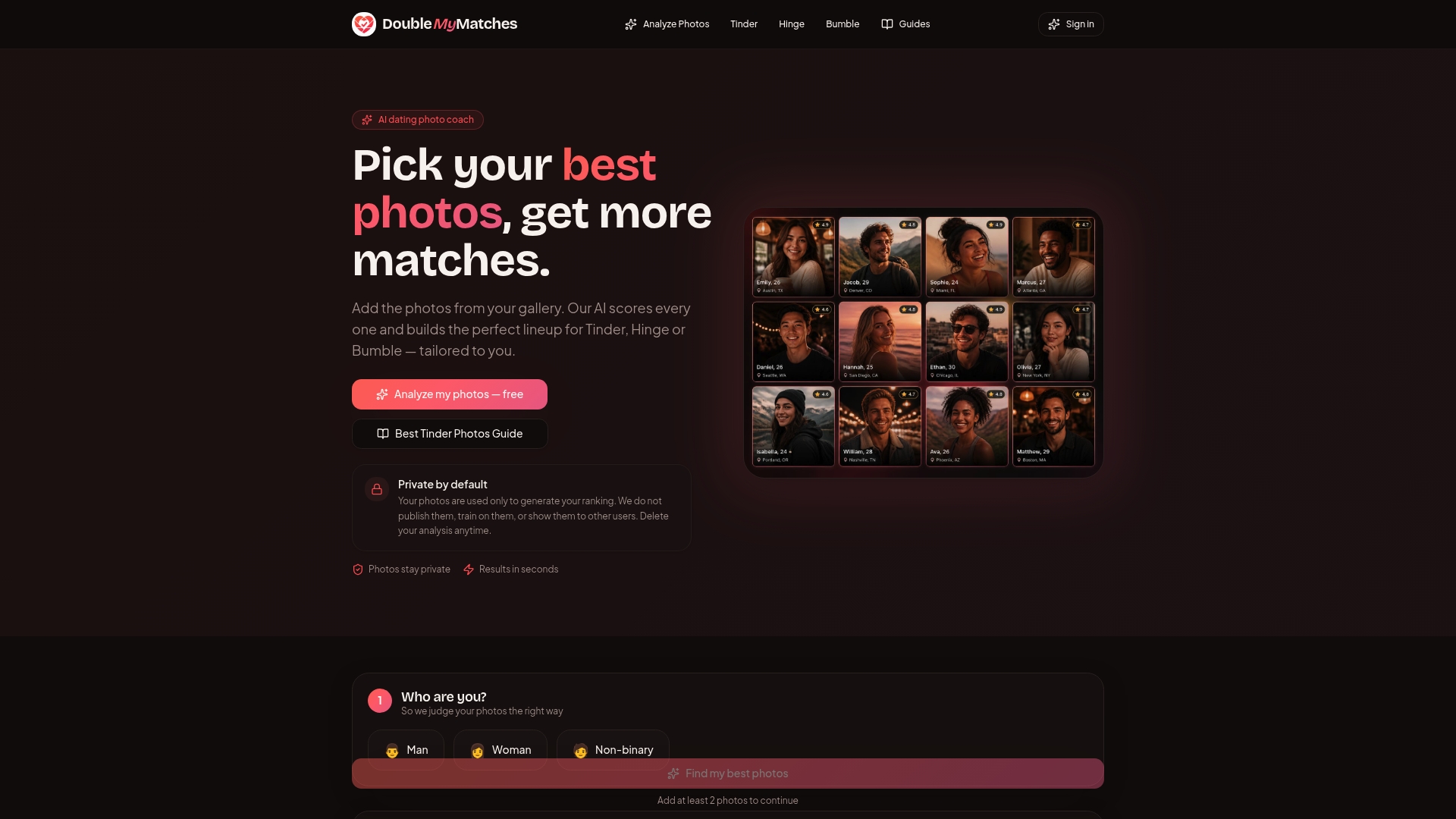
Here's what you get with a single report:
- A ranked, best-to-worst order for your entire gallery, so you know exactly which photo leads
- Per-photo feedback explaining the score, from lighting to expression to composition
- One-time, private processing, with your photos discarded after analysis, never stored or used for training
Start with the dating photo analyzer to get your full gallery scored, or try the profile picture tester first if you just want to check a couple of shots before committing. Either way, you'll have a clearer answer in minutes than a week of asking friends could ever give you.
Sources
- The impacts of media richness, blurriness, and beautification of online dating profile visual elements on dating outcomes
- What people look at in multimodal online dating profiles: how pictorial and textual cues affect impression formation
- Swipe right? Using beauty filters in male Tinder profiles reduces women's evaluations of trustworthiness but increases physical attractiveness and dating intention