

AI photo analysis is the process by which artificial intelligence algorithms automatically assess the content and quality of photos to extract meaningful insights. Understanding what AI photo analysis does gives you a real advantage on dating apps like Tinder, Hinge, and Bumble, where your first photo decides whether someone swipes right or moves on. The technology evaluates everything from lighting and sharpness to facial expression and background, producing objective scores that remove the guesswork from photo selection. Doublemymatches applies this technology specifically to dating profiles, ranking your photos so your strongest images always lead.
What does AI photo analysis measure in dating profile images?
AI photo analysis measures technical image quality through a set of objective metrics. These include blur detection using Laplacian variance, exposure levels, sharpness, noise, and resolution. AI quantifies blur and exposure through structured data on bit depth, resolution, and perceptual hashes. That means the system can tell you precisely why a photo looks flat or unclear, not just that it does.
Technical quality matters because dating app algorithms and human viewers both respond to clarity. A blurry or poorly lit photo signals low effort, even if the subject looks great. The main technical factors AI analyses in your dating photos include:
-
Blur level — detected via Laplacian variance; high blur scores reduce photo appeal significantly
-
Exposure — underexposed or overexposed images lose detail in faces and backgrounds
-
Sharpness — fine detail in eyes and facial features drives perceived attractiveness
-
Noise — grain from low-light shooting degrades perceived image quality
-
Resolution — low-resolution images compress poorly and appear pixelated on mobile screens
-
Colour balance — unnatural colour casts make skin tones look off and reduce trustworthiness
AI tools generate metadata on all these factors simultaneously, including format, colour, and object detection. That breadth of analysis is what makes AI feedback faster and more consistent than asking friends for opinions.
Pro Tip: The most common technical mistake is shooting in low light with a phone camera. Switch to natural daylight near a window, and your sharpness and noise scores will improve immediately without any editing.
How does AI recognise what is actually in your photos?
AI recognises photo content through object detection and scene understanding. The system identifies faces, body poses, backgrounds, props, and spatial relationships between elements. Vision language models detect spatial relationships and emotional context quickly, processing multiple inputs at once. This means the AI does not just see a face. It understands whether you are smiling, where you are standing, and what the background communicates about your lifestyle.

For dating profiles, this content recognition matters enormously. A photo of you hiking outdoors signals activity and confidence. A photo taken in a cluttered bedroom signals the opposite. AI reads these contextual cues the same way a potential match does, but without bias or fatigue.
AI also detects signs of heavy editing. Over-edited photos get flagged because artificial smoothing and inconsistent lighting create spectral anomalies the system recognises. This is critical for dating profiles because over-filtered images reduce perceived authenticity. Matches who feel misled by profile photos are far less likely to convert into real dates.
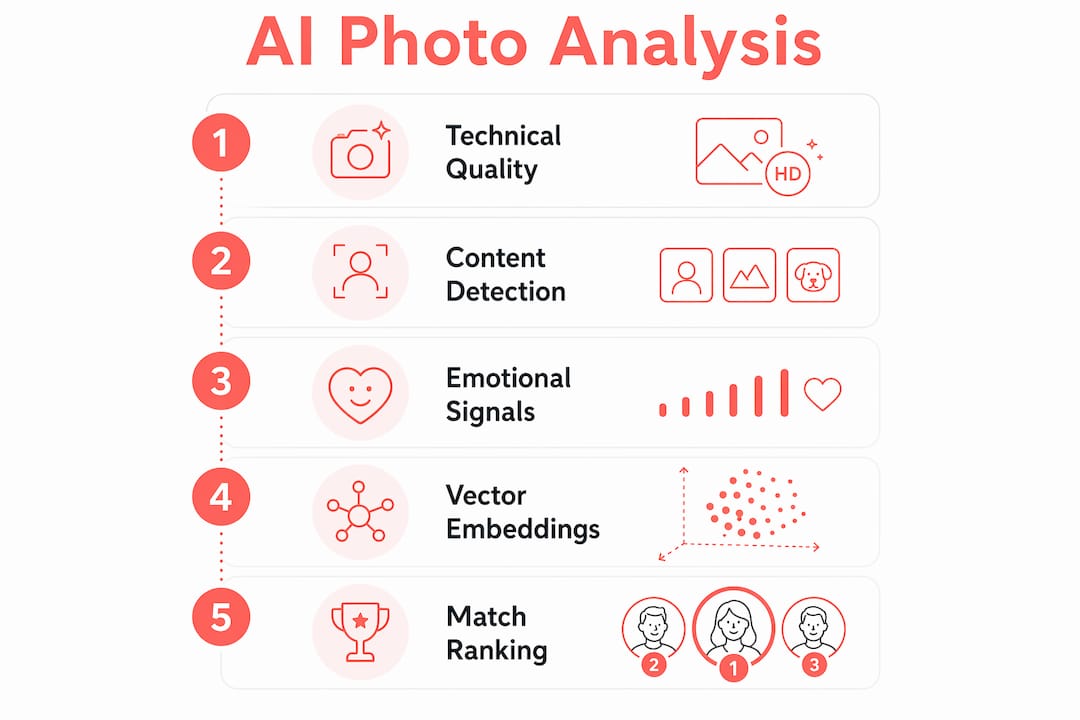
The emotional signals AI extracts are equally telling. A genuine smile, direct eye contact, and open body posture all register differently from a forced expression or a photo where you are looking away. AI flags artificial smoothing and inconsistent lighting as signals of manipulation, which can hurt your ranking even if the photo looks polished to the naked eye.
Pro Tip: Use photos where your expression is natural and unposed. Candid shots taken during activities consistently score higher on authenticity signals than studio-style selfies with heavy filters applied.
What role do vector embeddings play in match ranking?
Vector embeddings are numerical fingerprints that AI creates from your photos. Every image gets converted into a long sequence of numbers that represents its visual characteristics. AI uses vector embeddings to compare and rank images within matching systems. The comparison happens against a learned database of features found in high-performing dating photos.
A common misconception is that AI ranks photos by judging attractiveness directly. It does not. The system matches your photo’s vector against patterns associated with successful outcomes, such as high engagement or right-swipe rates. A technically poor photo produces a distorted vector, which skews results even if the person in the photo is objectively attractive.
| Photo characteristic | Vector embedding quality | Likely match outcome |
|---|---|---|
| Sharp, well-lit, natural expression | Strong, distinct vector | Higher ranking, more right-swipes |
| Blurry, low resolution | Weak, noisy vector | Lower ranking, reduced visibility |
| Heavy filter, artificial smoothing | Distorted vector | Flagged for low authenticity |
| Clear background, good composition | Clean vector with strong context signals | Consistent high performance |
Poor quality photos skew results even when the subject is attractive, because the embedding reflects the image data, not the person’s appearance alone. This is why photo quality is not vanity. It is the actual input the algorithm uses to decide how often your profile appears.
How do AI photo analysis tools improve your dating photos practically?
Modern AI photo analysis tools give you specific, repeatable feedback rather than vague impressions. You upload your photos, and the system scores each one across technical and content dimensions. Google Photos AI recognises thousands of categories at upload time, including faces, objects, and scene types. Dating-specific AI tools apply similar recognition to rank your photos against what works on platforms like Tinder, Hinge, and Bumble.
The practical process works like this:
-
Upload your full photo set. Include every photo you are considering, not just your favourites. AI often identifies a strong performer you would have overlooked.
-
Review the technical scores. Check blur, exposure, and sharpness ratings first. Fix or replace any photo scoring poorly on these basics before worrying about content.
-
Read the content feedback. Look at what the AI identifies in each photo: background, expression, body language, and any flags for over-editing.
-
Use the ranking to set your order. Your highest-scoring photo should always be your lead image. First impressions on dating apps happen in under a second.
-
Test and iterate. Swap in new photos after making changes and re-run the analysis. Small adjustments to lighting or cropping can shift a photo’s score meaningfully.
The most effective photo sets share these qualities, based on what AI analysis consistently rewards:
-
One strong close-up showing your face clearly with natural light
-
One full-body or activity shot that shows context and lifestyle
-
At least one photo with a genuine, unforced smile
-
No heavy filters or skin-smoothing effects
-
Backgrounds that are clean or contextually interesting, not distracting
AI photo analysis tools that specialise in dating profiles go further than general image tools by weighting factors that matter specifically for match rates, not just general image quality. That specialisation is what makes the feedback genuinely useful rather than generic.
Key takeaways
AI photo analysis gives you objective, repeatable feedback on the exact factors that determine whether your dating profile photos attract matches or get ignored.
| Point | Details |
|---|---|
| Technical quality is measurable | AI scores blur, exposure, sharpness, and noise objectively, removing guesswork from photo selection. |
| Content recognition reads context | AI identifies backgrounds, expressions, and body language the same way a potential match does. |
| Vector embeddings drive ranking | Poor image quality distorts the numerical fingerprint AI uses, reducing your profile’s visibility. |
| Authenticity signals matter | Over-edited photos get flagged by AI and reduce perceived trustworthiness with real matches. |
| Iteration improves results | Re-testing photos after small changes reveals which adjustments actually shift your scores. |
Why I think most people use AI photo tools the wrong way
People tend to upload their three favourite photos, get a score, feel reassured or deflated, and stop there. That is the wrong approach entirely. AI photo analysis is most valuable as a testing tool, not a verdict.
Vision models process tokens to find statistical patterns rather than emotional or personality cues. That distinction matters. The AI will not tell you that a photo captures your sense of humour or that your eyes look particularly warm in one shot. It tells you what the data says about technical quality and content signals. Your job is to combine that data with your own knowledge of who you are and what you want to communicate.
The pitfall I see most often is over-reliance on a single score. A photo can score well technically but still feel flat or generic. Conversely, a photo with slightly lower sharpness might carry a genuine moment that no algorithm fully captures. Even advanced vision models struggle with nuanced interpretation in complex images. Use the AI score to eliminate your worst photos and identify your strongest ones, then apply your own judgement to the middle tier.
The best approach is to treat AI analysis as one round of editing in an ongoing process. Upload a fresh set every few weeks. Notice which types of photos consistently score well for you. Build on those patterns rather than chasing a perfect score on a single image.
— William
How Doublemymatches puts AI photo analysis to work for you
Doublemymatches applies AI photo analysis directly to the challenge of getting more matches on Tinder, Hinge, and Bumble. The platform scores your photos across technical quality and content factors, then ranks them from strongest to weakest so you know exactly which image to lead with.

You get instant feedback on lighting, expression, composition, and authenticity signals, with no waiting and no vague opinions. Your photos are analysed and then discarded. They are never stored or used to train the AI, so your privacy stays intact. Whether you want to score your profile pictures or get a free Tinder photo review, Doublemymatches gives you the specific, honest feedback you need to put your best photos forward.
FAQ
What does AI photo analysis actually do?
AI photo analysis automatically evaluates images for technical quality, content, and emotional signals, producing objective scores. It identifies factors like blur, exposure, facial expression, and background to rank photos by likely performance.
How does AI analyse photos without understanding attractiveness?
AI compares your photo’s vector embedding against patterns from high-performing images rather than judging attractiveness directly. Poor technical quality distorts this comparison and reduces your ranking regardless of how you look.
Can AI detect if my dating photos are over-edited?
Yes. AI detects artificial smoothing and inconsistent lighting as spectral anomalies that signal photo manipulation. Over-edited photos get flagged and can hurt your profile’s perceived authenticity.
How many photos should I upload for AI analysis?
Upload every photo you are considering, not just your current favourites. AI often identifies strong performers you would have dismissed, and ranking a full set gives you a more accurate picture of your best options.
Does Doublemymatches store my photos after analysis?
Doublemymatches analyses your photos and then discards them immediately. They are never published or used to train the AI, so your images remain private throughout the process.