

AI photo analysis for dating apps scores your profile pictures in seconds, rating them on lighting, expression, and composition so you know exactly which ones to use and which to drop. According to a 2024 survey, 68% of dating app users find AI photo selection helpful, while 52% have difficulties manually choosing profile images. That gap between what people want and what they can confidently do themselves is exactly where AI image assessment earns its place.
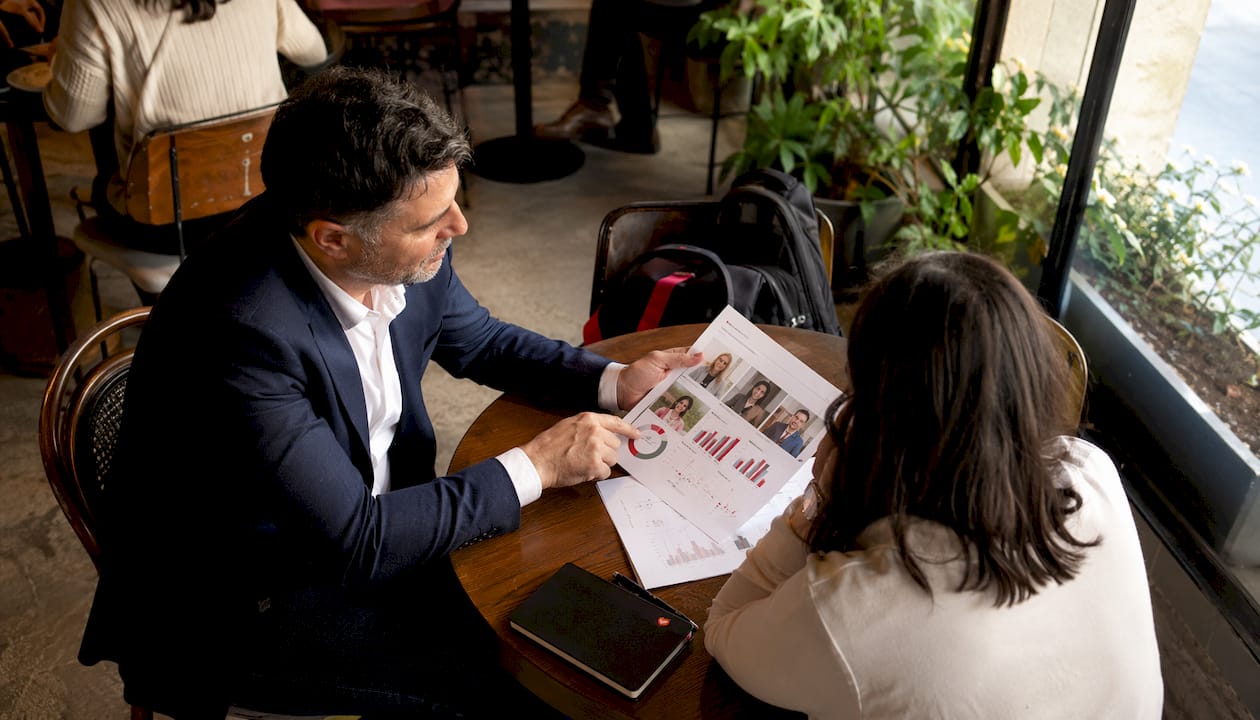
DoubleMyMatches is built for this. It analyses your uploaded photos, ranks them, and delivers instant feedback on what is working and what is holding you back. Your photos are assessed and then discarded. They are never published or used to train the AI, so your privacy stays intact.
Table of Contents
- How does AI photo analysis for dating apps work?
- What do your AI photo rating scores actually mean?
- What makes a great dating profile photo?
- How should you tailor photos to Tinder, Hinge, and Bumble?
- Photo selection strategies for men and women
- How to use AI tools to improve your dating app photos
- What happens to match rates after applying AI recommendations?
- How does combining AI scores with your own feedback improve results?
- DoubleMyMatches: instant AI feedback on your dating photos
- Key takeaways
How does AI photo analysis for dating apps work?
Upload your photos and the AI returns a score within seconds. It does not just look at whether you are attractive. It reads the signals your photos send: how clear your face is, whether your expression reads as warm or closed off, whether the background competes with you for attention. These are the same cues a potential match processes in the first fraction of a second.
AI photo analysis tools evaluate a range of attributes that directly affect engagement:
- Lighting: natural, even light scores higher than harsh shadows or dim indoor shots
- Facial expression: genuine smiles with eye engagement outperform forced or neutral looks
- Composition: framing, rule of thirds, and a clear focal point all affect how the photo reads
- Background: cluttered or distracting backgrounds reduce your score
- Social proof: group shots can help, but only when it is obvious which person you are
- Uniqueness: photos that stand out from the standard gym mirror selfie perform better
The scoring system translates these factors into a number you can act on. A high score means the photo signals well. A low score tells you something specific is off, and the feedback tells you what.
What do your AI photo rating scores actually mean?
A score on its own is only useful if you know what it is measuring. AI photo rating does not assess physical attractiveness in the way a person might. It quantifies signalling effectiveness: how well a photo communicates approachability, authenticity, and social presence to someone who has never met you.
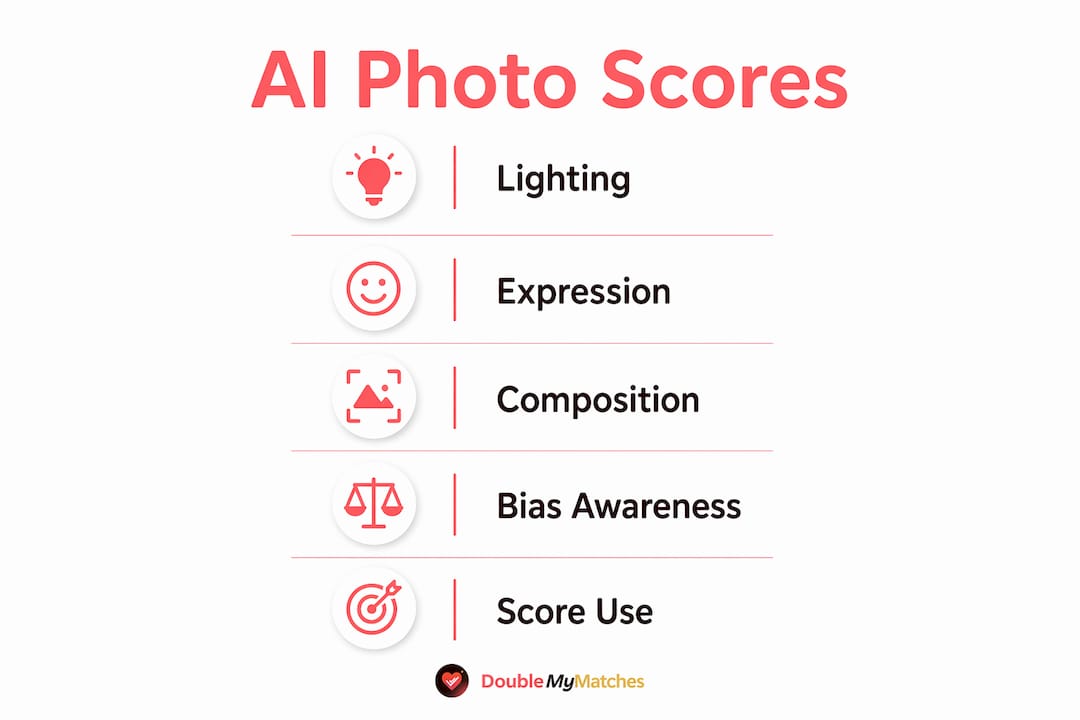
Lighting scores reflect how clearly your face reads. A photo taken near a window in natural light will almost always outscore one taken under fluorescent office lighting, because shadows obscure features that build trust quickly.
Expression scores go deeper than "are you smiling." The AI detects whether your smile reaches your eyes, whether your gaze is directed at the camera, and whether your overall expression reads as open. Genuine expressions consistently outperform posed ones in engagement data.
Composition scores cover framing and focus. Is your face centred and prominent? Is the background adding context or creating noise? A photo where you are small in the frame, or where something behind you draws the eye, will score lower even if everything else is right.
A few things worth knowing about score reliability. AI models carry recognised algorithmic biases, and no scoring system is perfectly objective. Treat your scores as strong guidance, not absolute verdicts.
Pro Tip: If a photo feels authentically you but scores lower than expected, do not automatically discard it. Cross-reference the AI feedback with what the photo is actually communicating about your personality and lifestyle.
Even a set of high-scoring photos needs variety. One strong headshot does not cover all the signals a good profile needs to send. A balanced photo set covering distinct signals consistently outperforms a single "perfect" image.
What makes a great dating profile photo?
Research points to five distinct signals that high-performing profiles cover collectively. These are not five photo types. They are five questions your photo set needs to answer for anyone looking at your profile.
| Signal | What it answers | What it looks like |
|---|---|---|
| Clarity | Can I actually see who this person is? | Face forward, clear light, single subject, no sunglasses |
| Full body | What does this person actually look like? | At least one head-to-toe candid shot |
| Lifestyle context | What does their life look like? Do I fit in it? | You somewhere specific: outdoors, travelling, at an event |
| Social proof | Are they someone others want to be around? | A candid group shot where you are clearly part of the scene |
| Conversation hook | Is there something here I can ask about? | An unusual location, a specific activity, a telling detail |
Research on dating profile photos confirms that high-performing profiles do not have better individual photos. They have more complete signal sets.
Your lead photo carries the most weight. First impressions form in under 100 milliseconds, which means your opening image sets the tone before anything else is consciously processed. It needs to be unambiguous: one person, face clearly visible, nothing competing for attention.

Natural expression consistently beats a posed smile. The data on smiling is genuinely split across studies, but one finding holds across all of them: a relaxed, natural expression outperforms a visibly performative one.
Weak photos actively drag your profile down. Viewers do not average their impressions across your set. They anchor to the worst photo. Removing a confusing or low-quality image often does more for your match rate than adding a new good one.
- Lead with your clearest, most unambiguous photo
- Include at least one activity or context shot
- Show variety across settings, not multiple versions of the same pose
- Remove weak photos before adding new ones
- Aim for five photos to cover all five signals without redundancy
How should you tailor photos to Tinder, Hinge, and Bumble?
Each app has a different culture, and the photo that performs well on one platform may not land the same way on another. Different platforms favour different photo qualities, and understanding those differences helps you sequence your set effectively.
Tinder uses vision-language models to evaluate social "vibe", moving beyond basic technical analysis to judge social context and intent. Its AI reaches 76% accuracy in predicting which photos generate engagement, but that still means one in four photos is misjudged. Tinder rewards photos that read as socially confident and contextually rich.
Hinge leans towards authenticity and conversation starters. Photos that show you doing something specific, in a real place, with a detail someone can ask about, tend to perform better than polished headshots. The app is built around prompts and dialogue, so your photos should open doors rather than close them.
Bumble places emphasis on approachability and warmth. Photos where you look relaxed and open, rather than posed or guarded, align with the platform's tone. Empowerment cues matter here, so photos that show confidence without aggression tend to resonate.
- Tinder: prioritise social context and vibe; avoid solo shots that feel static
- Hinge: lead with a conversation hook photo; show a specific activity or location
- Bumble: warm, approachable expression; candid over posed
- All platforms: five photos is the consistent target across Tinder, Hinge, and Bumble
- Use a Tinder photo analyser to simulate platform-specific performance before committing to a set
Photo selection strategies for men and women
The signals that land well differ by gender, and AI analysis can surface those differences clearly. Behavioural research consistently shows that men and women benefit from different photo emphases, though authenticity remains the baseline for both.
For men:
- Prioritise variety: lifestyle shots, social proof, and at least one activity photo
- Avoid leading with a selfie; a photo taken by someone else reads as more socially grounded
- Include a full-body shot; profiles without one often prompt scepticism
- Show context: where you go, what you do, who you spend time with
- A genuine, relaxed smile outperforms a serious or overly intense expression
For women:
- Clarity and naturalness are the strongest signals; heavily filtered photos reduce perceived authenticity
- An approachable, warm expression in the lead photo consistently outperforms a neutral or posed one
- Include a lifestyle context shot that reflects your actual interests, not a generic setting
- Avoid group photos in the lead slot; it creates immediate confusion about who you are
- A full-body candid, rather than a posed full-length shot, reads as more genuine
AI analysis can highlight gender-specific weaknesses you might not notice yourself. A man's profile that is heavy on selfies and light on context will score lower on social proof. A woman's profile where every photo is from the same angle or setting will score lower on variety. The profile picture tester surfaces these patterns quickly.
How to use AI tools to improve your dating app photos
The process is straightforward, and the feedback is immediate. Here is how to get the most from it.
- Upload your current photos. Include everything you are considering, not just your favourites. AI analysis is most useful when it has your full set to compare.
- Read the scores and identify the weakest photo. Do not start by looking for your best one. Find the photo that is dragging the set down and remove it first.
- Act on the specific feedback. If the lighting score is low, retake that photo near a window or outdoors. If the expression score is low, try a more relaxed setting where a genuine smile comes naturally.
- Rebalance your set against the five signals. After removing weak photos, check whether you still cover clarity, lifestyle context, social proof, full body, and a conversation hook.
- Re-upload and rescore. Iterative testing is how you close the gap between your current set and a high-performing one.
Pro Tip: Combine AI scoring with a reverse image dating search to check how your photos appear across platforms and confirm your images are presenting you consistently.
On privacy: reputable AI photo analysis services analyse your images and discard them. They do not store, publish, or use your photos for model training. DoubleMyMatches operates on this basis. If a service is unclear about its data practices, that is a reason to look elsewhere. On-device AI processing is one approach that keeps photos entirely on your device, though not all services use this method.
AI scores are guidance, not gospel. The limitations of algorithmic bias are real, and no model is perfectly calibrated for every person. Use the scores to identify clear problems, then apply your own judgement on what feels authentic to you.
What happens to match rates after applying AI recommendations?
The pattern is consistent across people who apply AI feedback properly: removing weak photos and rebalancing the signal set produces a measurable lift in matches. The improvement is not magic. It is the result of fixing specific, identifiable problems that were quietly suppressing engagement.
The most common scenario is a profile where one or two photos are actively creating friction. A group shot where it is not clear who you are. A low-light photo that makes you look less approachable than you actually are. A selfie that repeats a signal already covered by two other photos. None of these feel like obvious problems when you are looking at your own profile, but they register immediately to someone swiping.
After applying AI recommendations, the profiles that see the biggest improvement are usually not the ones that were terrible to begin with. They are the ones that were almost there, held back by one or two photos that were quietly anchoring the set downward. Fixing those specific issues, rather than replacing everything, is often what tips the balance.
How does combining AI scores with your own feedback improve results?
AI scores tell you what the algorithm sees. Your own knowledge tells you what the photo is actually communicating about you. The most effective approach combines both.
Start with the AI score to identify technical problems: lighting, composition, expression clarity. These are areas where the AI is genuinely more objective than you are, because you cannot see your own photos the way a stranger does. Then layer in your own judgement on context and authenticity. A photo that scores well technically but does not reflect how you actually live is not serving you well, even if the number looks good.
The benefits of profile photo analysis compound when you treat it as an iterative process rather than a one-time fix. Upload, score, adjust, rescore. Each round closes the gap between what your photos are communicating and what you want them to say. Most people see the clearest gains after two or three rounds of this, once the obvious weak photos are gone and the remaining set is genuinely balanced across signals.
DoubleMyMatches: instant AI feedback on your dating photos
If you have read this far, you already know what a strong photo set needs to do. DoubleMyMatches gives you the fastest way to find out whether yours is doing it.
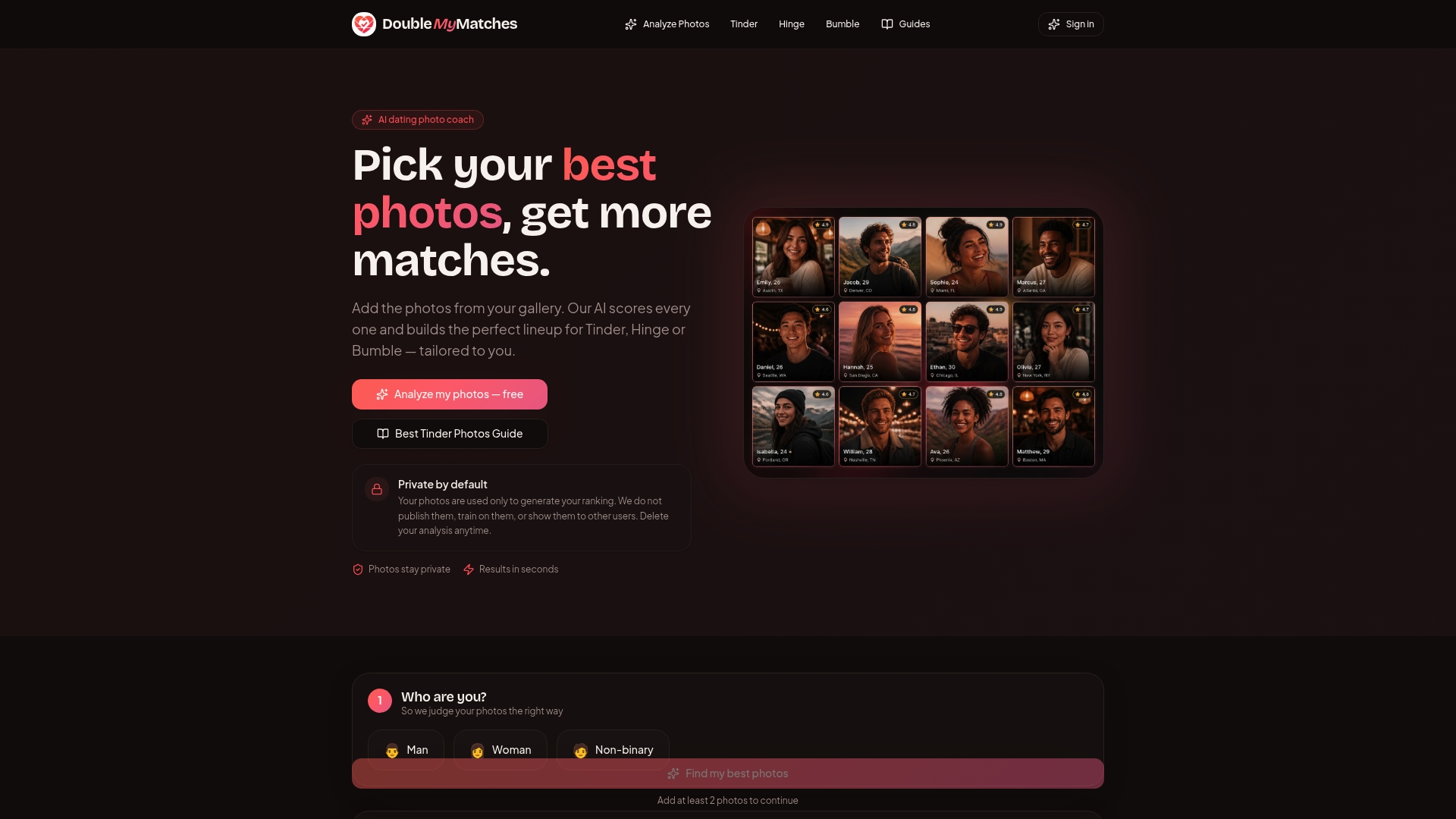
Upload your photos and get an instant score on lighting, expression, composition, and the signals your set is covering or missing. The feedback is specific enough to act on immediately, not just a number with no context. Your photos are analysed and discarded. They are never stored, published, or used for training.
The dating photo analyser works across Tinder, Hinge, and Bumble, so the feedback is relevant to wherever you are actually swiping. If you want to go further, the full AI dating photo review gives you a detailed breakdown of every photo in your set with ranked recommendations on what to keep, what to fix, and what to replace. Upload your photos now and find out exactly what is working.
Key takeaways
AI photo analysis for dating apps works best when you use scores to fix specific weaknesses, balance your signal set across five photo types, and apply your own judgement on authenticity.
| Point | Details |
|---|---|
| AI scores signal quality, not attractiveness | The AI rates approachability, clarity, and social proof, not physical appearance alone. |
| Five signals beat one perfect photo | Cover clarity, full body, lifestyle context, social proof, and a conversation hook across your set. |
| Weak photos anchor your profile down | Removing your worst photo often improves match rates more than adding a new good one. |
| App culture shapes what works | Tinder rewards social vibe; Hinge values conversation starters; Bumble favours warmth and approachability. |
| DoubleMyMatches scores your photos instantly | Upload your set, get specific feedback on each image, and your photos are discarded after analysis. |