
An AI photo check can give you a genuinely useful read on your dating-profile appeal. It measures the visual signals that drive right-swipes on Tinder, Hinge, and Bumble: lighting, facial expression, composition, image clarity, and app-specific framing. What it cannot measure is your personality, chemistry, or the dynamic energy you bring to a real conversation. Think of it as an honest mirror for your photos, not a verdict on you as a person.
Here's what a good AI attractiveness assessment covers:
- Lighting — whether your face is well-lit, shadow-free, and shot in natural or soft artificial light
- Expression — warmth, approachability, and a genuine smile versus a flat or forced look
- Composition and framing — correct cropping, eye-level angle, and clean background
- Image quality — resolution, sharpness, and absence of blur or heavy filters
- App-specific appeal — portrait framing for Tinder, lifestyle context for Hinge, and full-body shots for Bumble
Immediate next steps: upload your current photos to DoubleMyMatches, get a per-photo score and best-to-worst ordering, then swap your weakest photo first. That single change often moves match rates noticeably.
Table of Contents
- What does an AI "how attractive am I" test actually measure?
- How accurate are AI attractiveness scores, and what do they miss?
- How to prepare your photos for a reliable AI analysis
- What to do after you get your AI score
- DoubleMyMatches: private AI photo analysis, instant results
- Key takeaways
- The team's perspective on AI attractiveness scores
- Useful sources for deeper reading
- Ready to see exactly where your photos stand?
What does an AI "how attractive am I" test actually measure?
AI photo analysis reads your images the same way a first-time viewer does: fast, visual, and based on a handful of clear signals. The core dimensions are lighting, expression, pose, composition, image resolution, clothing and grooming cues, and social-proof elements such as group shots or activity props.
Each dimension connects directly to dating-app behaviour. Strong, even lighting makes your face readable at thumbnail size, which is how most people first see you on Tinder. A genuine, relaxed smile correlates with approachability and increases the likelihood of a super-like or opening message. Composition matters because a poorly cropped or cluttered photo loses attention before the viewer consciously registers why.
On Hinge, lifestyle context photos (you at a gig, cooking, hiking) carry extra weight because the app prompts conversation starters. On Bumble, a clear full-body shot in the first three photos tends to perform better than a tight headshot sequence. AI tools trained on app-specific data can flag when your lineup is missing these cues.
Pro Tip: Switch your main photo to one taken in natural daylight with a slight, relaxed smile. That single change addresses the two most common scoring weaknesses and is the fastest way to move your results.
How accurate are AI attractiveness scores, and what do they miss?
AI scores are reliable for photo-first impressions and unreliable for everything else. Social-science research confirms that attractive photos correlate with more messages, more dates, and more positive social outcomes. That part the AI gets right. What it cannot capture is the dynamic, in-person experience of attraction: voice, body language, wit, and the chemistry that builds during a real interaction.
There are also recognised biases worth knowing about. AI models trained on limited or skewed datasets can misrepresent diverse groups. Proportion-based measures such as the Phi Mask perform differently across ethnicities, and cultural preferences for facial features vary considerably. If you are a UK user from a South Asian, Black British, or East Asian background, your score may reflect the biases of the training data as much as your actual photo quality.
A note on scale reliability: Academic research comparing nine different attractiveness rating scales found little evidence of advantage for one scale over another, meaning the number itself matters less than the relative ranking of your photos. Use AI scores to compare your own photos against each other, not to benchmark yourself against the population.
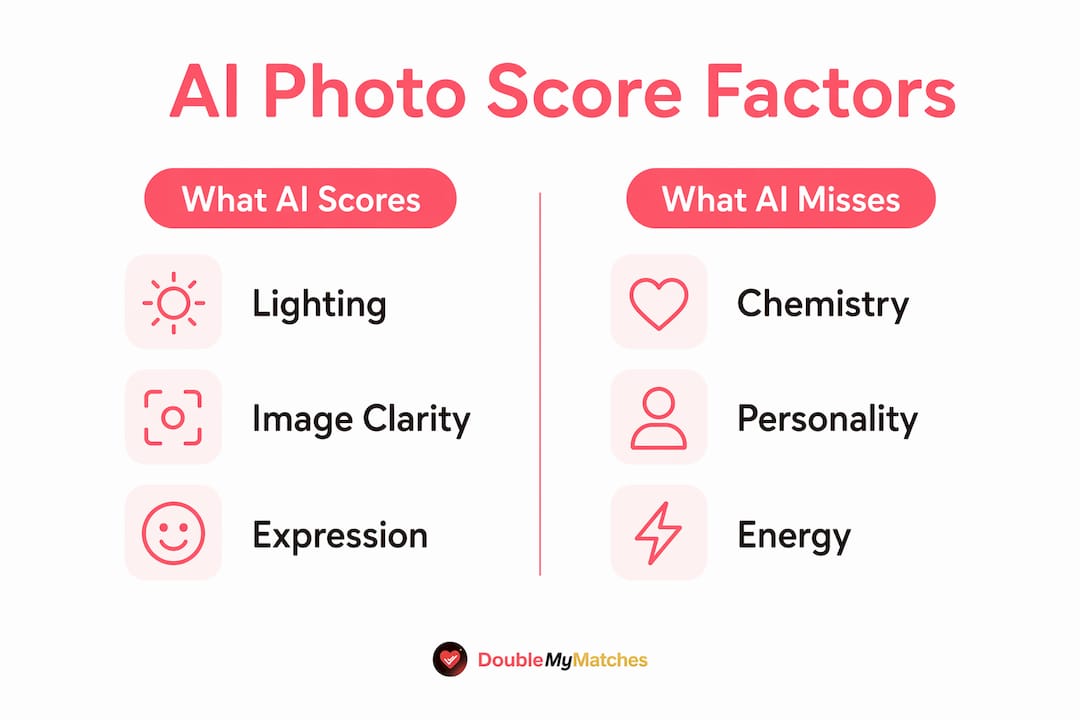
| What AI scores well | What AI misses |
|---|---|
| Lighting and image clarity | Chemistry and in-person energy |
| Facial expression and warmth | Personality and humour |
| Composition and cropping | Voice, tone, and body language |
| Grooming and clothing cues | Cultural nuance in attraction |
| Photo variety and app-specific framing | Dynamic interpersonal signals |
Treat your score as one signal among several. Dating coach John Keegan and clinical therapist Rebecca Tenzer both emphasise confidence and authenticity as key drivers of perceived attractiveness, and those qualities show up in photos in ways that go beyond symmetry or lighting alone.
How to prepare your photos for a reliable AI analysis
The quality of your feedback depends directly on the quality of what you upload. Rushed or outdated photos produce misleading scores.
- Gather five photo types: a close headshot, a mid-body shot (waist up), a full-body shot, a social or group photo, and one activity or hobby shot.
- Shoot in natural light: stand facing a window or step outside on an overcast day. Avoid harsh overhead lighting or dark indoor shots.
- Use a clean background: a plain wall, greenery, or an uncluttered outdoor setting. Busy backgrounds pull attention from your face.
- Frame at eye level: hold the camera at eye height or slightly above. Shots from below are unflattering; shots from too far above look like selfies.
- Wear what you'd actually wear on a date: neat, fitted clothing that suits you. Avoid sunglasses in your lead photo.
- Choose recent images: photos more than 12 months old often no longer reflect how you look. Current images produce scores you can act on.
- Upload at least four photos: a single photo gives limited data. Four or more let the AI rank your lineup and identify your weakest slot.
Pro Tip: Before uploading, evaluate your photos against these criteria yourself. Removing obviously weak shots before the analysis makes the ranking more useful.
What to do after you get your AI score
Your score is most valuable as a ranked list, not a single number. Start by placing your highest-scoring photo first. Profile photos drive swipe rates more than any other profile element, so the lead slot is where the biggest gains are.
From there, A/B test one change at a time. Swap your second photo for a week, note whether your match rate rises or falls, then move to the next slot. A one-week window on Tinder or Hinge is usually enough to see a directional shift. Changing multiple photos simultaneously makes it impossible to know what worked.
On the psychological side, use the feedback to guide action, not self-criticism. Entertainment-style quizzes and reflective tools are useful behaviour-change prompts but should not be treated as definitive personal rankings. If a score feels discouraging, focus on the specific, fixable elements: lighting, expression, or a weak background. Those are solvable in an afternoon. If you want a second opinion, a human dating coach can add context the AI cannot, particularly around personality signals and profile copy.
DoubleMyMatches: private AI photo analysis, instant results
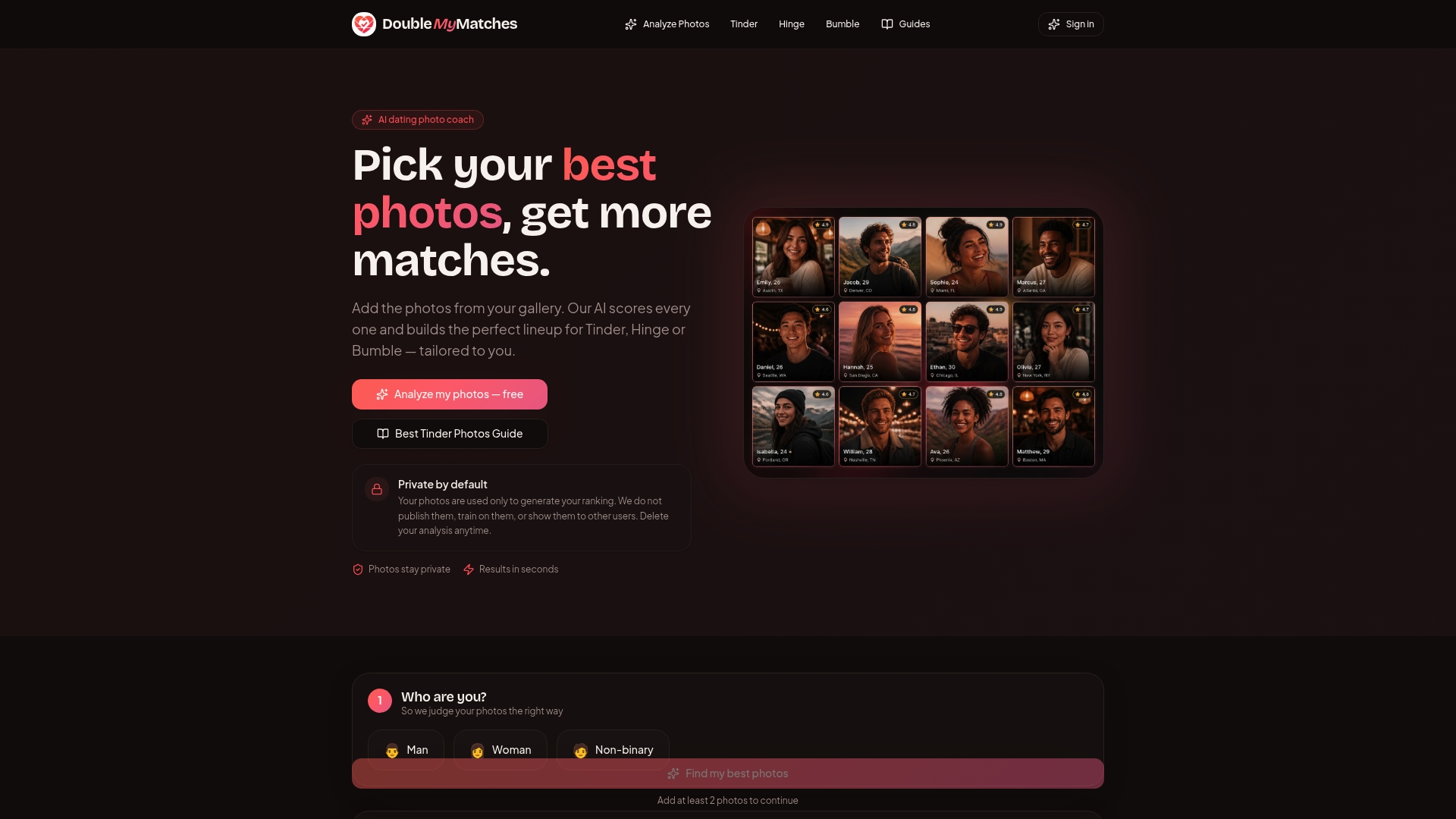
DoubleMyMatches scores each of your photos individually across lighting, expression, composition, and app-specific appeal, then ranks them from strongest to weakest. You receive per-photo feedback, a recommended lineup order, and clear guidance on which photos to retake or remove.
What you get:
- Instant per-photo scores with specific improvement notes
- Best-to-worst photo ordering for Tinder, Hinge, or Bumble
- Identification of photos that actively harm your profile
- Personalised lineup recommendations for men and women
Privacy: your photos are analysed once and then discarded. They are never published or used to train the AI. That is a firm commitment, not a footnote.
"After getting my photos ranked, I moved my second photo to the top slot and my matches doubled within a week. I had no idea that one image was holding me back." — DoubleMyMatches user
Pricing is structured as a one-off report, with options to bundle multiple reports or access an unlimited-use annual pass. There is no subscription and no ongoing commitment.
Get your AI Tinder profile review or rate your photos now to see your ranked lineup.
Key takeaways
AI photo analysis gives you reliable, photo-specific feedback on the visual signals that drive matches on Tinder, Hinge, and Bumble, but it measures your photos, not your worth as a person.
| Point | Details |
|---|---|
| AI measures photo signals | Lighting, expression, composition, and clarity are reliably scored; personality and chemistry are not. |
| Bias is real | Models trained on limited datasets can misrepresent diverse ethnicities; use scores to compare your own photos, not to benchmark against others. |
| Prep photos carefully | Upload at least four current, well-lit photos across five types for meaningful, actionable feedback. |
| Act on ranking, not the number | Lead with your highest-scoring photo and A/B test one change at a time over a week. |
| DoubleMyMatches | Offers per-photo scoring, ranked lineups, and a privacy-first one-time analysis with no photo retention. |
The team's perspective on AI attractiveness scores
There is a version of this conversation that treats AI scores as either gospel or gimmick. Neither is right. What we see, consistently, is that people with genuinely strong photos are held back by one or two weak ones they cannot identify themselves. The AI does not tell you how attractive you are in any deep sense. It tells you which photos are working and which are not. That is a narrower claim, but it is a useful one.
The point raised by dating coach John Keegan and clinical therapist Rebecca Tenzer deserves emphasis: confidence and authenticity show up in photos in ways that proportion scores do not capture. A technically well-lit photo of someone who looks uncomfortable will still underperform. The best outcomes we see come from people who use the score to fix the obvious technical problems, then bring genuine energy to a retake.
One thing worth saying plainly: an AI score is not a measure of your value. It is a measure of how a specific photo performs under specific conditions. Attractiveness is context-dependent and dynamic; it shifts during an interaction as energy, humour, and warmth come through. A photo can only carry so much of that. Use the tool for what it is good at, and trust that the rest of you shows up when it counts.
Useful sources for deeper reading
These sources back the claims in this article and are worth reading if you want more detail on measurement methodology, cultural variation, or photo technique.
| Source | What it supports |
|---|---|
| Psychometrics of facial attractiveness rating scales (PMC) | Why relative photo ranking matters more than a single score |
| Physical attractiveness (ScienceDirect) | Universal and culture-specific attractiveness patterns; photo-first impression research |
| Objective facial attractiveness measurement (ResearchGate) | Limitations of proportion-based measures across ethnicities |
| wikiHow attractiveness score guide | Expert quotes on confidence and authenticity as measurable drivers |
| DoubleMyMatches privacy and product overview | Privacy policy, one-time analysis guarantee, and product details |
Before uploading any photos to any AI tool, check the privacy policy. DoubleMyMatches discards your photos after analysis and does not use them for model training. Confirm the same for any other tool you consider.
- AI photo analysis for dating apps: practical strategies for interpreting and acting on AI feedback
- What affects the dating app algorithm: how photos interact with Tinder, Hinge, and Bumble ranking systems
- Photo changes that increase matches: specific before-and-after examples with match-rate context
Ready to see exactly where your photos stand?
Most people on dating apps are losing matches to photos they think are fine. DoubleMyMatches gives you a clear, ranked breakdown of every photo you upload: which one to lead with, which to cut, and what to fix before your next retake. No subscription, no guesswork, and your photos are deleted the moment the analysis is done.
Get your free profile photo rating and see your strongest lineup in minutes.