

Your facial expression is the single biggest lever you can pull in a dating photo. Research published in Scientific Reports confirms that more expressive people are better liked and perceived as more agreeable. Viewers form that impression in roughly 100 milliseconds, well before they read a single word of your bio. DoubleMyMatches' AI photo analysis consistently shows that expression is one of the top-ranked factors separating high-performing profiles from low-performing ones.
Do: lead with a genuine smile that reaches your eyes, and keep your face fully visible in your main photo. Don't: wear sunglasses in your lead image, or use an obviously posed, stiff "model" shot.
Table of Contents
- Why does facial expression shape first impressions on dating apps?
- Which expressions actually increase your approachability and matches?
- How does expression interact with lighting, framing, and body language?
- How should you pick, order, and test your photos?
- What are the most common expression mistakes, and how do you fix them?
- How should you adapt your expression for different dating platforms?
- What does the evidence say about expression and match rates?
- Do cultural differences affect how expressions read in dating photos?
- Key takeaways
- The thing most people get wrong about expression in dating photos
- Get an honest read on your dating photos with DoubleMyMatches
- Useful sources
Why does facial expression shape first impressions on dating apps?
Expression signals warmth and predictability, and those are the two things a stranger needs to feel before they swipe right. Scientific Reports' large-scale study found that more facially expressive participants were more well-liked and readable, with expressivity linked to agreeableness and extraversion. In a dating context, that translates directly: a readable face feels safer to approach.
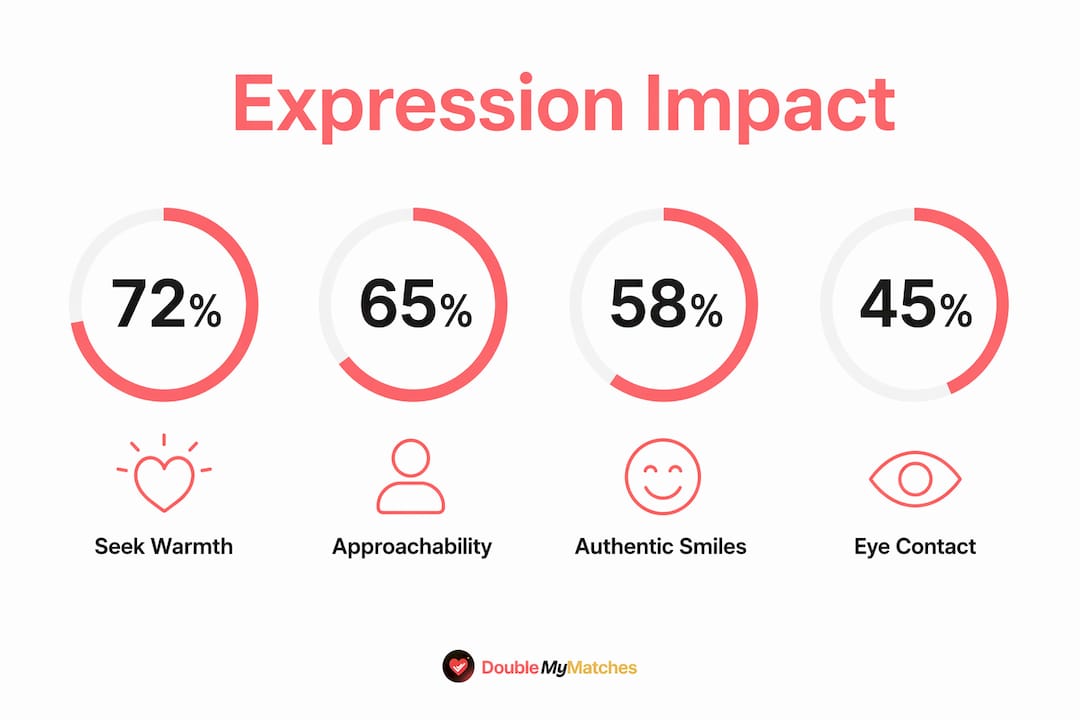
The rapid decision window matters here. At that speed, the brain is not weighing your hobbies or your job title. It is reading warmth first, competence second. A Duchenne smile (where the muscles around your eyes engage as well as your mouth) is the single most reliable warmth signal a still photo can carry.
Research by Judith Holler and colleagues at the Max Planck Institute adds another layer: facial expressions are multimodal signals that communicate intent, not just emotion. On a dating app, that means your expression tells a viewer whether you are approachable and open, before they have any other information to go on.
- Warmth beats competence in fast social judgements, especially on casual apps.
- Readability predicts liking. People prefer partners whose intentions they can read quickly.
- Expression is stable. The same study found expressivity is consistent across contexts, meaning your natural expressive style will come through in photos taken in different settings.
Which expressions actually increase your approachability and matches?
A candid laugh and a full Duchenne smile outperform posed grins and neutral stares for approachability and message volume. That is the short answer. Here is how to apply it.
Expressions to use:
- Duchenne smile: eyes crinkle, teeth visible, the whole face is involved. This reads as genuine warmth.
- Candid laugh: caught mid-reaction, not posed. Think laughing at something just off-camera rather than grinning at the lens.
- Soft closed-mouth smile: warm and approachable without being intense. Works well for a second or third photo.
- Approachable neutral: relaxed, direct eye contact, no forced grin. Better than a stiff stare, but weaker than a genuine smile for a lead image.
Expressions to avoid:
- Forced grin: lips pulled wide, eyes flat. Viewers detect the mismatch instantly.
- Stoic "model" stare: looks curated and cold. Approachability drops sharply.
- Sunglasses or obscured eyes: removes the eye-crinkle cue entirely, which is the primary warmth signal.
Pro Tip: Ask a friend to say something funny just before the shutter clicks. A reactive laugh is almost impossible to fake and produces the kind of candid, eye-reaching expression that performs best in dating photos.
A good scenario: you, mid-laugh at a café table, eyes bright, looking slightly off-camera. A weaker scenario: a studio-style headshot with a rehearsed smile and perfect lighting but zero spontaneity.

How does expression interact with lighting, framing, and body language?
Expression only performs when the rest of the frame supports it. A genuine smile in harsh overhead light, with half your face in shadow, loses most of its warmth signal. Photographer guides consistently recommend soft natural light, eye-level camera height, and authentic expression as the three controllable factors that matter most.
Soft window light or open shade preserves the subtle eye-crinkling that makes a Duchenne smile legible. Direct flash flattens it. Camera height matters too: a lens positioned at eye level reads as an equal, while a low angle can make even a warm expression look imposing.
Body language reinforces what your face is saying. An open posture (shoulders back, arms uncrossed) paired with a slight forward lean signals engagement. A closed posture undercuts even the best smile.
Composition checklist for expression clarity:
- Face clearly visible, no sunglasses or hat brim cutting across the eyes
- Lead photo cropped from chest to top of head, face occupying most of the frame
- Soft, even light (open shade, window light, overcast sky)
- Camera at eye level
- Variety across your lineup: not every photo the same expression or the same setting
How should you pick, order, and test your photos?
Choose a lead image with direct eye contact and a genuine expression, then build variety around it. That one decision moves the needle more than anything else in your lineup. For photo selection and ordering, follow this sequence:
- Lead photo: direct eye contact, Duchenne smile or candid laugh, face unobscured.
- Activity shot: you doing something you actually do regularly. Anchors you in real life.
- Social photo: with friends, clearly you, placed third (not first).
- Full-body shot: relaxed, natural setting.
- No group photo as your lead: if a viewer cannot identify you in under a second, the photo subtracts rather than adds.
- Recency: photos from the last 12–18 months only.
Research suggests a moderate number of photos is the sweet spot. Too few limits the impression you build; too many can feel like overcompensating.
Testing methods:
- Show three candidate lead photos to friends and ask which feels warmest, not which looks best.
- Run a quick thumbnail test: shrink the photo to app size on your phone and check whether your expression still reads clearly.
- Use DoubleMyMatches' AI photo analyser to get an objective score on expression, lighting, and composition without sharing your photos publicly.
Platform adaptation: on casual apps like Tinder, a candid laugh or big smile works well as a lead. On more relationship-focused platforms, a warm but slightly softer expression can feel more considered and less performative.
What are the most common expression mistakes, and how do you fix them?
Small fixes often produce the biggest improvements in match rate. Most profiles fail on the same handful of issues.
- Overly posed "model" face → swap for a candid prompt. Ask someone to make you react rather than asking you to smile.
- Sunglasses in the lead photo → replace with a clear-faced shot. The eye-crinkle is non-negotiable for warmth.
- Every photo the same expression → add variety. One candid laugh, one soft smile, one engaged neutral across your lineup.
- Face too small in the lead photo → crop closer. At app thumbnail size, a distant full-body shot loses all expression detail.
- Rehearsed poses → shoot 20–30 frames per session and pick the candid moments. The keeper rate is low, so volume is your friend.
For a fast audit, check your photo selection against these fixes before uploading anything new.
How should you adapt your expression for different dating platforms?
The platform shapes what "approachable" looks like. On Tinder and Bumble, where swiping is fast and casual, a high-energy candid laugh or a big open smile performs well as a lead. The warmth signal needs to land in under a second, so go bold.
On Hinge, where profiles include prompts and the format encourages slightly more considered browsing, a warm but composed expression (direct eye contact, genuine smile, not necessarily full-teeth) can feel more authentic to the slower pace. Serious relationship platforms reward photos that look like you, not a highlight reel.
The underlying principle stays the same across all platforms: warmth first, readability second, variety across the lineup. What changes is the intensity. Match the energy of the platform, not just the format.
What does the evidence say about expression and match rates?
Analysis of high-performing dating photos shows that full-teeth, eye-crinkle smiles and candid laughs consistently score highest for approachability. Profiles with a clear Duchenne smile in the lead position receive substantially more right-swipes than profiles led by neutral or sunglasses-on shots, particularly for men, where the default viewer expectation skews closer to neutral and a warm smile shifts the read more dramatically.
The Frontiers research on visual dating profiles found that profile richness (variety of photo types) contributed to stronger perceived positive traits and more favourable assessments. A single expressive headshot is a start. A lineup that shows warmth, social context, and real-life activity is what converts right-swipes into messages.
Photos that look like a curated performance consistently underperform compared with authentic, in-the-moment shots. The gap is not subtle.
Do cultural differences affect how expressions read in dating photos?
Yes, though the core warmth signals are more universal than most people assume. Research on facial expression and emotion confirms that the basic expressions (happiness, warmth, openness) share a common genetic origin and are recognised across cultures. A genuine smile reads as warm in London, Lagos, and Lahore.
Where culture does matter is in intensity and context. In some East Asian cultural contexts, a very wide open-mouthed laugh can read as less composed than a softer smile. In many Western European and North American contexts, the opposite is true: a restrained expression can read as cold or disinterested. If you are on a UK-based app and your audience is primarily British, a warm, natural, open smile is the right call.
The practical takeaway: lead with genuine warmth rather than trying to calibrate for every possible viewer. Authenticity travels further than cultural micro-optimisation.
Key takeaways
Your facial expression drives approachability in dating photos, and a genuine Duchenne smile in your lead image is the single most reliable way to signal warmth to a stranger in under a second.
| Point | Details |
|---|---|
| Lead with eyes and warmth | Your main photo needs direct eye contact and a genuine smile that reaches your eyes. |
| Candid beats posed | Candid laughs and reactive expressions outperform rehearsed grins for approachability. |
| Vary your lineup | Include at least one candid laugh, one soft smile, and one engaged neutral across four to six photos. |
| Test before uploading | Use a thumbnail test or DoubleMyMatches' AI analysis to check expression clarity at app size. |
| DoubleMyMatches | The AI photo analyser scores your expression, lighting, and composition so you know which photos to lead with. |
The thing most people get wrong about expression in dating photos
Most people treat their lead photo as a chance to look their best. That framing is the problem. Looking your best and reading as warm are not the same thing, and on a dating app, warmth wins every time.
The profiles that perform consistently well are not the most polished. They are the most readable. A slightly imperfect candid photo where your eyes are genuinely lit up will outperform a flawless studio portrait where your expression is flat. The research backs this up, and so does the pattern we see across DoubleMyMatches users: when people swap a curated, posed lead photo for a candid, eye-reaching smile, the response rate improves. Not because the new photo is technically better, but because it is warmer.
The other thing worth saying: most people underestimate how much their expression varies across photos. You might feel like you are smiling in all of them. The AI often tells a different story. Getting an objective read on which photos actually carry warmth, rather than which ones you think look good, is where the real gains are.
Get an honest read on your dating photos with DoubleMyMatches
Knowing which of your photos carries the most warmth is harder than it sounds. Most people pick the photo they like best, not the one that reads best to a stranger in 100 milliseconds. DoubleMyMatches closes that gap.
Upload your photos to the AI dating photo analyser and get an instant score on expression, lighting, and composition. The AI flags which images carry genuine warmth and which ones fall flat, so you stop guessing and start uploading with confidence. Your photos are analysed and then discarded immediately; they are never published or used to train the AI. Head to DoubleMyMatches and find out which photo should be leading your profile.
Useful sources
- Being facially expressive is socially advantageous — Scientific Reports, 2024 — primary academic source for the expressivity and likeability claim.
- Dating App Photos That Get Replies — LoveCertain — Duchenne smile and warmth-first evidence; photo lineup sequencing.
- Best dating profile photos: what the research says — LoveCertain — direct eye contact and photo variety research.
- I looked at 500 right-swiped dating photos — Magnt — candid laugh and Duchenne smile performance data.
- How to take good dating profile pictures — Photography Shark Studios — capture workflow, light, and volume shooting advice.
- Dating Profile Photos guide — Signal Studio NYC — 100-millisecond decision window reference.
- Facial expressions are central to how we communicate — Max Planck Institute — multimodal signalling and intent (Judith Holler).
- The interpersonal effects of emotions — PMC — facial expression and social judgement research.
- Facial expression and emotion — PMC — cross-cultural universality of basic expressions.
- Visual elements in dating profiles — Frontiers in Communication — profile richness and perceived positive traits.