

Dating app algorithms are defined by three core signals: profile completeness, swiping behaviour, and engagement speed. Understanding what affects dating app algorithm ranking is the difference between appearing in front of compatible people and disappearing into the back of the queue. These systems no longer rely on a simple attractiveness score. They use multi-dimensional models that weigh your activity, your selectivity, and how you communicate once you match.
How profile content and activity influence your dating app ranking
Your profile is the foundation of your algorithmic score. Profile completeness signals to the algorithm that you are a genuine, engaged user. Incomplete profiles with missing photos or blank prompts rank lower because the system has less data to work with.
Dating app ranking factors reward users who show up consistently. Daily or frequent app use keeps your profile in active pools, which means you appear in more feeds. Profiles that go dormant for days at a time are quietly deprioritised.
New users receive a short-term advantage. New users get a 7–14 day visibility boost when they first join, giving the algorithm time to gather interaction data and calibrate your ranking. This window is your best opportunity to make a strong first impression, so having a complete, high-quality profile from day one matters enormously.
Engagement velocity is another major factor. Responding within 24 hours is a strong positive signal that modern algorithms actively reward. Platforms like Hinge weight timely messaging over total message volume, so a quick reply counts more than a long one sent three days later.
Here is what the algorithm rewards in your profile activity:
- Complete every section. Fill in all photo slots, answer prompts, and add lifestyle details. Each completed field adds a data point the algorithm can use.
- Log in daily. Active users appear in more recommendation feeds than inactive ones.
- Reply promptly. Aim to respond to matches within 24 hours to maintain your engagement score.
- Avoid frequent profile rewrites. Repeatedly editing your profile can reset your algorithmic score, which costs you the momentum you have built.
- Use your new user window wisely. The first two weeks on any platform carry outsized weight.
Pro Tip: Upload your best photo as your first image before you do anything else. The algorithm and the people swiping on you both judge the first photo fastest.
What swiping behaviour does to your ranking
Swiping is not a neutral act. Every right-swipe and left-swipe sends a signal to the algorithm about your preferences and your reliability as a user.
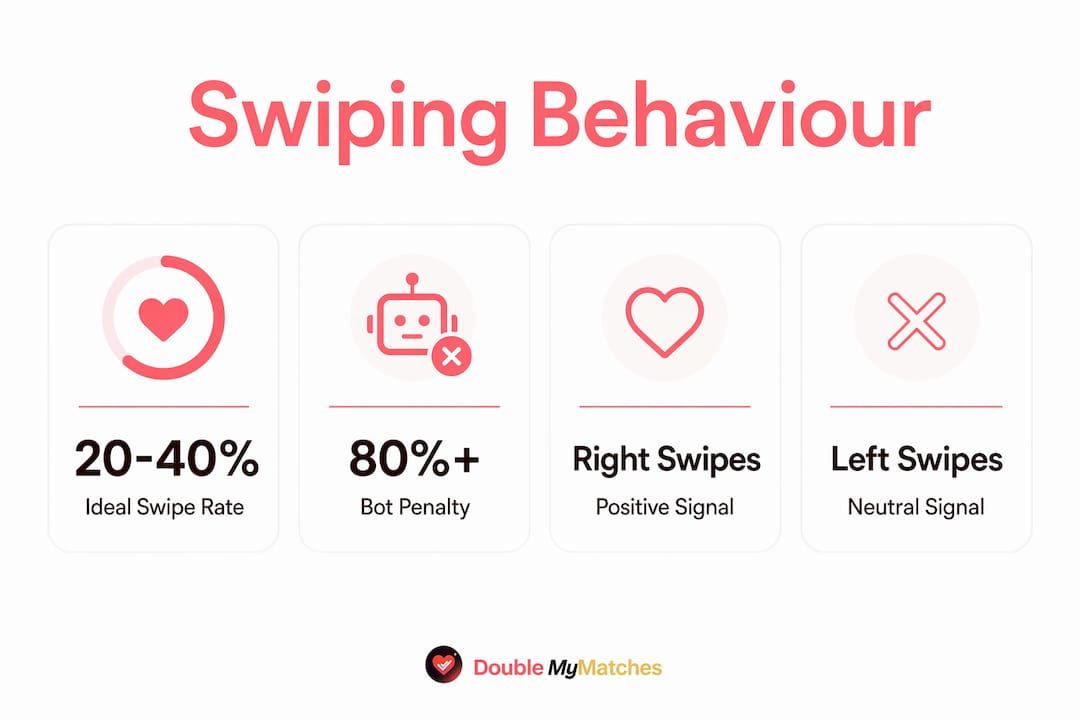
The ideal right-swipe rate sits between 20% and 40%. Mass right-swiping above roughly 80% triggers anti-bot classifiers that actively downgrade your profile's visibility. The algorithm interprets indiscriminate swiping as low-quality engagement, and your ranking drops as a result. In severe cases, this behaviour can lead to a shadowban, where your profile remains visible to you but is shown to far fewer people.
Reciprocal interest modelling is the engine behind modern matching. The formula most platforms use resembles P(A likes B) × P(B likes A) × P(engagement). Reciprocal recommender models improve top-10 match success rates from 23% to 42% by prioritising mutual liking over one-sided attraction. This means the algorithm is not just asking "will this person swipe right on you?" It is asking "will both of you swipe right and then actually talk?"
Here is how swiping behaviour shapes your ranking in practice:
- Keep your right-swipe rate selective. Aim for 20–40% to signal genuine interest rather than automated behaviour.
- Swipe on profiles you would genuinely message. The algorithm tracks whether your matches lead to conversations.
- Do not ghost your matches. Even polite declines rank better than silent non-responses, which penalise your profile behind the scenes.
- Review your filters. Strict filters act as binary gates before ranking even applies. A filter set to a 5-mile radius or a narrow age band can exclude most of your potential matches before the algorithm has a chance to show you to them.
- Watch for mutual unmatching patterns. Frequent unmatches after conversations start are a negative signal the algorithm registers.
The table below summarises the key swiping behaviours and their algorithmic effects.
| Behaviour | Algorithmic effect |
|---|---|
| Right-swipe rate of 20–40% | Positive ranking signal |
| Right-swipe rate above 80% | Penalty, possible shadowban |
| Prompt replies to matches | Higher engagement score |
| Ghosting matches | Negative visibility impact |
| Overly strict filters | Reduced match pool before ranking |
How AI reads your photos and bio to cluster your profile
Modern dating apps use machine learning at every layer of the matching process. Understanding dating app algorithms means understanding that your photos and bio text are both being actively analysed, not just displayed.

Natural Language Processing extracts interests and lifestyle signals from your bio. The algorithm reads your words and builds a profile of who you are and what you value. Two users who both mention hiking, cooking, and travel will be clustered together and shown to people who have previously swiped right on similar profiles.
Computer vision assesses your photos for face clarity, composition, lighting, and eye contact. AI models analyse photo quality via computer vision to cluster similar profiles, which means a blurry or poorly lit photo does not just look bad to the person swiping. It scores lower in the system itself. The algorithm uses photo and text embeddings to group users with similar preferences and present them to compatible audiences.
Repeated swiping on a specific profile type narrows your feed over time. Consistently right-swiping a specific profile type reduces feed diversity and can trap you in a narrow loop of similar profiles. This is sometimes called a "rut," and it limits your exposure to a broader range of potential matches.
Algorithmic desirability is not a single attractiveness score. It is a multi-dimensional vector that includes your photo quality, bio richness, engagement history, and swiping patterns. No single element dominates. Improving any one of these factors moves your ranking in a positive direction.
Pro Tip: Vary the types of profiles you engage with occasionally. Broadening your swiping behaviour signals to the algorithm that you are open to a wider range of matches, which can refresh your feed.
The table below shows how AI interprets different profile elements.
| Profile element | How AI reads it |
|---|---|
| Bio text | NLP extracts interests and lifestyle signals |
| Lead photo | Computer vision scores clarity, lighting, composition |
| Swiping history | Builds preference clusters and narrows feed |
| Messaging speed | Engagement velocity score |
| Match conversations | Signals genuine connection intent |
Common misconceptions about what dating app algorithms actually predict
The biggest misconception about dating apps is that the algorithm predicts attraction. Algorithms sort profiles for mutual likelihood of a match and message exchange, not for lasting relationship potential. The system measures swipe probability and engagement, not compatibility in any deep sense.
Feed narrowing is a real and underappreciated problem. If you consistently swipe right on a very specific type of person, the algorithm learns this and shows you fewer profiles outside that type. You end up in an echo chamber of similar profiles, which can feel like the app has run out of people to show you.
The emotional side of this is worth taking seriously. Pressures to optimise for algorithmic desirability can increase self-objectification and anxiety. Users begin to monitor match counts and visibility as proxies for self-worth, which leads to constant profile edits and emotional distress.
Dating apps are designed around attention and engagement metrics, not relationship outcomes. The algorithm rewards behaviour that keeps you on the app, which is not always the same as behaviour that leads to a meaningful connection.
The distinction between validation and connection matters. Getting matches feels good, but the algorithm has no way of knowing whether a match will lead to a date or a relationship. Treating your match count as a measure of your worth is a trap the system's design actively encourages.
Key takeaways
Dating app algorithms reward profile completeness, selective swiping, prompt engagement, and high-quality photos, while penalising mass swiping, ghosting, and overly narrow filters.
| Point | Details |
|---|---|
| Profile completeness matters | Fill every section to give the algorithm more data and signal genuine intent. |
| Swipe selectively | Keep your right-swipe rate between 20–40% to avoid anti-bot penalties. |
| Reply within 24 hours | Engagement velocity is a direct ranking signal on platforms like Hinge. |
| Photo quality is scored by AI | Computer vision assesses lighting, clarity, and composition, not just human viewers. |
| Filters cut before ranking | Overly strict filters reduce your match pool before the algorithm even applies. |
Our honest view on working with dating app algorithms
— The Team @ DoubleMyMatches
We have seen a lot of users chase algorithmic tricks: deleting and reinstalling apps to reset scores, swiping right on everyone to maximise exposure, rewriting bios every week. None of it works consistently, and most of it backfires.
The most effective approach is also the most straightforward. Build a complete, honest profile. Swipe on people you would genuinely want to meet. Reply to your matches promptly. Loosen your filters if your match rate feels low. These behaviours align with what the algorithm actually rewards, and they also make you a better person to match with.
The psychological pressure to perform for an algorithm is real, and we think it is worth naming directly. Your match count is not your value. The algorithm measures engagement signals, not your worth as a person or your potential as a partner. Keeping that distinction clear protects your wellbeing and, ironically, tends to produce better results. People who approach apps with patience and genuine intent come across better in their profiles and their conversations.
— The Team @ DoubleMyMatches
How DoubleMyMatches helps your profile work harder
Your photos are the single biggest factor the algorithm and real people both judge first. If your lead photo scores poorly on clarity, lighting, or composition, no amount of bio work will compensate for it.
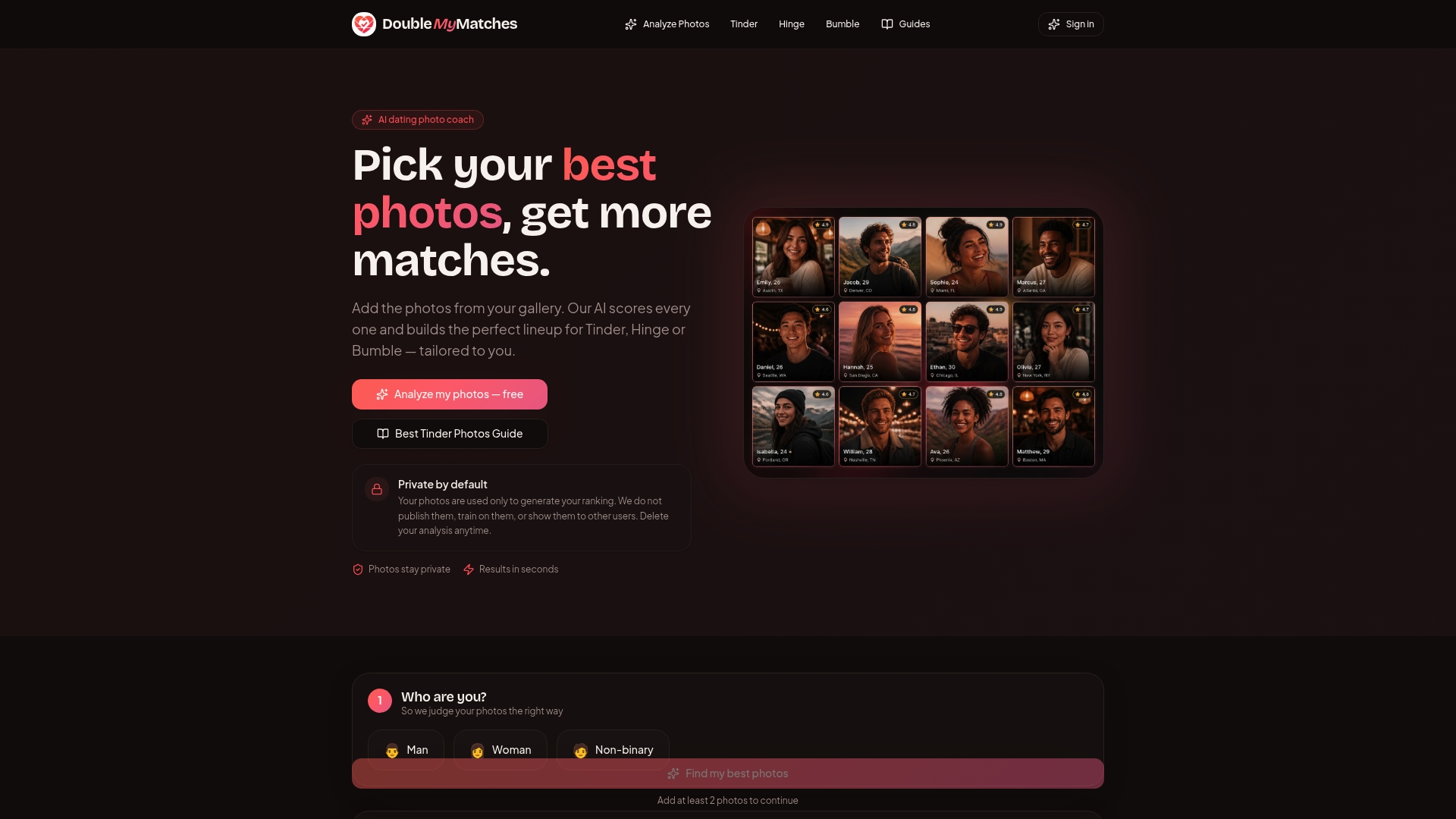
DoubleMyMatches uses AI photo analysis to score and rank your dating photos based on the exact attributes that matter: lighting, expression, composition, and face clarity. You get immediate feedback on which photos to lead with and which to drop. The AI ranks your photos from strongest to weakest so you always put your best image first. Your photos are analysed and then discarded. They are never published or used to train the AI. If you want your profile to work with the algorithm rather than against it, start with your photos.
FAQ
What is the ideal right-swipe rate on dating apps?
The ideal right-swipe rate is between 20% and 40%. Swiping right on more than 80% of profiles triggers anti-bot penalties that reduce your visibility.
Does replying quickly to matches actually help your ranking?
Yes. Responding within 24 hours is a direct positive signal in modern dating app algorithms. Platforms like Hinge actively weight engagement speed over message volume.
Can strict filters hurt your match rate?
Strict filters act as binary gates before the ranking algorithm applies. Setting very narrow location or age filters can exclude most potential matches before the algorithm has any chance to show you to them.
Do dating apps predict relationship compatibility?
No. Dating app algorithms measure the probability of a mutual swipe and a message exchange, not long-term compatibility or relationship potential.
Why does my feed start showing the same types of profiles repeatedly?
Repeatedly swiping right on a specific profile type trains the algorithm to narrow your feed. Broadening your swiping behaviour occasionally can refresh the variety of profiles you see.