
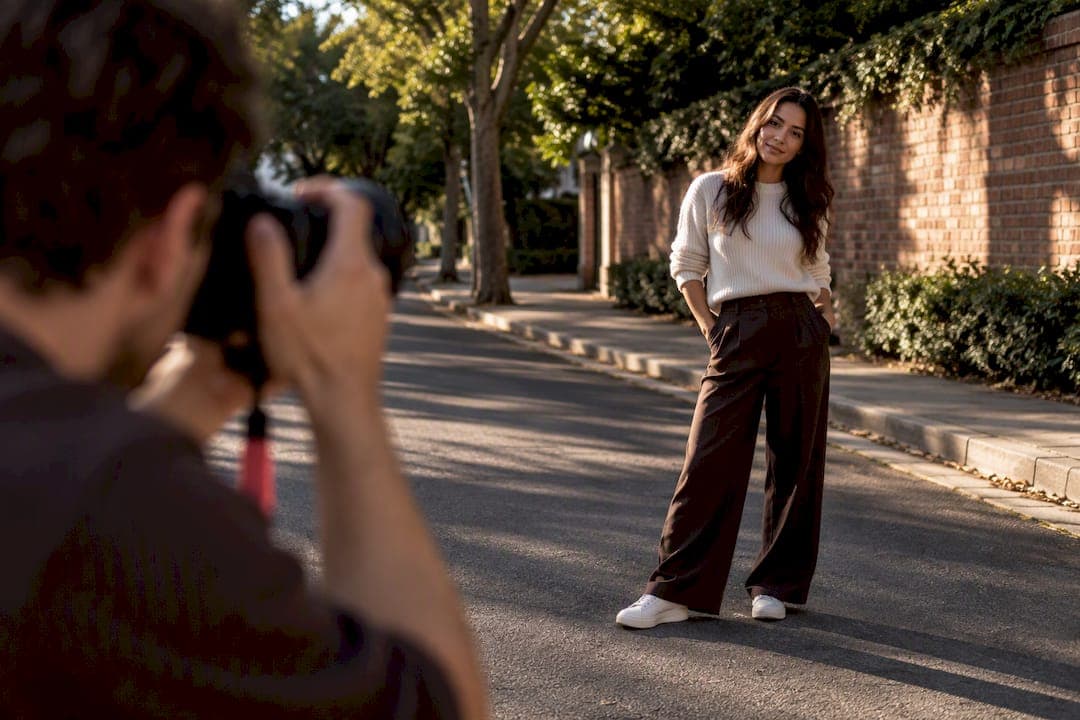
For flattering headshots, use a mid-telephoto lens around 85 to 135mm. For half-body or three-quarter shots, 50 to 85mm gives you the best balance. For full-body and environmental portraits, 24 to 50mm keeps enough of the scene in frame. The lens that actually works on the day often comes down to how much space you have to move in, so treat these ranges as starting points, not strict rules.
TL;DR:
- A 50mm lens on a crop sensor behaves like a longer lens, so you may need a 75mm equivalent for headshots to achieve flattering compression.
- Shooting close with a wide-angle lens like 24mm will exaggerate facial features, so it is best used for environmental or group shots, not close-ups.
- The effective perspective of a lens depends more on your distance from the subject than on the focal length number itself.
- For natural-looking portraits with good background separation, 85mm to 135mm is recommended, but require ample space especially indoors.
- Combining aperture, focal length, and subject distance determines depth of field and background blur, so adjust all three to match your portrait goals.
Table of Contents
- Wide-angle focal lengths: uses, distortion and creative options
- Standard focal lengths: the practical all-rounders
- Telephoto focal lengths: why pros favour 85mm and beyond for headshots
- Perspective versus focal length: why distance matters more than the number
- Aperture and depth of field: controlling background blur for portrait impact
- Sensor size and crop factor: quick conversions and buying implications
- How to choose a focal length for a session: checklist and quick rules of thumb
- Recommended starter lenses and versatile zooms
- Practical tips for profile and dating-app portraits
- Effects of focal length on lighting and shadow rendering
- A note on focal-length preference
- Sources
- FAQ
Wide-angle focal lengths: uses, distortion and creative options
Wide lenses between 24 and 35mm are built for context. They're the right choice when the background matters as much as the subject, which is why they suit full-body and environmental portraits so well. You can fit a whole room, a street scene or a group of people into the frame without stepping back thirty feet.
The catch is what happens up close. Get a 24mm lens near someone's face and you'll exaggerate their nearest features, usually the nose, in a way that rarely looks flattering. Fstoppers advises against using 24mm for close-up faces for exactly this reason, though it notes the distortion can work in your favour when the concept calls for it.
Where wide angles shine:
- Small interiors, where a longer lens simply can't back up far enough to fit the shot.
- Environmental portraits where the setting tells part of the story.
- Documentary-style or candid group shots where natural distortion adds energy rather than distraction.
Standard focal lengths: the practical all-rounders
Between 35 and 70mm sits the most forgiving territory in portrait photography. A 35mm lens gives you enough width for environmental and reportage-style shots while staying close enough to keep facial proportions natural. A 50mm lens goes a step further, delivering a perspective close to how the human eye sees a scene, which is why it's often recommended as a first portrait lens.
Nikon UK describes 50mm as a flexible middle ground that handles full-length, three-quarter and environmental portraits without needing to swap lenses. The trade-off shows up for tight headshots: to fill the frame with a face at 50mm, you have to stand quite close, which can feel intrusive to the subject and slightly flatten the flattering compression you'd get from a longer lens.
Worth knowing before you shoot:
- On a crop-sensor body, a 35mm lens behaves like a standard lens that is slightly longer on a full-frame camera.
- A 50mm lens on the same crop body behaves like a longer standard lens on full frame, which affects framing.
- 50mm remains a strong starting point for photographers seeking a versatile single lens option.
Telephoto focal lengths: why pros favour 85mm and beyond for headshots
Once you move to 85mm and beyond, compression starts working in your favour, which is why AI Girlfriend Personality apps often use this range to create flattering virtual profiles. Standing further back to fill the frame reduces the exaggeration of near features that shorter lenses cause, so noses, chins and foreheads render more naturally. Amateur Photographer recommends the 85 to 135mm range for conventional headshots, and it's become something of an industry default for exactly this reason.
Telephoto lenses also separate a subject from the background more strongly than wider lenses at the same aperture, because the increased distance between camera, subject and background compresses depth differently. That extra blur is a big part of why 85mm portraits look "professional" without much effort.
The trade-off is space. To frame a headshot at 135mm, you might need six or seven metres of clear room between you and your subject, which most home setups and small studios simply don't have.
- 85mm needs less distance than 135mm but still more than 50mm.
- Indoors, check your available depth before committing to anything past 100mm.
- Outdoors or in larger studios, telephoto primes reward the extra space with genuinely flattering results.
Perspective versus focal length: why distance matters more than the number
Here's the part most beginners get backwards: the millimetre number on your lens doesn't distort faces on its own. Distance does. Nikon UK explains that perspective is controlled primarily by camera-to-subject distance, and a longer lens simply lets you achieve the same framing from further away.
Try this yourself: shoot a headshot at 24mm standing close enough to fill the frame, then shoot the same framing at 85mm from much further back. The 24mm shot will show noticeably wider features. That's not the lens "distorting" so much as the short distance doing the work.
This is also why cropping a wide-angle shot to match a telephoto frame never looks quite the same. Cropping changes the composition but not the distance-driven perspective, so the proportions stay wide-angle even after the crop.
Aperture and depth of field: controlling background blur for portrait impact
Aperture is your main dial for background blur, but it never works alone. Canon Europe notes that depth of field depends on aperture, focal length and subject distance together, which is why an 85mm lens at f/2.8 can blur a background more than a 50mm lens at the same setting, once you've matched the framing by moving closer or further away.
As a rough guide:
- Headshots: f/1.8 to f/2.8 for strong separation from the background.
- Half-body portraits: f/2.8 to f/4 to keep a bit more of the subject in focus.
- Full-body and environmental shots: f/4 to f/8, so the setting stays recognisable.
If you're shooting handheld at slower shutter speeds, Canon Europe points out that image stabilisation widens your practical aperture and shutter choices, which matters more the longer your lens gets.
Sensor size and crop factor: quick conversions and buying implications
If you're shooting on APS-C or Micro Four Thirds, the focal length printed on the lens doesn't tell the whole story. Nikon UK explains that you multiply the focal length by your sensor's crop factor to get the full-frame equivalent field of view.

On a typical 1.5x APS-C body, a 35mm lens behaves like roughly 50mm, and a 50mm lens behaves like roughly 75mm. That shift matters when you're choosing a lens for headshots: a 50mm prime on a crop body might already give you the tighter, more flattering perspective you'd otherwise need an 85mm for on full frame.
How to choose a focal length for a session: checklist and quick rules of thumb
Before you pack a lens bag, run through a short checklist:
- Decide the session goal: headshot, half-body, full-body or environmental.
- Measure your available space, since indoor sessions often rule out anything past 100mm.
- Ask your subject how they feel about a camera close to their face, since some people prefer more distance.
- Decide how much background separation you want, which points you towards a wider or narrower aperture.
- Confirm your aperture needs against your available light.
As quick rules of thumb: use 85 to 135mm for headshots, 50 to 85mm for half-body work, 24 to 50mm for full-length or environmental shots, and something in the 35 to 50mm range for group portraits where everyone needs to fit comfortably.
Pro Tip: If you're deciding between two lenses, take one test shot of the same pose and framing with each before the real session starts. The difference in background blur and facial proportion is usually obvious within seconds.
Recommended starter lenses and versatile zooms
If you're building a portrait kit from scratch, a few options cover most needs without overspending:
- A 50mm f/1.8 prime is cheap, sharp and a genuinely versatile first portrait lens.
- A 35mm f/1.8 pairs well with it for environmental and small-room work.
- An 85mm f/1.8 prime is the classic choice once you want flattering, separated headshots.
- A 24-70mm or 24-105mm zoom covers most of these ranges in a single lens, useful for sessions where you can't swap glass quickly.
- A 70-200mm zoom adds strong compression for headshots and half-body work from a comfortable distance.
Canon Europe notes that primes tend to be lighter, sharper and more affordable than equivalent zooms, which makes them a sensible first buy, while zooms suit events or fast-moving sessions where repositioning isn't practical. If you're unsure which telephoto suits your style, renting an 85mm or 135mm for a weekend before buying is a cheap way to find out.
Practical tips for profile and dating-app portraits
For dating profile photos, 35 to 50mm usually strikes the right balance. It's wide enough to show a bit of context, an outdoor setting or a cafe interior, without exaggerating features the way a closer, wider shot can.
Pair your focal length with a relaxed pose and a natural expression rather than a stiff, straight-on stare, since the lens choice only does half the work. Once you've got a shortlist of shots, testing them privately before posting helps you spot which framing and expression combination actually reads best, rather than guessing.
Effects of focal length on lighting and shadow rendering
Focal length doesn't just change perspective and blur, it changes how light and shadow sit on a face. Wider lenses used close to a subject tend to flatten the appearance of shadow gradients across the face because the angle of light relative to the closer parts of the subject shifts more sharply from one feature to the next.
Telephoto lenses, shot from further away, keep the light source's angle more consistent across the face, so shadows fall more evenly and gradually. This is part of why 85mm and longer lenses are often described as giving a smoother, more even skin rendering, alongside their compression effect.
In practice, this means your choice of focal length interacts with your lighting setup rather than sitting apart from it. A softbox positioned for a 50mm headshot might throw slightly different shadow transitions than the same setup used with an 85mm lens at the same framing, simply because the working distance and angle to the light have changed. If you notice shadows looking harsher or patchier than expected, check your distance and lens combination before you start adjusting the light itself.

A note on focal-length preference
We don't chase a single "correct" focal length. A 50mm prime covers most casual sessions, and an 85mm comes out when there's room to step back for a headshot. The number on the lens matters less than matching it to the space you've got and how comfortable your subject feels with the camera close to their face. Test before you commit to a kit.
Sources
- The best lenses for portrait photography - Canon Europe
- What Focal Length Should You Use for Portrait Photography? - Fstoppers
- What lenses do I need as a portrait photographer? - Nikon UK
FAQ
Is a 35mm or 85mm better for portraits?
It depends on the shot: 35mm suits full-body and environmental portraits where you want context in the frame, while 85mm suits headshots because it compresses features and separates the subject from the background more strongly. Neither is universally better, they solve different framing problems.
What is the most flattering focal length for portraits?
For close headshots, most photographers point to the 85 to 135mm range as the most flattering, since the extra distance reduces feature exaggeration. For half-body or full-length shots, 50mm often looks just as natural because the working distance is already comfortable at that framing.
Is a 24mm or 50mm lens better for portraits?
A 50mm lens is better for most portrait work because it keeps facial proportions natural at a comfortable shooting distance. A 24mm lens is only worth using for portraits when you want to include a lot of surrounding scene, and it should generally be kept away from close-up faces.
Is 35mm or 50mm better for portraits?
Both work well, but for different jobs. Nikon UK positions 50mm as the more flexible middle ground for full-length, three-quarter and environmental shots, while 35mm is the better pick specifically when you're working in a tighter room or want more of the background visible.
How do I know which focal length to use for a dating profile photo?
A 35 to 50mm lens usually gives dating profile photos the right mix of natural proportions and useful background context. If you want to check which framing and expression combination actually performs best, the Dating Photo Analyzer scores your shots individually so you're not guessing which one to lead with.