
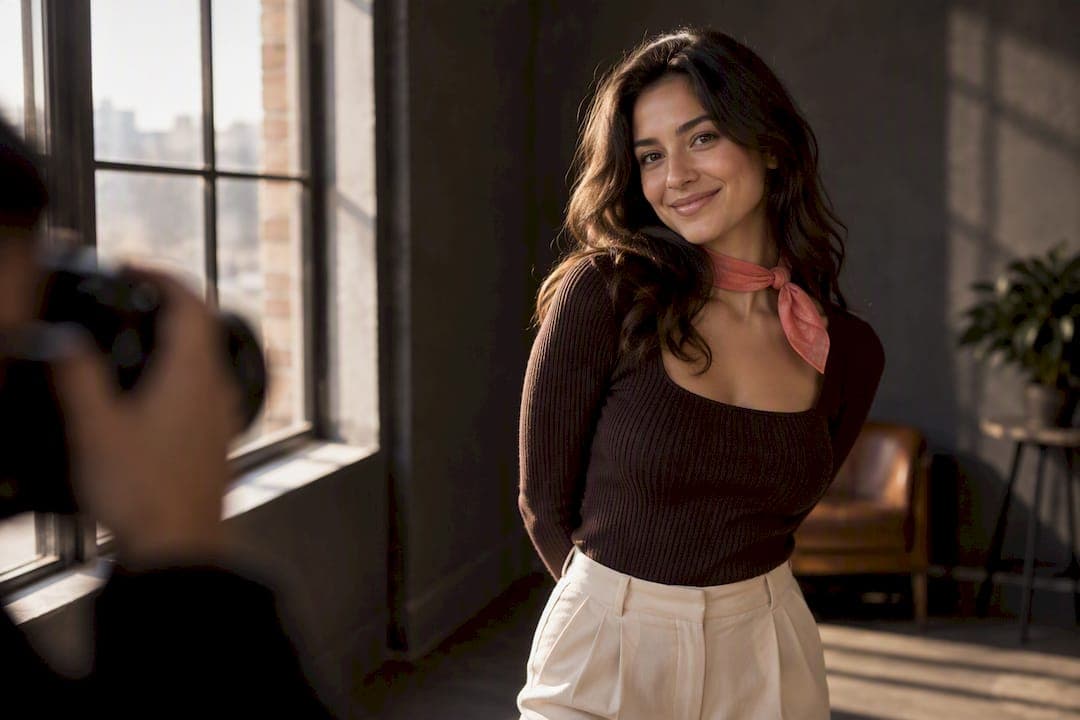
Eye contact, a genuine Duchenne smile and an open, angled body posture are the three fastest ways to lift how trustworthy and approachable you look in a dating photo. Fix light first, then camera angle, then expression, in that order. Get those three right and everything else on your profile, from your bio to your prompts, has a much easier job to do.
TL;DR:
- Proper lighting, eye contact, and genuine smiling significantly increase perceptions of trustworthiness and approachability in dating photos.
- Angling the body, using natural poses, and including full-body shots help create a relaxed and authentic appearance.
- Small technical adjustments like better light and camera angle often yield more improvements than outfit changes.
- Camera height and positioning are crucial; shooting slightly above eye level and avoiding wide-angle distortion enhances photo quality.
- Cultural differences influence how body language cues, such as eye contact and smiling, are interpreted across various dating audiences.
Table of Contents
- How body language signals attraction and approachability in dating photos
- Poses and composition that look natural, not staged
- Getting a genuine expression on camera
- Lighting and camera angle: the fixes that matter most
- What a single photo cannot tell you
- A practical checklist for auditing your own dating photos
- What DoubleMyMatches sees most in real photo audits
- How culture changes the way body language reads on dating apps
- What we see most and one honest takeaway
- Want a second opinion on your photos right now?
- Sources
- FAQ
How body language signals attraction and approachability in dating photos
Someone scrolling a dating app spends a fraction of a second on your first photo before deciding whether to keep looking. In that instant, they are reading body language, not analysing your personality.
Direct eye contact with the camera is the strongest single cue. Research on first impressions shows that direct gaze reliably increases how trustworthy and romantically interesting a person appears, while a gaze that drifts off camera reads as evasive or nervous, even when that was never the intention behind the shot.
Smiling matters just as much, but not all smiles are equal. A Duchenne smile, one that engages the muscles around the eyes and not just the mouth, signals genuine warmth. A mouth-only smile, sometimes called a social smile, can look posed or guarded to a stranger scrolling quickly.
Posture finishes the picture. Open shoulders, relaxed arms and a slight lean towards the camera all read as comfort and availability. Crossed arms, hunched shoulders or a rigid, squared-on stance signal the opposite, even in a photo where you were simply cold or self-conscious.
Quick visual checks before you upload:
- Are your eyes visible and looking towards the lens, or close to it?
- Do your eyes crinkle slightly when you smile?
- Are your arms open rather than folded across your chest?
- Is your body turned at an angle rather than squared to the camera?
Photo fix worth trying: swapping a flat, front-facing lead photo for one with direct eye contact and an open posture is one of the highest-leverage single changes you can make to a profile, according to feedback DoubleMyMatches gives users who retest their lineup.
Poses and composition that look natural, not staged
Stiff, symmetrical poses are the number one giveaway of a posed photo. Photographers lean on a handful of simple tricks to avoid that:
- Turn three-quarters, not full-on. Angling your body away from the camera and turning your face back towards it creates a natural S-curve through your shoulders and hips, which reads as relaxed rather than braced.
- Shift your weight onto one leg. Standing with even weight on both feet looks like a passport photo. Asymmetry, one hip slightly higher, weight on your back foot, breaks that stiffness immediately.
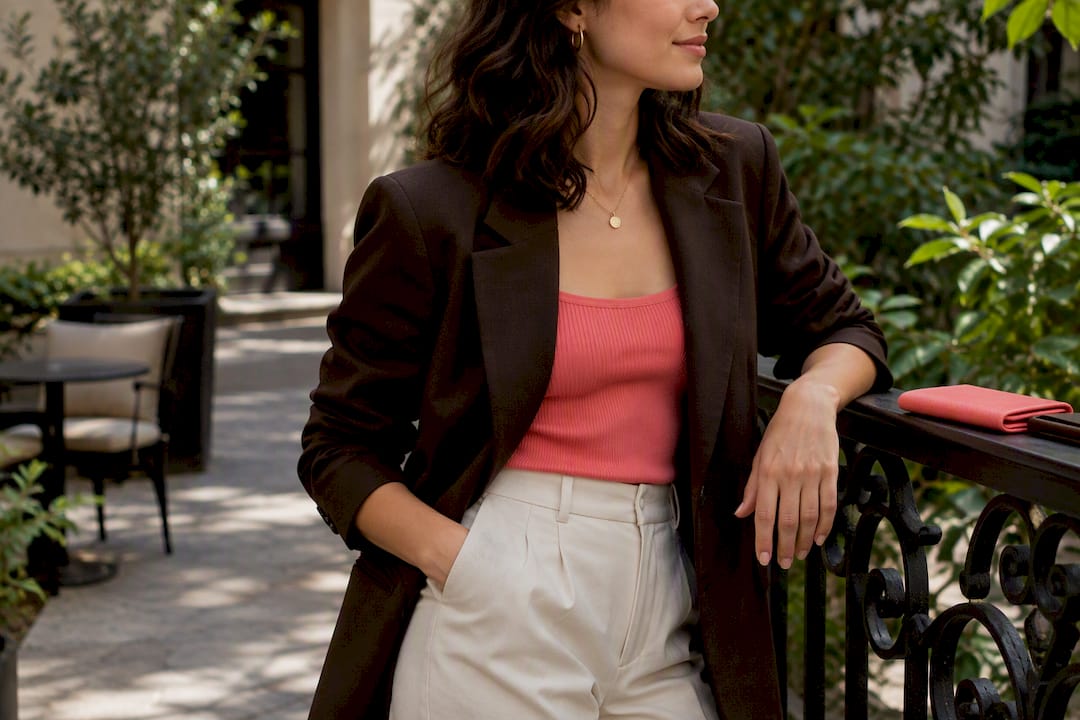
- Try the lean. Leaning against a wall, doorway or railing gives your body something to do and removes the "where do I put my arms" problem.
- Capture movement. A mid-walk shot, a laugh caught candidly, or a hand reaching for a coffee cup all look far more natural than a static pose.
- Sit when you can. Seated poses, on a step, a low wall, a bar stool, soften the body line and are often more flattering than standing straight on.
- Shoot at least one full-body frame. Face-only photos leave a gap that readers fill with doubt. Include one clear, full-length shot so there is nothing left to guess.
Shoot landscape rather than portrait for full-body shots. Most apps crop to a square or a tall rectangle, and a horizontal frame gives you room to crop without accidentally losing your feet or the top of your head.
Pro Tip: Never let your hands hang flat against your sides or cross over your chest. Give them a job, hold a jacket, rest one in a pocket, touch a railing, and the whole pose relaxes.
Getting a genuine expression on camera
Photographers chase eyes, not teeth. A genuine Duchenne smile involves the muscles around the eyes, and it is far more persuasive to a stranger than a wide, mouth-only grin held for the camera. You can read more about how expression shapes first impressions in DoubleMyMatches's guide to expression in dating photos.
The trick is to stop posing and start reacting. Genuine expressions come from a stimulus, not an instruction:
- Ask a friend behind the camera to tell a quick, ridiculous story right before the shutter clicks.
- Get someone to say something that makes you laugh, then shoot on the recovery, not the peak.
- Talk through what you did that morning instead of staring down the lens waiting to smile.
If you keep getting the dreaded "deer-in-headlights" stare, it is usually a camera height problem, not a personality problem. Raise the camera slightly above eye level, relax your jaw, and try a gentle "squinch" (softening your lower eyelids) rather than a full wide-eyed stare.
Lighting and camera angle: the fixes that matter most
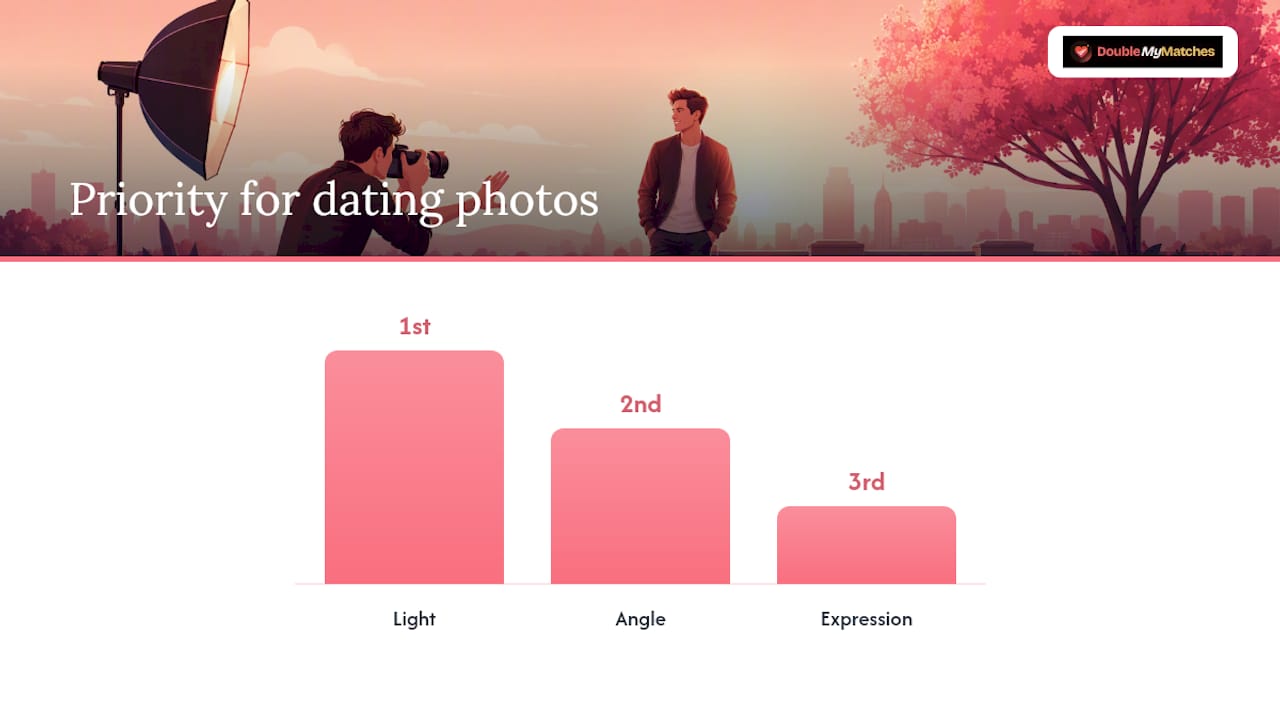
Photographers rank the order of importance for dating photos as light first, angle second, expression third, because bad light undoes good posing every time. Soft window light or open shade flatters almost everyone; harsh overhead midday sun creates shadows under the eyes and across the nose that no smile can fix.
Camera position matters nearly as much. A phone held at arm's length in a close-up selfie creates wide-angle distortion, exaggerating your nose and jaw while shrinking your eyes. Step back, hand the phone to a friend, or use a tripod and timer, and shoot from roughly eye level rather than looking down at the lens. DoubleMyMatches's guide to camera angles covers this in more detail.
A few final composition rules:
- Leave headroom above your head so the crop does not clip your hair.
- Keep feet inside the frame for full-body shots.
- Shoot slightly wider than you think you need; apps crop to square more often than you expect.
Small technical fixes like these consistently outperform a full restyle. Better light and a better angle on the same outfit will beat new clothes shot in bad light almost every time.
What a single photo cannot tell you
A photo is a frozen moment, not a personality test. Context, timing and staging all shape what a picture shows, and a single frame can genuinely mislead you about someone's intent or long-term feelings, no matter how confidently a caption or comment section reads into it.
Before you draw any conclusion from a photo, whether it is your own or someone else's, ask:
- Was the pose directed, or caught candidly?
- Who took it, and what was the relationship or occasion?
- What was happening just before or after the shot?
- Does the same body language repeat across several photos, or is it a one-off?
A slouched shoulder in one holiday snap means very little. The same slouch appearing in every photo across a profile tells you something more consistent. Judge patterns across a set of images, not a single frame in isolation.
A practical checklist for auditing your own dating photos
Run your current lineup through this before you upload anything new:
- Does your lead photo show your face clearly, with visible eyes and a genuine smile?
- Is there at least one full-body shot in the set?
- Do your photos vary in setting and activity, rather than five gym mirror selfies?
- Have you avoided heavy filters that smooth skin unnaturally or distort proportions?
- Does your body language look open (uncrossed arms, relaxed shoulders) in most shots?
Order your lineup with a clear, eyes-forward portrait first, followed by a full-body photo, then two or three lifestyle or activity shots that show range.
| Check | Why it matters |
|---|---|
| Clear lead portrait | Sets first impression; visible eyes build trust |
| At least one full-body shot | Removes doubt and signals transparency |
| Varied settings/activities | Shows range beyond a single moment |
| Minimal filtering | Keeps expectations honest for matches |
| Open body language across shots | Confirms the cue is a pattern, not a fluke |
A simple test: swap your lead photo for two weeks and track whether conversations pick up. Asking a couple of friends for a blind, five-second read on your top two candidates often surfaces the same instinctive read a stranger on an app would have.
What DoubleMyMatches sees most in real photo audits
Scoring photos for lighting, expression and composition across thousands of uploads shows the same pattern again and again: the biggest jumps in perceived approachability come from small fixes, not new wardrobes. Swapping a flat-lit selfie for one with better window light, or replacing a squared-on stance with a slight turn, tends to move the needle more than an entirely new outfit.
Every photo submitted for analysis is reviewed once and then deleted; nothing is stored, published or used to train the underlying model. That one-time, privacy-first approach is part of why DoubleMyMatches keeps recommending targeted, specific fixes rather than a blanket "take more photos" answer.
How culture changes the way body language reads on dating apps
Body language is not read the same way everywhere. Eye contact that signals confidence in one culture can feel unusually direct or even confrontational in another, where a softer, more oblique gaze is the norm for polite interaction. Smiling itself carries different weight too: broad, teeth-forward smiles are the expected default on North American profiles, while some European and East Asian dating cultures favour a more restrained, closed-mouth smile that is not read as distant, but as measured and genuine.
Physical proximity in photos follows a similar pattern. A photo showing you standing close to friends or family can read as warm and socially embedded in one cultural context, and as unremarkable background detail in another. Group photos are a particularly common flashpoint: in some markets they signal social proof, in others they raise the "which one are you" problem and slow down the first impression rather than helping it.
None of this means you need to perform a different personality for different audiences. It does mean two things worth keeping in mind. First, if your matches skew towards a specific cultural background, it is worth noticing how your existing photos might read to that audience specifically, not just to you. Second, when you are judging someone else's profile, resist assuming your own cultural defaults for eye contact, smiling or personal space are universal. What looks guarded to you might simply be a different, equally genuine, way of presenting warmth.
What we see most and one honest takeaway
Most people spend hours agonising over what to wear and barely a second thinking about where the light is coming from. That is backwards. Across the fixes covered here, light, angle and a genuine expression consistently do more work than any outfit choice.
Do not chase one perfect photo. Test a few changes, swap a lead image, add a full-body shot, fix the lighting, and see what actually shifts. Use the checklist above as your baseline, and if you want an outside, unbiased read, an AI photo review can spot what you have stopped noticing in your own pictures.
— The Team @ DoubleMyMatches
Want a second opinion on your photos right now?
Reading your own body language in a photo is genuinely hard. You already know what you meant to convey, so your brain fills in the confidence and warmth that a stranger scrolling past might not see at all.

That is exactly the gap DoubleMyMatches was built to close. Upload your current lineup and the AI scores each photo on the same cues covered here, eye contact, expression, posture, angle and lighting, and ranks them from strongest to weakest for Tinder, Hinge or Bumble specifically. If you just want a fast read on one shot before you commit to a full audit, the Profile Picture Tester gives you an instant score. For a full lineup review with ordering recommendations, the Full Report is available for a one-time fee, and if you want to retest after making changes, additional paid options are offered. Every photo is analysed once and then deleted, never published, never used to train the model. Start with the dating photo analyzer and see exactly which fixes will move your lineup the most.
Sources
The gaze and trust findings cited above come from the Psychological Science first-impressions research, and the Duchenne smile explanation draws on Psychology Today's coverage of genuine smiles. For a photographer's take on building rapport before the shutter clicks, see this boudoir photography perspective on comfort and authenticity.
FAQ
What does body language in photos typically mean?
Open posture, direct eye contact and a genuine smile typically read as confidence and approachability, while crossed arms, averted gaze or a stiff, squared stance tend to read as guarded or uncomfortable. Context still matters. A single unusual pose in one photo tells you far less than the same pattern repeated across several images.
What is the 3 6 9 rule for dating?
There is no single, agreed definition of a "3 6 9 rule" in dating psychology or photography research, and claims about it vary widely across informal sources. Rather than rely on unverified rules, focus on the tested fundamentals covered here: light, angle, genuine expression and open posture.
How can you tell if two people have chemistry in a photo?
Genuine chemistry tends to show through mirrored body language, matching posture, synchronised laughter, and closeness that looks relaxed rather than posed for the camera. A single staged photo can mimic these signs without real chemistry behind it, so patterns across several candid shots are a more reliable read than one frame.
What body language signs indicate attraction in dating photos?
Direct eye contact, a Duchenne smile that engages the eyes, an open and slightly angled posture, and subtle mirroring of another person's stance are the clearest signs. These cues, along with lighting and composition, are among the factors scored by AI services that rank uploaded dating photos.
How much does a DoubleMyMatches photo report cost?
The Full Report is a one-off $7, and Retest & Lock In, for reviewing changes after your first report, is a one-off $17. Both are available directly on the DoubleMyMatches site.