

Men match with roughly 5.26% of the profiles they swipe right on, and the typical (median) man does far worse, at around 2.04%. Women average about 44.4%, nearly nine times higher. Those figures come from SwipeStats' analysis of 7,079 Tinder profiles, covering 294 million swipes and 3.14 million matches. If you're a man matching on a few percent of your right-swipes, you're not doing badly. You're doing normally.
The one-sentence takeaway: most men should stop chasing more matches and start chasing better ones, because volume rarely beats a sharper, more selective approach.
- Men: average match rate around 5.26%, median around 2.04%
- Women: average match rate around 44.4%
- Sample: 7,079 profiles, 294 million swipes, 3.14 million matches
Key Takeaways
| Point | Details |
|---|---|
| Know your realistic baseline | Median male match rate is 2.04%, so don't benchmark against the 5.26% average alone. |
| Selectivity beats volume | Swiping right on under 4% of profiles lifted match rates to roughly 11.85% versus 2.19% for power-swipers. |
| Test one variable at a time | Run each photo or bio change for 2 to 4 weeks or 100+ right-swipes before judging results. |
| Track conversations, not just matches | A high match count with few replies means the profile still needs work. |
| Speed up testing with AI scoring | A dating photo analyzer can flag weak photos before you run weeks of live testing. |
Table of Contents
- Understanding Tinder match rate benchmarks: averages vs medians
- What actually moves your match rate
- How to measure your Tinder match rate properly
- Priority checklist to lift your match rate
- How AI photo analysis speeds up the testing process
- What we see working in practice
- Sources
Understanding Tinder match rate benchmarks: averages vs medians
Averages lie a little, and it's worth knowing how. An average adds up every match rate in the dataset and divides by the number of people. A median finds the person sitting exactly in the middle when everyone is ranked from worst to best. When the two numbers are far apart, as they are here, it tells you the data is skewed.
Look at the male figures again: an average of 5.26% against a median of 2.04%. That gap exists because a small number of high-performing men pull the average upwards while most men sit well below it. If you're using "5%" as your personal target, you're actually benchmarking yourself against a distribution shaped by outliers, not against what a typical man experiences.
- Average: total matches ÷ total people, easily skewed by a handful of top performers
- Median: the midpoint value, closer to what "typical" actually looks like
- Practical rule: use the median as your realistic baseline, and treat the average as the ceiling most men never reach
This matters for the gender gap too. Women's median match rate isn't published as widely as men's, but even accounting for skew, industry data on Tinder's scale consistently shows the gap holding across multiple datasets. Practically, this means a man swiping right on almost everyone can still end up matching with under 3% of profiles, while a woman doing the same might match with nearly half of hers. The playing field isn't level, and pretending it is will only leave you frustrated with numbers you were never going to hit.
What actually moves your match rate
Four things drive most of the variance in match rate, and you control all of them.
- Photos. Lighting, how prominent your face is in the shot, genuine expression, and variety across your lineup all shift outcomes. A blurry, dark, or group-heavy photo set does more damage than people expect.
- Swiping behaviour. This is the big one. SwipeStats found that men who swiped right on fewer than 4% of profiles recorded match rates around 11.85%, compared with roughly 2.19% for men who swiped widely. Selective swiping doesn't just improve your odds per swipe. It may also improve how the algorithm ranks you, because it reads your restraint as a signal of genuine preference rather than indiscriminate liking.
- Bio. Shorter, more specific bios tend to outperform long ones in the SwipeStats sample. Specificity beats cleverness.
- Activity signals. How often you're active, and how you behave in a session, feeds into how the app ranks your profile against others, a dynamic covered in more detail in what affects the dating app algorithm.
Pro Tip: Before touching your bio or photos, cut your right-swipe rate down to the people you'd genuinely want to meet. This single change often moves the needle more than any photo edit.
How to measure your Tinder match rate properly
Guessing your match rate from memory is useless. You need a denominator (right-swipes) and a numerator (matches), tracked over a fixed window.
- Pick a 2 to 4 week window. Long enough to smooth out daily noise, short enough that your profile hasn't changed mid-test.
- Count every right-swipe you make, not every swipe. Left-swipes don't belong in the denominator.
- Count matches from that same period. Divide matches by right-swipes, then multiply by 100.
- Don't judge results below roughly 100 right-swipes. Smaller samples swing wildly and will mislead you.
- Change one variable per test. Swap only the photo lineup, or only the bio, never both at once, so you know what caused the shift.
Here's what the maths looks like in practice:
A jump from 50 to 150 right-swipes with a genuine strategy change gives you a far more trustworthy number than judging your profile off a single day's results.
Priority checklist to lift your match rate
Once you've got a baseline, work through changes in order of impact, testing each for the full window before moving to the next.
- Photos first. Swap your lead shot for a clear, well-lit headshot with a natural smile, then test variety (a candid, a hobby shot, one with a slight body-language change). Photo examples that actually get matches show that small, context-specific tweaks, like changing the angle or adjusting clothing contrast, often outperform a full photo overhaul because they keep you recognisable while fixing the cues people react to.
- Bio second. Cut clichés like "just here to have fun" or "love to travel," and replace them with one specific, conversation-starting detail. Test a 15-word bio against your current one.
- Swiping strategy throughout. Aim for selective right-swiping rather than power-swiping. Fewer, better-targeted swipes tend to raise both your match rate and your algorithmic standing.
- Run each test for 2 to 4 weeks, or until you've logged at least 100 right-swipes, before deciding whether a change worked.
Pro Tip: Log match rate and conversation rate separately. A photo change that boosts matches but not replies is only solving half the problem.
For guidance on bio structure and layout beyond photos, simple profile changes that get real matches is worth a read before you start editing.
How AI photo analysis speeds up the testing process
Running photo tests manually works, but it's slow. You need real swipe data, real time, and a decent sample size before you know if a change helped. DoubleMyMatches shortens that loop by scoring your existing photos instantly, based on lighting, expression, composition, and what tends to perform on Tinder, Hinge, or Bumble.
- Instant scoring ranks your photos from strongest to weakest before you upload a single one live
- Per-photo feedback flags which shots are actively working against you
- Best-to-worst lineup recommendations replace guesswork with a suggested order
On privacy, the approach is straightforward: DoubleMyMatches analyses your photos once, then discards them. Nothing is published, and nothing is used to train the underlying AI. Practical examples of the kind of swaps that tend to help are covered in real Tinder photo examples for men.
If you've got months to run structured A/B tests yourself, DIY works. If you want a faster read on which photos are holding you back before you spend weeks swiping, paid analysis gets you there in minutes rather than a full testing cycle.

What we see working in practice
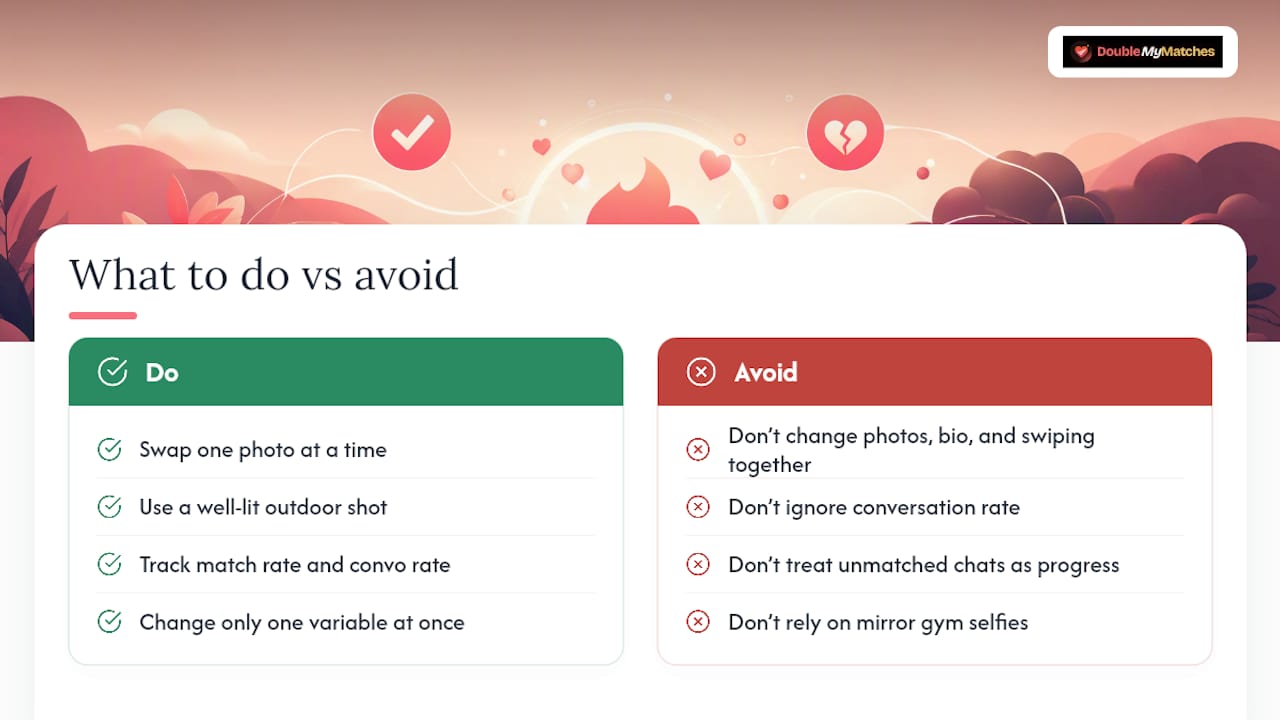
The biggest surprise for most clients isn't a dramatic photo overhaul. It's how much a single swap, dropping a dim gym mirror selfie for one well-lit outdoor shot, can shift results. The most common mistake is changing three things at once (photos, bio, and swiping habits together) and then having no idea which one actually worked.
Our advice stays consistent: track conversation rate alongside match rate. A pile of matches that never turn into chats isn't progress. It's noise.
— The Team @ DoubleMyMatches