
Your lead photo is the single biggest lever on your profile. Swap it for a clear, well-lit headshot with eye contact and a genuine smile, and you will see the difference within days. Everything else, from bio length to your opening line, builds on that foundation.
Here is a quick checklist you can action in under 30 minutes:
- Primary photo: replace any group shot, sunglasses selfie, or blurry image with a sharp headshot, good lighting, direct eye contact.
- Photo order: headshot first, then a full-body or activity shot, then a social or lifestyle photo.
- Bio lead: open with one specific detail about yourself, not a list of adjectives.
- Conversation hook: end your bio with a question or an invitation, something the other person can actually reply to.
- Intent line: one short sentence stating what you are looking for (casual, something serious, open to seeing where it goes).
- Privacy check: remove your full name, workplace, and postcode from your profile before you go live.
Two bio templates you can copy right now:
Two opening-line examples:
Table of Contents
- How to pick, order, and test your profile photos
- Write a bio that actually invites a conversation
- How to choose the right app and adapt your profile
- First messages that actually get replies
- Arranging the first date safely and practically
- Why these tactics work: the research behind the advice
- The part most people skip
- Get objective feedback on your photos with DoubleMyMatches
- Further reading and sources
How to pick, order, and test your profile photos
Your primary photo does most of the work. Swiping is fast, often under two seconds per profile, so the lead image has to earn attention immediately. A clear headshot with natural lighting, a genuine smile, and direct eye contact consistently outperforms every other photo type as the first image. Avoid sunglasses, group shots, or anything where your face is partially hidden.
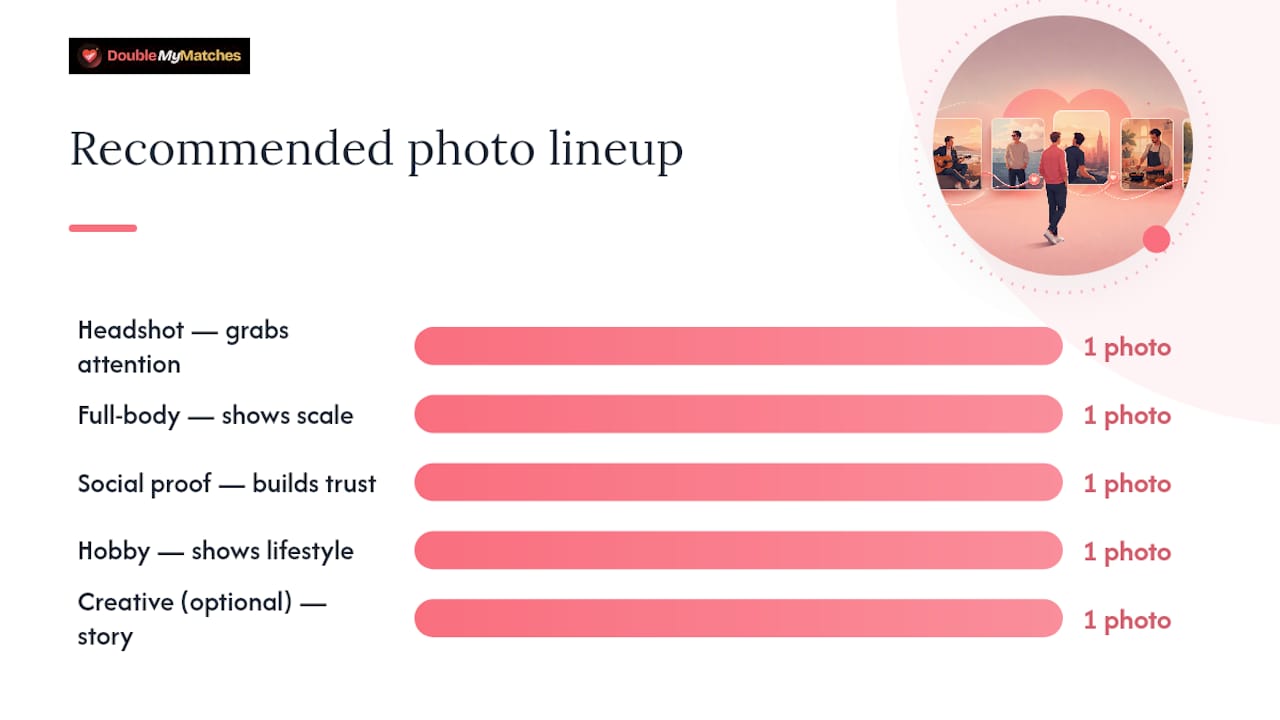
Beyond the lead, you need a supporting cast of 4–6 photos. Research recommends 4–6 images as the sweet spot. Fewer than four can look like you are hiding something, and more than six dilutes the impact of your strongest shots.
The order that works:
- Headshot (clear face, good light, genuine expression)
- Full-body or action shot (shows scale, energy, context)
- Social proof photo (you with friends or at an event, not a group selfie)
- Hobby or lifestyle shot (sport, cooking, travel, a pet)
- Optional creative shot (something that tells a small story)
Photos to avoid entirely: gym mirror selfies with no context, photos where you are the least prominent person, heavily filtered images, and anything that looks more than three or four years old.
Testing your lineup: treat your photos as an experiment. Swap one image at a time, leave it for two weeks, and measure whether your matches or messages increase. Changing multiple photos at once makes it impossible to know what moved the needle. Photo changes that produce measurable results tend to be smaller than people expect: better lighting, a warmer expression, or removing a distracting background.
Pro Tip: Run a quick blind test by asking two or three friends to rank your photos without telling them which one you currently use as your lead. Their instinct often differs from yours, and that gap is worth knowing.
| Photo factor | Guidance | Why it matters |
|---|---|---|
| Optimal photo count | 4–6 images | Balances information and cognitive load |
| Lead photo type | Clear headshot, eye contact, genuine smile | Dominates swipe decisions in under 2 seconds |
| Photo order | Headshot → full-body → social → hobby | Builds a narrative; keeps viewers engaged |
| Photos to cut | Group shots, sunglasses, blurry or old images | Reduce clarity and perceived confidence |
Write a bio that actually invites a conversation
The formula is simple: hook + brief context + specific conversation invite. One sentence that catches attention, two or three lines of genuine detail, and a question or prompt at the end. That structure gives the other person something to respond to, which is the whole point.
Length matters. SwipeStats analysis of thousands of profiles found that short, specific bios outperform long ones for match rates, particularly for men on swipe-first apps. On prompt-based apps like Hinge, slightly more depth works well because the format rewards it. As a rule: say more than nothing, say less than everything.
The Goldilocks disclosure principle applies here. Profiles with moderate personal detail score highest for attractiveness and perceived commitment potential. Sparse profiles feel evasive; over-detailed ones feel intense. Aim for a profile that feels like a good first conversation, not a CV or a therapy session.
UC Berkeley Haas research found that profiles signalling genuine curiosity about the other person are rated more appealing than those focused on self-promotion. Ending your bio with a real question is not just a tactic; it reflects something people actually respond to emotionally.
Ready-to-copy bio templates:
- Casual: "Graphic designer, Brighton. I spend weekends at car boot sales and I'm unreasonably good at pub quizzes. What's your specialist subject?"
- Serious: "Looking for something real. I work in education, love long walks that end at a good pub, and I'm trying to get better at cooking Thai food. What does a good weekend look like for you?"
- Curious: "I ask too many questions and I think that's a feature, not a bug. Currently obsessed with cold-water swimming and bad documentaries. What's something you've changed your mind about recently?"
- Witty: "Professional overthinker, amateur bread baker. I will absolutely judge your coffee order. What's the most niche thing you're into right now?"
Before and after:
Before: "I love travelling, going to the gym, and spending time with friends and family. Looking for someone genuine."
After: "Just back from a solo trip to Porto — highly recommend the tram and the pastéis de nata. I run on weekends and I'm looking for someone who has an opinion about things. What's the best place you've visited recently?"
Dos and don'ts:
- Do use one specific anecdote or detail rather than a list of adjectives
- Do end with a question or an open invitation
- Do state your intent clearly but briefly
- Don't open with "I'm not sure what to write here"
- Don't list every hobby you have ever had
- Don't use phrases like "fluent in sarcasm" or "love to laugh" — they say nothing
For more on expressing genuine curiosity in your profile, Meet Me Here's blog covers this well.
How to choose the right app and adapt your profile
Not all apps reward the same things. Choosing the right platform and adapting your profile to its format can double your results without changing a single photo.
Swipe-first apps (Tinder, Bumble) are photo-led. Your images do the heavy lifting, and your bio needs to be short and punchy. A long bio on Tinder is rarely read in full. Keep it under 150 characters if you can, and make every word earn its place.
Prompt-based apps (Hinge, Thursday) reward written answers. Your responses to prompts are often the first thing someone reads, so treat each one as a micro-bio. A specific, slightly unexpected answer to a prompt outperforms a safe, generic one every time. Prompt-based answers that invite a response increase opening messages significantly.
Settings checklist before you go live:
- Set your intent filter clearly (casual, serious, open to both)
- Adjust distance and age filters to realistic ranges, not aspirational ones
- Enable photo verification if the app offers it — it builds trust
- Review what personal information is visible in your profile before publishing
- Turn off "show me to everyone" on apps that offer audience controls if you want to be selective
| App type | What it rewards | Bio length | Key tactic |
|---|---|---|---|
| Swipe-first (Tinder, Bumble) | Strong photos, punchy bio | Under 150 characters | Lead photo quality is everything |
| Prompt-based (Hinge) | Specific, witty prompt answers | Medium (per prompt) | End each answer with a hook |
| Interest networks (Thursday) | Shared activity, real-time intent | Short | Be direct about what you want |
Understanding what affects the dating app algorithm can also help you stay visible to the right people after you publish.
First messages that actually get replies
Personalise the opener, reference something specific from their profile, and ask an open question. That is the whole formula. Generic openers ("Hey, how's your week going?") get ignored because they require no effort and signal no real interest.
Primary photos and prompt answers create the conversation hooks that convert interest into messages. When you reference a specific detail, you show you actually looked, and that alone sets you apart from most people in someone's inbox.
Six opener templates you can adapt:
- "Your photo at [specific place] — have you been back since? I went last year and it completely changed how I think about [related topic]."
- "You said you're learning [skill]. How's that going? I tried it once and it was a humbling experience."
- "[Specific detail from their bio] — I have strong opinions about this. What made you get into it?"
- "Your answer to [prompt] made me laugh. Is that actually true or is it your best first-impression story?"
- "I see you're based in [area]. Have you been to [specific local spot]? I've been meaning to go."
- "You mentioned [book/film/band]. That's a bold choice. What made you pick it?"
Rules for tone and length: keep the first message to two or three sentences. Warm but not intense. Curious but not interrogating. Avoid compliments about appearance in the first message; they are common and they do not start a conversation.
Keeping momentum going:
- If they reply briefly, ask one follow-up question, not three
- If they go quiet after two exchanges, send one more message with a light reference to something they mentioned
- If there is no reply after three attempts, move on
Red flags worth noting: if someone deflects every personal question, gives only one-word answers consistently, or pushes to move off the app within the first few messages, those are worth paying attention to.
Arranging the first date safely and practically
Move from app to a real meeting within one to two weeks of matching. Longer than that and the conversation tends to lose energy. You do not need to know everything about someone before meeting; that is what the date is for.
Safety checklist before you go:
- Tell a friend or family member where you are going, who you are meeting, and when you expect to be back
- Choose a public venue for the first meeting, a café, a bar, a daytime walk somewhere busy
- Keep your own transport arranged, do not rely on the other person to get you home
- Do not share your home address, workplace, or full surname before you have met in person
- Trust your instincts: if something feels off before you arrive, it is fine to cancel
First-date ideas for UK readers:
- A daytime coffee in a café you already like (low pressure, easy to extend or cut short)
- A walk in a park or along a canal, with a pub at the end
- A casual food market or street food event (something to talk about, no awkward silences over a menu)
- A short activity date: pottery, a cookery class, mini golf (gives you something to do together)
- An afternoon at a gallery or museum (free in most UK cities, easy conversation starter)
If you need to leave early, a simple script works well: "I've had a really nice time, but I need to head off. It was good to meet you." You do not owe anyone an explanation, and you do not need to invent one.
Timing: suggest the date in the message, not as a vague "we should meet up sometime." Specific is better. "Are you free Saturday afternoon?" gets a yes or no. "We should hang out" gets a non-answer.
Why these tactics work: the research behind the advice
The guidance in this article is not based on intuition. It comes from peer-reviewed research and large-sample data analyses that consistently point to the same conclusions.
UC Berkeley Haas research found that profiles signalling curiosity about knowing the other person are rated more appealing than those focused on self-presentation. The practical implication: end your bio with a question, not a statement about yourself.
A PLOS ONE study on profile originality showed that specific anecdotes and stylistic detail outperform generic interest lists. A short story fragment ("I once spent three hours lost in Lisbon and it was the best afternoon of the trip") beats "I love travelling" every time.
The Goldilocks disclosure finding from psychology experiments confirms that moderate self-disclosure scores highest for attractiveness. Too little feels evasive; too much feels overwhelming. A reasonably fleshed-out profile with one or two genuine personal details sits in the right zone.
SwipeStats data from thousands of profiles shows that men and women experience very different match-rate baselines on swipe-first apps. That gap means optimisation matters more for some users than others, and testing is the only reliable way to know what works for you specifically.
| Research finding | Practical takeaway |
|---|---|
| Curiosity about the other person increases appeal (UC Berkeley) | End your bio with a question, not a self-description |
| Specific anecdotes beat generic lists (PLOS ONE) | Replace "I love hiking" with a short, specific story |
| Moderate disclosure scores highest (psychology experiments) | Aim for a profile that feels like a good first conversation |
| 4–6 photos is the optimal range (industry analyses) | Remove weak photos rather than adding more |
| Short, specific bios outperform long ones (SwipeStats) | Cut anything that does not add a real detail or hook |
The part most people skip
There is a tendency, when optimising a profile, to focus entirely on self-presentation: the best photo of yourself, the cleverest bio line, the most impressive hobby. The research points in a different direction. Profiles that show genuine interest in the other person consistently outperform those that are well-crafted but inward-facing.
That is not a small distinction. It changes what you write, how you write it, and what you ask at the end of your bio. A profile that says "here is who I am, aren't I interesting?" is competing with thousands of others doing the same thing. A profile that says "here is a bit about me, and I'm genuinely curious about you" is doing something rarer.
The same principle applies to first messages. Referencing a specific detail from someone's profile is not just a tactic for getting a reply. It signals that you actually looked, that you are paying attention, and that the conversation will be a real one rather than a copy-paste exchange.
Most people know this instinctively in real life. The challenge with dating apps is that the format nudges you towards self-promotion. Resisting that nudge, even slightly, tends to produce better results than any amount of photo editing or bio polishing.
Get objective feedback on your photos with DoubleMyMatches
Most people cannot tell which of their photos is actually their strongest. Friends are kind, not honest, and your own favourites are rarely the ones that perform best. DoubleMyMatches gives you instant, objective AI scoring on every photo you upload, ranked from strongest to weakest based on lighting, expression, and composition.
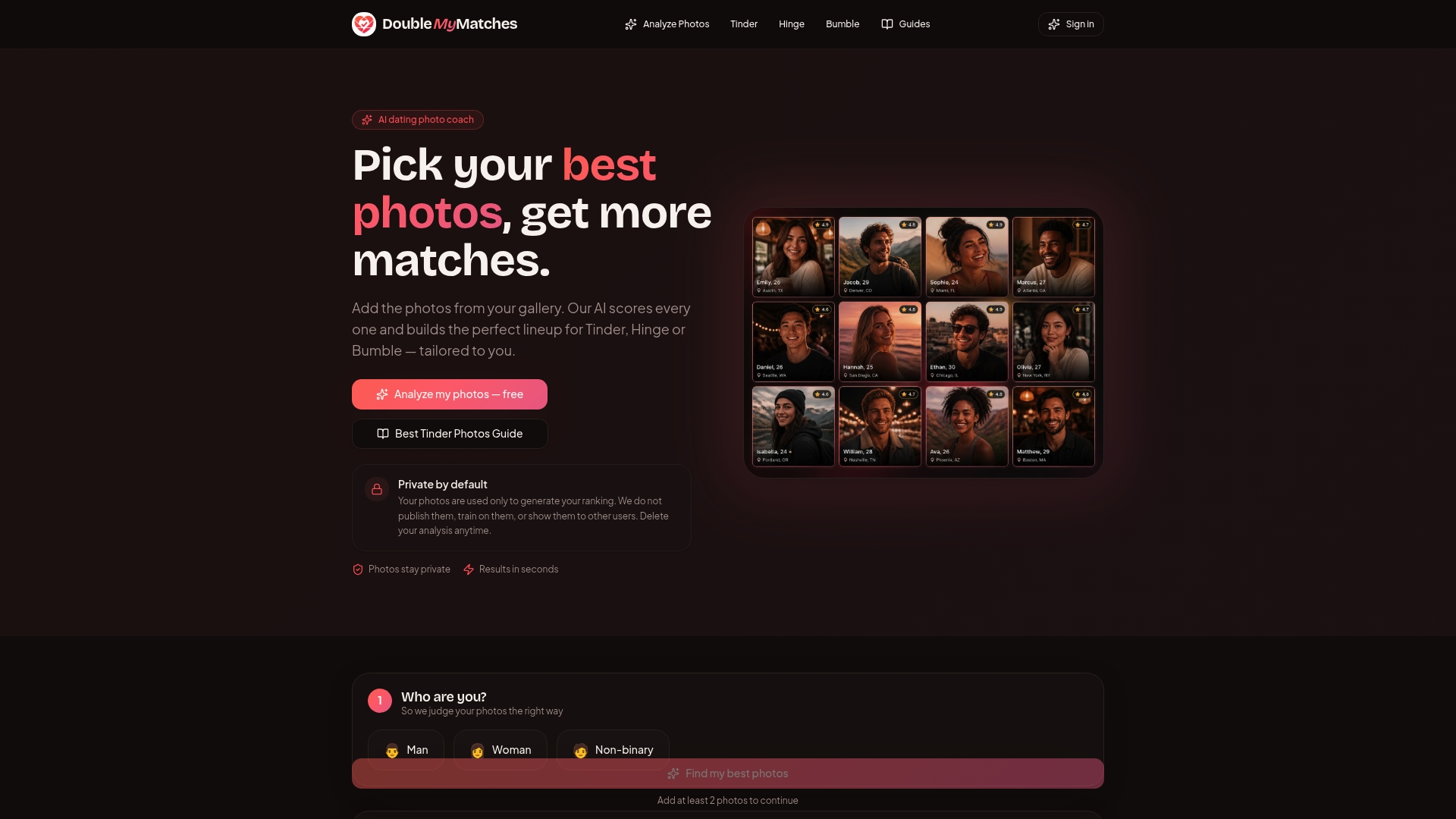
The service analyses your photos for Tinder, Hinge, or Bumble and tells you exactly which to lead with, which to cut, and why. You get per-photo feedback, a best-to-worst ordering, and a clear lineup recommendation, all in one report. Photos are analysed once and then discarded; they are never stored, published, or used to train the AI.
If you have followed the steps in this article and want to know whether your photo lineup is actually working as hard as it should, the Dating Photo Analyser is the fastest way to find out. Upload your photos, get your scores, and go into your next match with confidence.
Further reading and sources
The guidance in this article draws on peer-reviewed research and large-sample industry analyses. Source selection prioritised studies with clear methodology and datasets large enough to draw reliable conclusions.
- Research reveals the key to an irresistible online dating profile — UC Berkeley Haas
- Tinder Profile Examples That Get Matches (2026) | SwipeStats
- Vice: Scientists found the perfect amount of information to put in your dating profile
- How to Write a Dating Profile That Actually Gets Matches (Psychology-Backed Formula) | Lustdr
- Forbes Health: How to make a good dating profile
- How to Write a Dating Profile That Gets Replies in 2026