
Yes, testing your photos works, and it usually beats guessing. Real-user feedback gives you audience-specific insight that a mirror check never will, while a reputable AI tool is the next best thing when you can't gather willing testers. Start with a clear headshot as your main photo, then use scores and comments to pick the rest. Just check the provider deletes your images afterwards.
TL;DR:
- Testing photos with AI or real users provides more accurate feedback on approachability, authenticity, and trustworthiness than guessing or mirror checks.
- Scores are most reliable when rated by demographics matching your target audience, such as specific age and gender groups, rather than friends or broad online groups.
- A set of six varied photos, especially including candid and recent shots, improves profile appeal more than focusing solely on polished or studio images.
- Trustworthy platforms should delete your images afterward and not use them for training AI models; always check privacy policies before uploading.
- Combining DIY photo testing with paid, normalized feedback helps optimize your dating profile photos effectively and efficiently.
Table of Contents
- How does testing dating photos actually work?
- Who should actually rate your photos?
- What should you test for, and what photos do you need?
- How do you turn scores into your final five photos?
- Is it safe to upload your photos to a testing service?
- Do you need a paid service, or can you test photos yourself?
- What our photo tests keep revealing
- Get an objective read on your photos with DoubleMyMatches
- Sources
How does testing dating photos actually work?
Most testing platforms follow the same basic flow. You upload a handful of photos, tell the tool you're testing for dating (not LinkedIn or a passport renewal), and sometimes filter by the age range or gender you're hoping to attract. From there, real people or an AI model score each shot, and you get results back, often within minutes.
- Upload your shortlist and set your context, dating, and target audience filters
- Receive scores per photo, usually broken down by trait rather than one blunt overall number
- Get written comments where the platform supports them, flagging what's working and what isn't
- Compare results across your set to spot the strongest contenders
The scoring itself deserves a mention. Serious platforms normalise ratings to correct for harsh voters, someone who rates everything a 4 out of 10 gets weighted differently to someone who rates everything an 8. Without that correction, your scores mean very little. On payment, expect one of three models: a free trial photo, a credit system where you pay per test, or a flat one-off report. DoubleMyMatches' profile-picture tester uses the one-off report model, which suits people who want a quick answer rather than an ongoing subscription.
Who should actually rate your photos?
The people rating your photos should look roughly like the people you're trying to date. A panel of straight women in their 30s will give you very different feedback to a mixed-age general crowd, and if you're using Hinge to find something serious, that's a meaningful difference. Getting this wrong is one of the quickest ways to end up "optimising" for the wrong audience entirely.
- Targeted crowd panels: filtered by age and gender, closest to real-world dating app users, usually the most reliable option
- Friends and family: free and fast, but they know you, so they can't judge first impressions the way a stranger would
- Niche communities (Reddit threads, dating advice forums): honest and often blunt, but small and skewed towards a particular type of user
- AI proxies: consistent and instant, useful when you can't gather enough human voters, though they lack lived dating-app context
When your groups disagree, don't average the scores and hope for the best. Weight the feedback from whichever demographic actually matches who you want to date.
What should you test for, and what photos do you need?
Three traits matter more than any others: approachability, authenticity, and perceived trustworthiness. Photos that read as staged or overly polished tend to score worse on approachability, even when they look "better" in a technical sense, and research on dating profile photos backs this up. Genuine expressions beat controlled ones, and direct eye contact in your main photo tends to correlate with higher perceived trustworthiness.
Build a set of six photos before you test anything, so you're comparing real options rather than whatever three shots you happened to have on your phone:
- Main headshot — clear face, good light, direct eye contact
- Full-body shot — shows your build and how you dress
- Social, non-lead photo — you with others, never as the first image
- Activity shot — a hobby, sport, or something you're genuinely into
- Recent casual photo — taken within the last six to twelve months
- Wildcard — something that hints at personality or a talking point
Run through a quick technical checklist too: are you making eye contact, is the light natural rather than harsh overhead fluorescent, is the background uncluttered, and is the photo actually recent?
Pro Tip: Skip the professional headshot-style portrait as your only test option. Include at least one candid, mid-laugh or mid-conversation shot, research consistently shows these outperform posed shots for approachability, even when the lighting is less than perfect.
How do you turn scores into your final five photos?
Numbers alone won't choose your lineup, but they'll rule out the obvious mistakes fast. Start with average trait scores, then read the written comments closely; a photo that scores fine but gets repeated comments about looking "distant" or "guarded" is quietly damaging your approachability, even if the raw number looks acceptable.
- Cut anything that consistently scores low on approachability or authenticity, regardless of how flattering you think it is
- When demographic groups disagree, favour the feedback from the audience you actually want to attract
- Order matters: lead with your strongest headshot, then alternate types, close-up, full-body, social, activity, so the set feels varied rather than repetitive
- Avoid leading with a group photo. Viewers have to work out which person you are, and that friction costs you swipes, as British GQ's dating photo advice points out
Five photos beats six or seven in most cases. Quality control matters more than volume.
Is it safe to upload your photos to a testing service?
Reasonable caution is warranted whenever a stranger's app is scoring your face. Before uploading anything, check the provider's policy for two specific clauses: does it delete your photos after analysis, and does it confirm your images won't be used to train its models? GDPR gives you the right to request deletion and to restrict how your personal data, including photos, gets processed, so a provider operating in that space should make deletion easy, not something you have to chase over email.
If you're testing with friends instead of a formal platform, strip identifying metadata where you can and get their consent before sharing images in a group chat. Anonymous crowd panels with opt-in filtering are generally the safer middle ground between "total strangers see my face" and "only my friends judge me."
Do you need a paid service, or can you test photos yourself?
DIY testing has its place. Rotating photos on your own dating app profile and watching your match rate over a week or two costs nothing and gives you real, if noisy, data. Texting three or four photos to a small group of friends works too, though expect bias; people who like you tend to say nice things. Posting a discreet poll in a relevant online community sits somewhere in between, honest feedback, but a small and self-selecting sample.
- App rotation: free, real-world signal, slow, and hard to isolate which change caused the shift
- Friend polls: fast and free, prone to flattery bias
- Small social polls: honest but low sample size, results can swing wildly
Paid testing earns its keep when you need demographic splits, normalised scoring that corrects for harsh raters, or written feedback you can actually act on. A sensible workflow combines both: run a quick DIY check first, then use a paid report periodically as your photos age or your target audience shifts.
What our photo tests keep revealing

Across the photos we score, the same mistakes show up again and again: group shots as the main image, heavy filters that make skin look plastic, and photos that are three or four years and one haircut out of date. The fix is almost always simpler than people expect.
Swap a group main photo for a single, candid, well-lit face shot, and the improvement is usually immediate and visible in how the rest of the set reads. People notice authenticity faster than they notice a perfect jawline.
— The Team @ DoubleMyMatches
Get an objective read on your photos with DoubleMyMatches
DoubleMyMatches gives you what a friend poll can't: consistent, unbiased scoring with no flattery bias and no waiting around for replies. Upload your shortlist to the dating photo analyzer and you'll get instant AI scoring across approachability, authenticity, and overall appeal, plus per-photo feedback that tells you exactly what's holding a shot back.
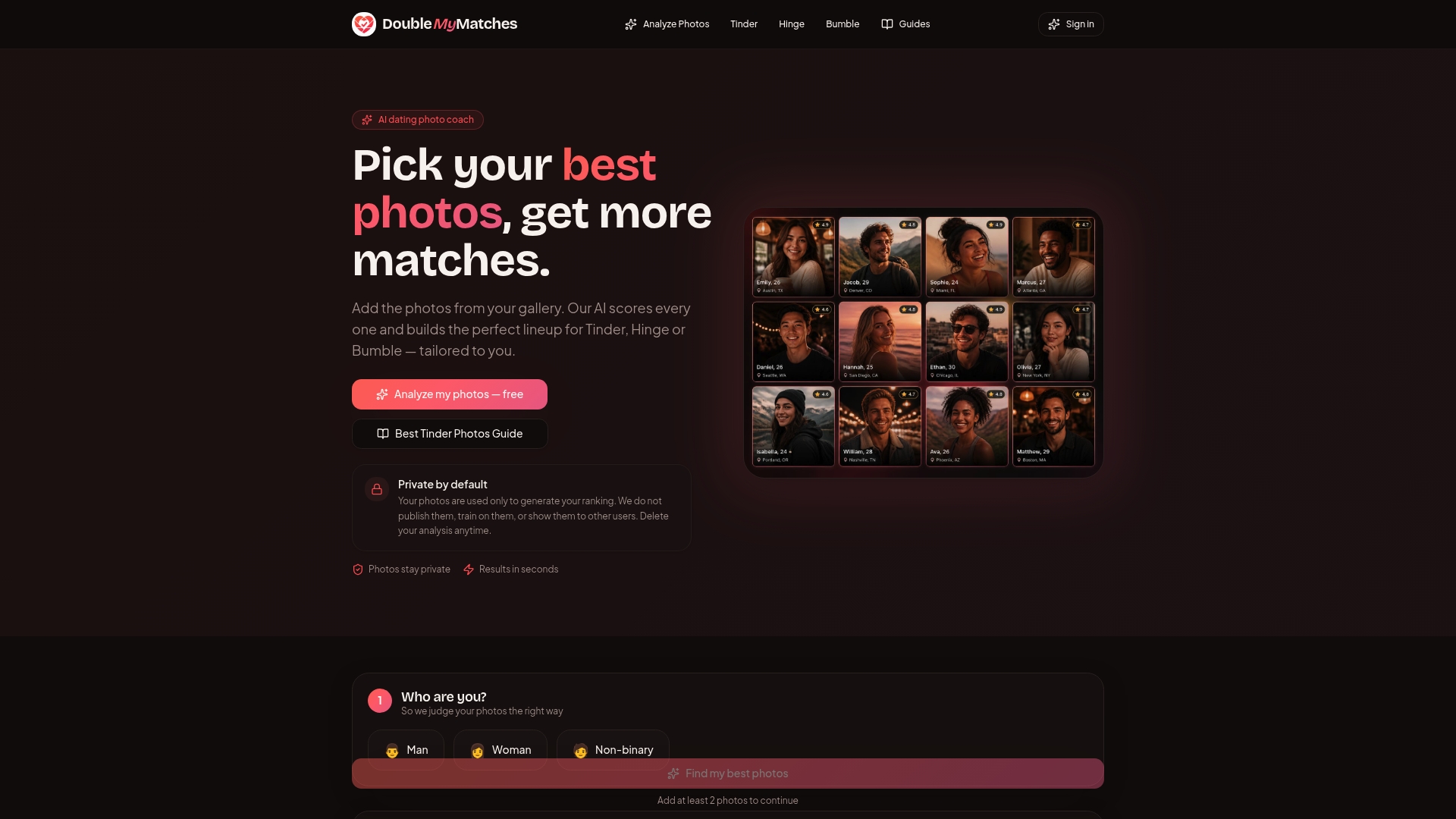
The report ranks your photos best to worst, so building your final five becomes a matter of following the order rather than guessing. Every analysis is one-off: your photos are assessed and then discarded, never used to train the AI or shared anywhere else. If you're unsure how this stacks up against manual crowd-testing tools, the Photofeeler vs AI Photo Analyzer comparison breaks down the practical differences. When you're ready, run your current lineup through the dating photo analyzer and see which photo should really be leading your profile.
Sources
For the research behind these recommendations, see the dating profile photo research summary, British GQ's photo advice, and GDPR guidance on your rights over personal image data. DoubleMyMatches also publishes a dating photo checklist and a step-by-step selection guide for further reading.
- Best Dating Profile Photos: What the Research Says
- How to take a good dating app photo, according to dating app experts | British GQ
- Gdpr