
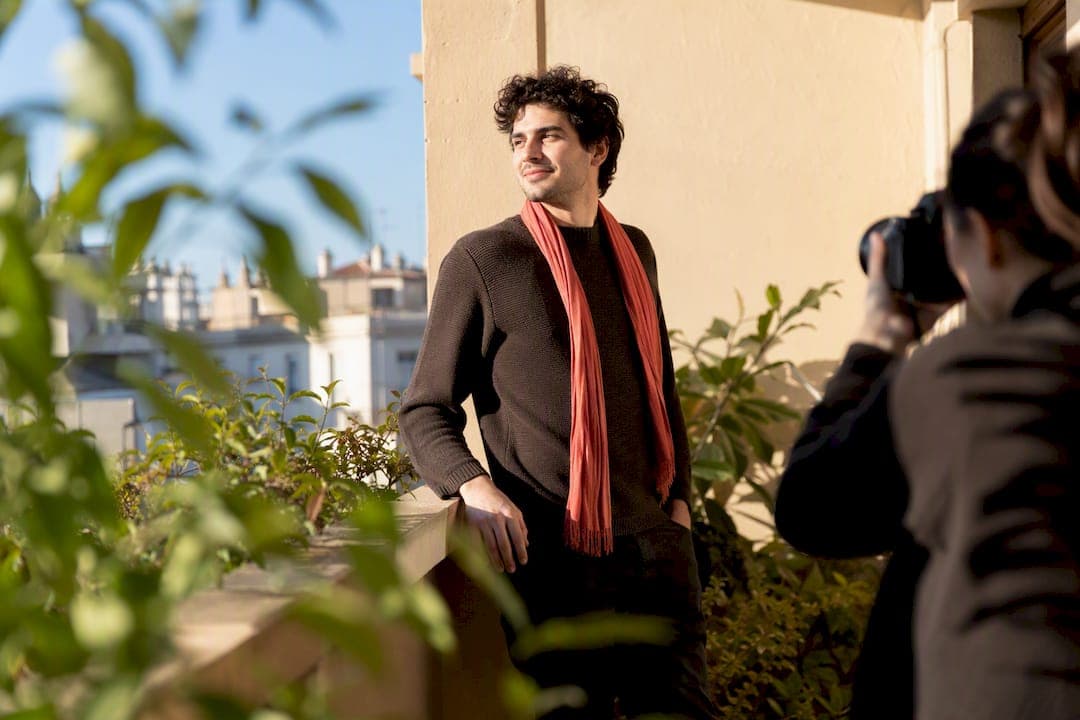
Your photos do most of the heavy lifting on Tinder. Your first photo alone determines whether someone taps into your profile at all, so that's the fix to make first. Your bio matters too, but only for the smaller group who already tapped through, which makes it the second job, not the first.
TL;DR:
- Your lead photo's quality, lighting, and facial visibility are the most critical factors for increasing swipe taps and initial interest.
- A lineup of six varied photos, with strong portraits first and lifestyle shots later, outperforms profiles with fewer or repetitive images.
- Fix your main photo before adjusting your bio, and test one change at a time over a week to identify what truly improves your match rate.
- Short, specific bios that convey intent or include an engaging hook are more effective than long or generic descriptions.
- Using AI photo analysis tools can quickly identify which images hurt your visibility, especially if you're unsure which photo is most effective.
Table of Contents
- Photos vs bio on Tinder: why your first photo decides everything
- What your bio actually does (and why it's the second job, not the first)
- How to prioritise: photos first, bio first, or both?
- Your photo optimisation checklist: what to fix first
- Bio templates and hooks that actually get replies
- Testing your changes: Smart Photos, simple A/Bs, and AI tools
- How DoubleMyMatches's photo analysis fits into testing
- A blunt take from the team at DoubleMyMatches
- Want a faster answer than a week of testing?
- Sources
- FAQ
Photos vs bio on Tinder: why your first photo decides everything
Here's the part that trips people up: your bio doesn't even enter the picture for most swipers. Someone scrolling through the stack sees your lead photo, decides in a fraction of a second, and either taps through or swipes on. If the first photo fails that instant test, nobody sees your bio at all, however well you've written it.
That's why photographer guides and dating app analysts keep landing on the same conclusion: photos get you seen, bios convert the people who already stopped scrolling. Think of it like a shop window. If the display is dull, nobody walks in to check the prices. Your lead photo is the window. Everything else, including your bio, is what's inside the shop.
Statistic to know: profiles built around a full six-image lineup, mixing a clear head-and-shoulders portrait with varied lifestyle shots, consistently pull more matches than sparse two or three photo profiles. Skipping slots isn't neutral. It's a cost.
What photographers actually tell daters to do
Professional photographers who work with dating app clients repeat a short list of rules, and they're worth taking seriously because they're based on how people actually judge faces in under a second:
- Use natural, even lighting on your face. Harsh overhead light or a dim bar photo hides your features and reads as low effort.
- Smile genuinely in your first photo. Photographer advice consistently finds that a real smile beats a stoic or "mysterious" expression for tap-through.
- Shoot at eye level or slightly above. Camera angles from below distort your face and rarely flatter anyone.
- Keep the background simple. Cluttered rooms or busy street scenes pull attention away from you.
- Crop tight enough that your face is clearly the subject, not a detail in a wider scene.
The slot strategy: what goes where
Your six photo slots aren't interchangeable. The first three do the acquisition work; slots four to six add depth once someone's already interested.
Photos one to three should show your face clearly, in good light, ideally in at least two different settings so it's obviously you and not a single lucky shot. Photos four to six can show a hobby, a full-body shot, or a social scene, giving a fuller picture of your life without competing with the lead image for attention.
Variety matters more than most people think. A profile that's six selfies from the same evening tells a swiper nothing new after the first one. A profile that mixes a portrait, an outdoor shot, and a candid moment with friends gives repeated small reasons to keep looking, and each reason nudges someone closer to a match.
Common photo mistakes that cost you matches
A handful of errors show up again and again, and they're avoidable without any special equipment:
- Mirror selfies. They almost always include phone glare, bathroom clutter, or an awkward pose that undercuts confidence.
- Group photos as the lead image. Swipers shouldn't have to guess which person is you, and many won't bother trying.
- Sunglasses or hats covering your eyes. Faces read as more trustworthy and more attractive when the eyes are visible, so hiding them in your main photo is a self-inflicted handicap.
- Heavy filters or over-editing. They tend to look artificial rather than flattering, and they can create a mismatch when you meet in person.
- Outdated photos. Anything older than six months or taken before a significant appearance change reduces trust once conversations move toward meeting up.
Pro Tip: If you're not sure which of your photos is strongest, don't guess. Swap your current lead photo for your best candidate, leave everything else untouched for a week, and compare the change in taps. That single-variable test tells you more than any amount of overthinking.
What your bio actually does (and why it's the second job, not the first)
A bio's job is conversion, not acquisition. Photos get someone to tap through; the bio decides whether that interest turns into a match and, eventually, a message. Having any bio at all beats having none, even a short one, but fewer people read it than look at your photos, so its ceiling is lower.
Treat your bio the way you'd treat seasoning on a dish. It can make a good meal better, but it can't rescue a bad one, and too much of it ruins the whole thing.
How long should a Tinder bio be?
Shorter tends to win. Some profile-data analyses report that bios under roughly 50 characters for men correlate with higher match rates than longer ones, and Tinder's own marketing has pointed to bios in the 15 to 45 word range as effective. The pattern holds across most of the advice out there: a punchy line beats a paragraph almost every time.
That doesn't mean every bio has to be a one-liner. It means every word has to earn its place. A bio does three jobs when it's written well:
- It weeds out mismatches. A line about wanting something serious, or specifically casual, saves both of you time.
- It gives someone an easy opening line. A hook about a niche hobby, a strong opinion, or a specific detail is far easier to reply to than "hey".
- It signals intent without over-explaining. One clear sentence about what you're looking for reads as confident. Three paragraphs read as anxious.
Bio mistakes that quietly kill your match rate
Some habits show up constantly and do more harm than the person writing them realises:
- Rambling life stories. Nobody's reading a full biography before deciding whether to message you. Cut it to the sharpest details.
- Negative or defensive language. Lines like "no drama please" or a list of dealbreakers read as guarded rather than confident, even when the intent is reasonable.
- Recycled clichés. "Looking for my partner in crime" and "6ft required, don't @ me" have been written thousands of times. They tell a reader nothing about you specifically.
- Listing without personality. A string of hobbies with no voice behind them ("gym, travel, food, dogs") reads like a form field, not a person.
Pro Tip: Read your bio out loud. If it sounds like something you'd actually say to a friend, keep it. If it sounds like a dating profile template, rewrite it until it sounds like you.
How to prioritise: photos first, bio first, or both?
Run a quick self-audit before touching anything. The fix that actually moves your numbers depends on where the breakdown is happening, and the diagnosis takes about a week.
- Weak lead photo, low taps overall. If your current main photo is dark, blurry, a group shot, or more than six months old, start there. This is the highest-leverage fix available and usually the fastest to see results from.
- Decent photos, but matches don't turn into conversations. If people are matching but conversations die immediately or you're not getting matches despite reasonable tap-through, your bio is likely the bottleneck. Rewrite it short and specific rather than adding more photos.
- Low tap-through and low conversation rate together. Test both, but change one variable at a time. Swap the lead photo first and hold the bio constant for a week, then adjust the bio while holding photos constant. Mixing both changes at once tells you nothing about which one worked.
The measurement itself is simple: keep everything else fixed, change one thing, and track taps or matches over a set window, ideally seven days, before drawing any conclusion.
Cost and time trade-offs are worth being honest about too. A DIY photo reshoot with a friend and decent daylight costs nothing but an afternoon. A professional dating photo session runs into real money and isn't necessary for most people. Rewriting a bio costs fifteen minutes. Paid app boosts cost money every time and do nothing to fix a weak lead photo, so they're the wrong first purchase for someone whose real problem is photo quality.
Your photo optimisation checklist: what to fix first
Work through this in order. Each step builds on the last, and none of it requires special gear.
- Pick your location before you pick your outfit. Natural daylight near a window, or outdoors in soft morning or late afternoon light, beats almost any indoor setup with artificial lighting.
- Get the camera to eye level or slightly above. Ask a friend to hold the phone rather than shooting a selfie at arm's length, which distorts proportions.
- Face the light, not away from it. Standing with your back to a window silhouettes your face and hides exactly the detail you're trying to show.
- Practise a real smile before you shoot. A relaxed, genuine expression photographs better than a posed smirk. Talk to whoever's holding the camera between shots so your face isn't frozen.
- Check the background for clutter. A plain wall, a park, or a clean street scene keeps the focus on you rather than competing detail.
- Choose your six photos by slot, not by favourite. Lead with your strongest clear portrait, then vary the rest across a mix of settings.
For that six-photo lineup, aim for something like this:
- Slot 1: Lead portrait. Clear face, good light, genuine smile, no sunglasses or hats.
- Slot 2: Full body shot. Shows your build and how you dress, answering a question every swiper has.
- Slot 3: Hobby or activity shot. Climbing, cooking, playing an instrument, anything that gives a real conversation hook.
- Slot 4: Social context. A photo with friends, cropped or captioned clearly enough that it's obvious which person you are.
- Slot 5: Travel or environment shot. A holiday or outdoor scene that adds a bit of story without becoming the whole profile.
- Slot 6: Candid moment. A natural, unposed shot, often the one that humanises the rest of the lineup.
If you've been putting off a proper reshoot, a step-by-step dating photo selection process is worth working through slot by slot rather than trying to pick six good photos at random from your camera roll.
Pro Tip: Refresh your lineup every two to three months, or immediately after any noticeable change in hairstyle, weight, or facial hair. A profile that no longer looks like you costs matches once people meet you, even if it was winning matches before.
Signs it's worth investing more time or money: you've swapped your lead photo repeatedly with no change in taps, your best guesses at "good photos" all look similar to each other, or you genuinely can't tell which of your existing shots is strongest. That's the point where a second opinion, whether from a friend with a good eye or a dedicated photo review tool, starts to pay for itself in saved guesswork.
Bio templates and hooks that actually get replies
A good bio doesn't need to be clever. It needs to be specific enough that someone can reply to it without effort. Three formats cover most of what works.
- Witty hook plus one real interest. Something like "Will beat you at pool. Won't admit it gracefully." gives a personality signal and an easy opener in one line.
- Direct intent plus specificity. "New to the city, always up for trying the restaurant everyone's talking about" tells someone exactly what you're looking for and gives them something concrete to suggest.
- Playful prompt inviting a reply. A line that ends in an implicit question, like "Convince me pineapple belongs on pizza", almost writes the opening message for the other person.
Tinder's own prompt features work the same way. Answering a prompt with a specific, slightly odd detail, rather than a safe generic answer, gives people far more to react to than a blank field ever will.
Testing your bio like you'd test a photo
Change one line, leave everything else the same, and track your match-to-message ratio over a week rather than a single day, since daily swipe volume varies too much to draw conclusions from. If your matches per view stay flat but the conversations that follow get longer or start faster, that's a sign the new bio is converting better even if the headline match number hasn't moved yet. Judge a winner by messages per match, not matches alone. A bio that pulls in a few extra matches but produces no conversations isn't actually working.
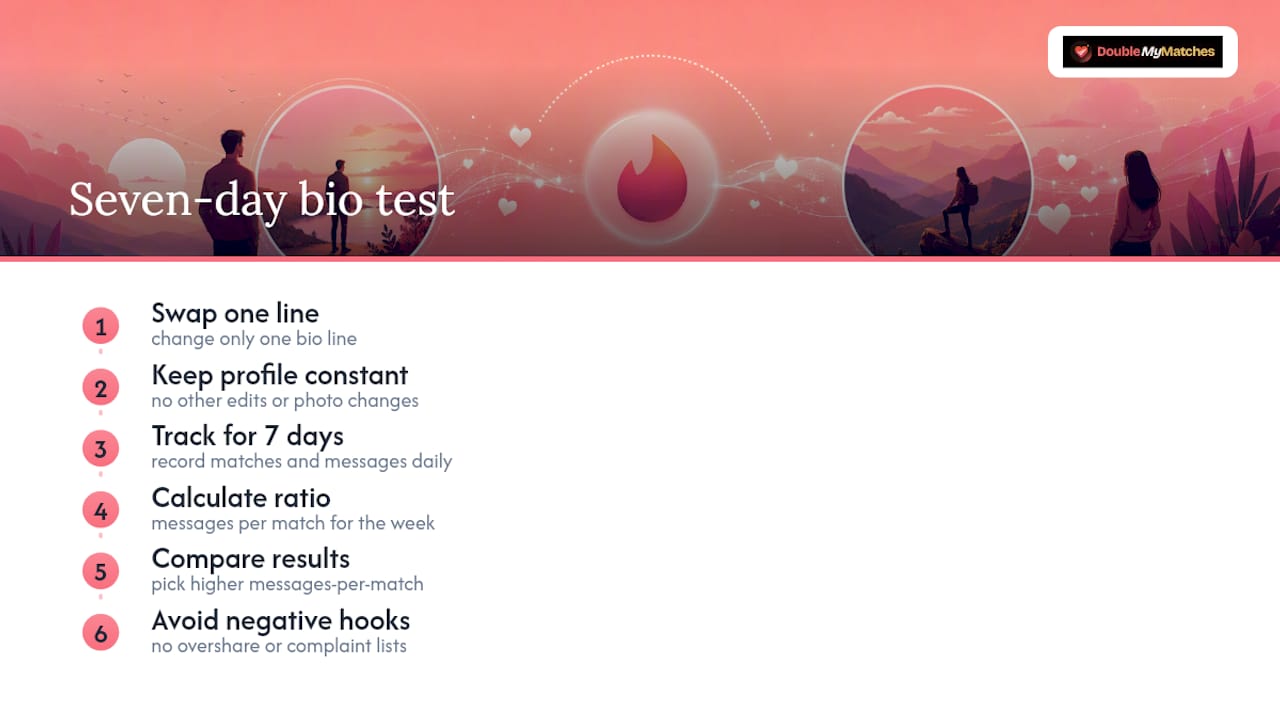
A caveat worth repeating: don't over-share, and don't lean on negative or weed-out language as your entire hook. A line like "not here for hookups, no time-wasters, must love dogs" reads as a list of complaints rather than an invitation, and it tends to depress replies even from people who'd otherwise be a good match.
Testing your changes: Smart Photos, simple A/Bs, and AI tools
Tinder's built-in Smart Photos feature automatically tests which of your uploaded photos performs best and reorders your lineup accordingly, based on real swipe data rather than your own guess. It's a low-effort first step, though it only works with the photos you've already uploaded, so it can't fix a lineup that's weak across the board.
Running your own test is straightforward if you keep it disciplined:
- Change one variable at a time. Either the lead photo or the bio, never both in the same window, or you won't know which change caused the result.
- Measure over a fixed period, ideally seven days, to smooth out normal day-to-day swipe fluctuations.
- Track taps per view, matches per 100 views, and messages per match rather than raw match count alone, since raw counts swing with how many people happen to be active that week.
- Give it enough volume before concluding anything. A handful of swipes on a slow day isn't a real sample.
Statistic to know: enabling Smart Photos and running structured, one-variable-at-a-time tests is the approach analysts recommend for isolating what's actually driving your match rate, rather than changing everything at once and guessing at the cause.
If you use any external AI photo or profile service, ask two questions before uploading anything: how long the service keeps your photos, and whether they're ever used to train the company's own models. A partner analysis of identity verification in AI-driven apps makes a similar point about presentation tools more broadly. What a vendor does with your data after the analysis matters just as much as what the analysis tells you.
How DoubleMyMatches's photo analysis fits into testing
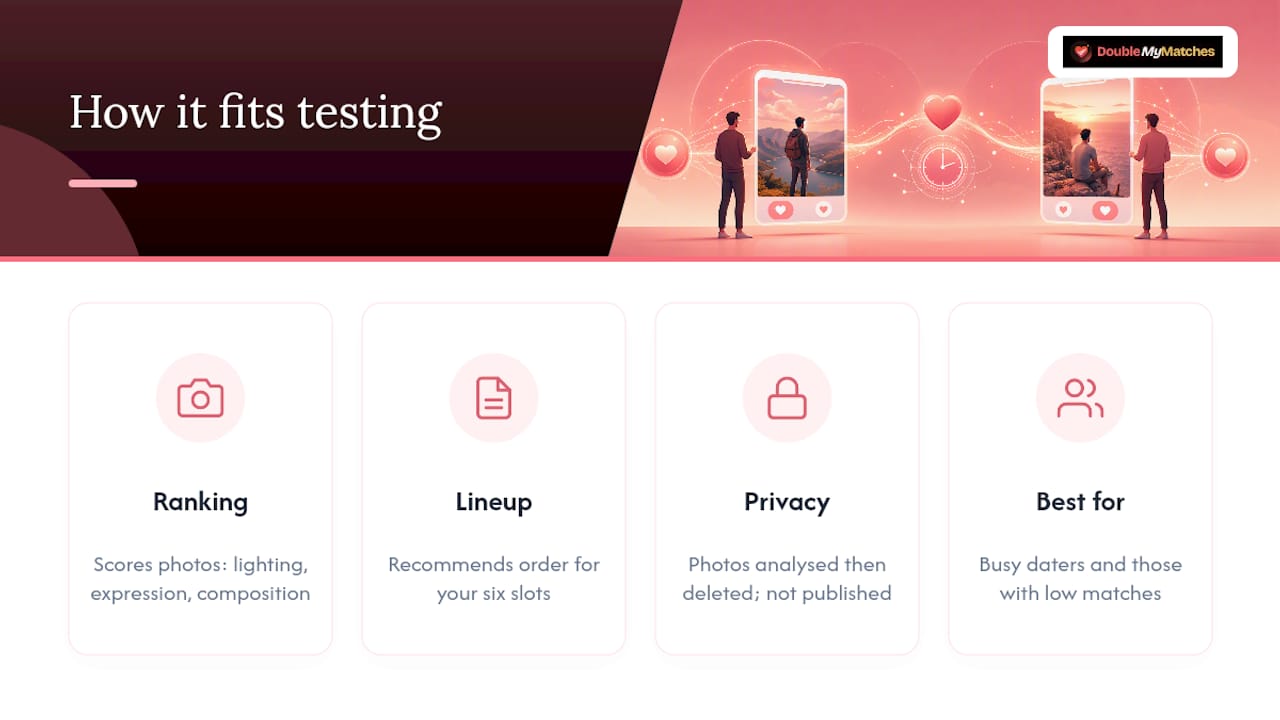
If you want a faster read on which of your photos is actually your strongest, an AI photo analysis tool can shortcut a lot of the trial and error. DoubleMyMatches ranks your uploaded photos from best to worst, scoring each one on lighting, expression, and composition, then gives you a recommended lineup order along with specific feedback on why a photo is helping or hurting you.
It's built specifically for the diagnosis this article walks through: which photo should lead, which ones are quietly costing you matches, and how your six slots should be arranged. That's useful precisely because it's hard to judge your own face objectively.
Privacy is handled the way it should be for anything this personal. Photos are analysed and then discarded. They're never published, and they're never used to train the underlying AI.
This tends to help two kinds of daters most: people too busy to run week-long manual tests on their own lineup, and people who feel like their photos are "fine" but keep getting fewer matches than expected without knowing why. If that's you, a free single-photo evaluation through the AI Tinder profile review is a reasonable place to start before committing to a full report.
A blunt take from the team at DoubleMyMatches
The most common mistake we see isn't a bad bio. It's a lead photo the person genuinely can't judge objectively anymore, because they've looked at it too many times to see it the way a stranger does. That's not a character flaw. It's just how familiarity works, and it's exactly why a second opinion, whether from a friend or a tool built for this, tends to catch things self-review misses.
Two things we'd tell any client before anything else: fix your lead photo before you touch a single word of your bio, and never change more than one thing between tests. Everything else is refinement.
Don't chase a formula that supposedly works for everyone. Test what actually works for your own profile, stay recognisably yourself in every photo, and let the results tell you what to change next.
— The Team @ DoubleMyMatches
Want a faster answer than a week of testing?
Running your own week-long A/B test works, but it takes patience, and most people would rather know today which photo is holding them back. That's the gap DoubleMyMatches closes. Upload your photos and get an instant ranking, best to worst, with specific feedback on why each one is helping or hurting your match rate.
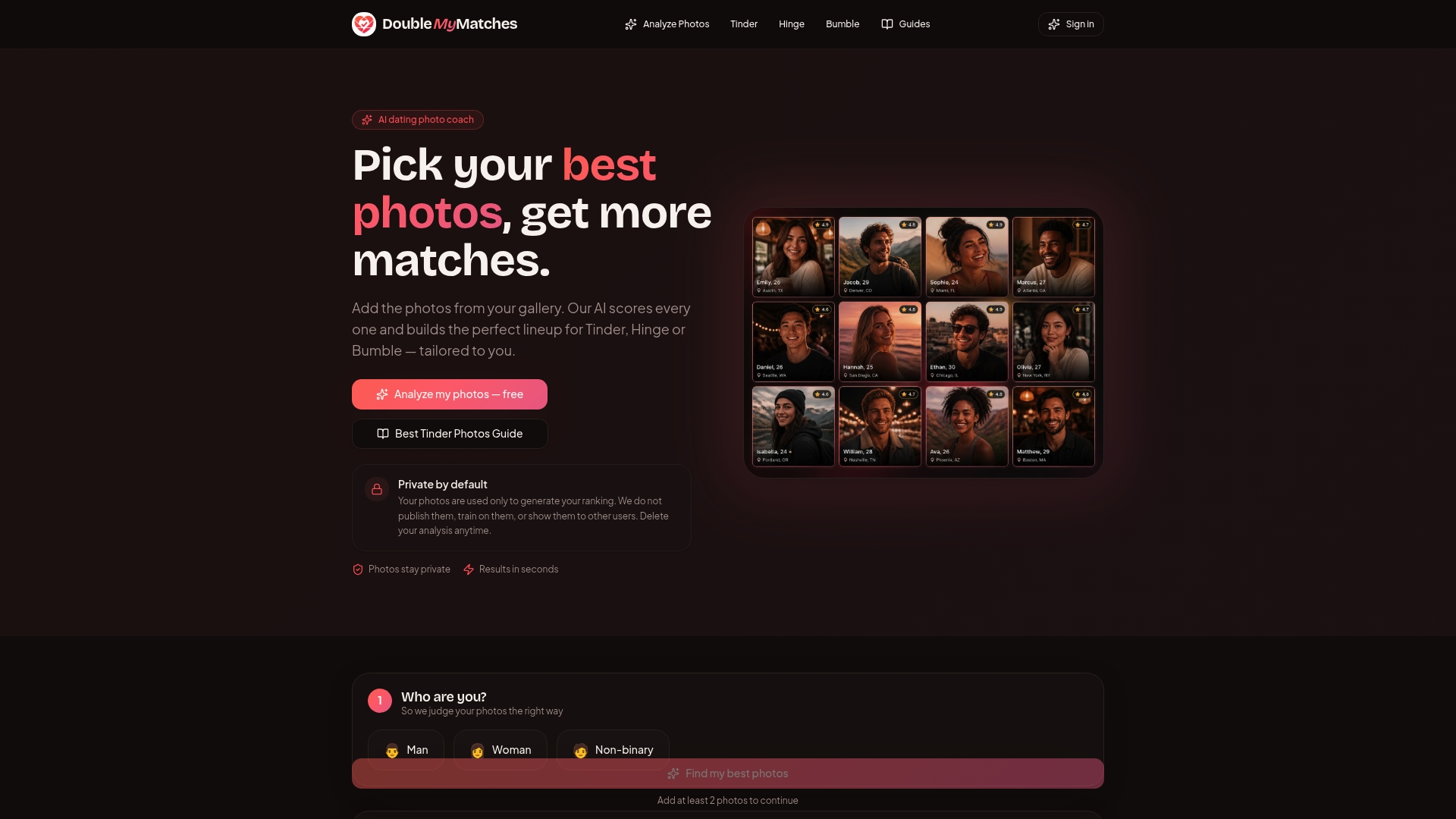
The report is a one-time purchase, not a subscription, and it's built around a simple idea: you shouldn't have to guess which photo is quietly costing you matches. It's most useful once you've already run through the checklist in this article and want a second, unbiased opinion on the results, or if you'd rather skip straight to a ranked lineup instead of manually swapping photos over several weeks.
Curious how it stacks up against other photo-scoring tools you might have seen? Read the comparison of Photofeeler-style scoring against AI photo analysis before you decide. If you're ready to see where your current lineup actually stands, start with the AI dating photo analyser and get your ranked results in minutes.
Sources
- How to take a good dating app photo, according to dating app experts | British GQ
- Tinder Profile Optimization: The Scientific Approach to More Matches | Magnt
- Best Tinder Profile Photos: A Photographer's Guide to More Matches | Photography Shark Studios
- Tinder Profile Examples That Get Matches (2026) | SwipeStats
FAQ
Is it true that most Tinder users are men?
Tinder doesn't publish a precise, verified gender breakdown, and figures circulating online vary widely by source and region, so treat any specific percentage with caution. What's better documented is that photo quality matters more for standing out precisely because competition for attention on the app is high.
Should I put a bio on Tinder?
Yes. Having any bio increases your matches compared with leaving it blank, even though fewer people read it than look at your photos. Keep it short and specific rather than skipping it entirely.
What type of picture is best for a Tinder profile?
A clear head-and-shoulders shot with natural lighting, a genuine smile, and an uncluttered background performs best as your lead photo. Photographer guidance consistently points to this format over group shots, mirror selfies, or heavily filtered images.
Do guys put shirtless photos on Tinder?
Some do, but it's not a reliable strategy for most profiles, since it tends to read as trying too hard rather than confident unless it fits a genuine context, like a beach or gym photo further down your lineup rather than the lead slot. A clear, well-lit face in your first photo consistently outperforms body-focused shots as the lead image.
How do I know if it's my photos or my bio holding me back?
Run a one-week test: swap only your lead photo and hold your bio constant, then track taps and matches. If your tap-through improves but matches don't convert to conversations, the bio is your next fix; tools like DoubleMyMatches can speed up the photo half of that diagnosis with a ranked, per-photo breakdown.