
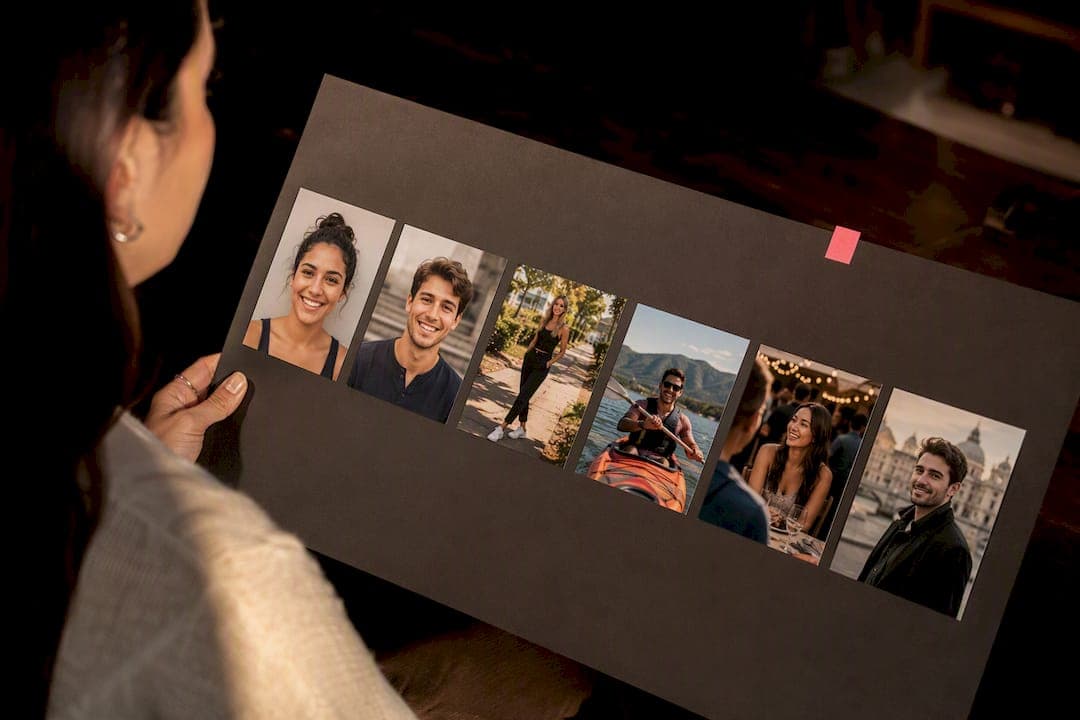
Lead with your best headshot. Genuine smile, good light, nothing else in the frame competing for attention. Then build a six-photo lineup around it using AI ranking to spot your top candidates instead of guessing, and pair that headshot with one honest candid shot to prove the smile is real. Test it privately before you commit.
TL;DR:
- Use a well-lit, front-facing headshot with a natural expression as your lead photo, as attractiveness significantly impacts success, outperforming intelligence by a wide margin.
- Incorporate a diverse lineup of photos including candid, full-body, social, and hobby shots, with consistent lighting and varied settings to build trust and showcase different aspects of your personality.
- Avoid heavy filters, outdated images, blurry group shots, or photos that don't resemble your current appearance to maintain honesty and approachability.
- Test your photo lineup privately with AI ranking tools to identify your most effective images and optimize their order before public posting.
- Focus on fixing common issues like background clutter, mismatched expressions, and shadowed shots, as small adjustments can dramatically improve match quality.
Table of Contents
- How should you order your dating photos?
- What do AI ranking systems actually measure?
- Why a mix of polished and candid photos works better
- What mistakes are quietly killing your swipe rate?
- How do you test your photo lineup privately before posting?
- What patterns actually predict better matches?
- Get a private, ranked photo lineup in minutes
- Sources
How should you order your dating photos?
Your first photo carries most of the weight, so put your strongest headshot there. Clarity matters more than styling: a well-lit, front-facing shot with a natural expression consistently outperforms anything moody, distant, or filtered. Attractiveness is genuinely the biggest lever you have. A one standard deviation improvement in perceived physical attractiveness increases selection success by around 20%, against roughly 2% for the same jump in perceived intelligence. Your lead photo is where that lever gets pulled.
From there, the rest of the lineup should work like a conversation building up trust rather than repeating the same pitch six times.
- Position 1: your best headshot. High clarity, natural light (ideally daylight, not a dim bar), and an expression that looks like you, not a passport photo.
- Position 2: a candid or activity shot. Caught mid-laugh, mid-hike, mid-something. This is where personality lands.
- Position 3: a full-length shot. Shows body shape and personal style without it dominating the whole set.
- Position 4: a social photo. With friends, at an event, somewhere you look at ease with other people.
- Position 5: a travel or hobby shot. Gives someone a reason to message you about something specific.
- Position 6: one more personality shot. Pet, hobby, or a setting that rounds out who you are.
A few rules keep this template from falling apart. Vary the setting across all six. Keep the lighting consistent enough that you look like the same person throughout. And never duplicate a pose or angle. Two gym mirror selfies back to back tells a viewer you only have one good photo, not six.
What do AI ranking systems actually measure?
AI photo ranking isn't guesswork dressed up in a score. It looks at specific, learnable features, and understanding them turns a mystery number into something you can act on.
- Lighting. Natural, frontal or three-quarter window light reads as trustworthy and clear. Backlit or dim shots hide your face and score lower almost every time.
- Expression. Genuine micro-expressions and real eye engagement outperform a posed grin. Viewers pick up on the difference even if they can't name why.
- Composition. Rule-of-thirds framing, a sensible head-to-frame ratio, and an uncluttered background all help the viewer focus on you instead of decoding the scene.
- Context. Props that hint at a story, a pet, a visible hobby, all give someone a reason to swipe or message.
Most ranking systems, including the one behind how Tinder uses AI to rank profile photos, don't score photos in isolation. They run pairwise comparisons, pitting one photo against another and tracking which wins more often. That relative approach tends to be more reliable than a single absolute score, because it mirrors exactly what a swiper does: compares your photos to each other in half a second, then moves on.
If you're short on time, put it into photos, not bio edits.
Why a mix of polished and candid photos works better
A profile made entirely of studio-quality shots can feel manufactured. One made entirely of blurry candids can feel careless. The sweet spot is a blend: two headshots, one full-body shot, one candid or activity photo, one social shot, and one travel or event photo.
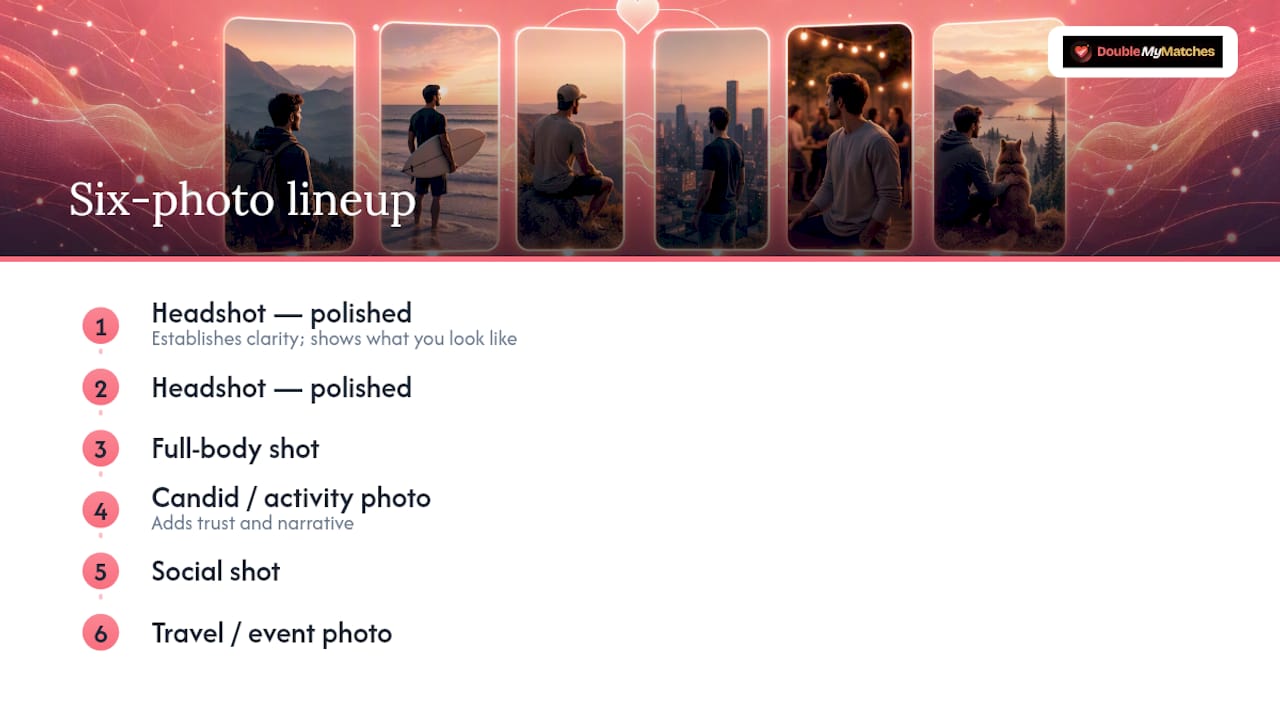
This mix works because each type does a different job. Polished photos establish clarity, so a viewer knows exactly what you look like. Candid shots add trust and narrative, the kind of detail that makes someone believe the profile is a real person rather than a highlight reel. Research on profile richness backs this up: multi-photo and higher-richness profiles tend to produce stronger dating intentions than single, uniform images.
One caution worth flagging: the same research found beautification effects were larger for female profiles than male ones in controlled tests. Editing dating photos for polish isn't wrong, but heavy-handed retouching can shift how a profile is perceived in ways that aren't always flattering. Light, careful edits beat aggressive ones.
Pro Tip: Before uploading, ask yourself if a friend would recognise you instantly from each photo. If the answer's no, that photo probably isn't earning its slot.
What mistakes are quietly killing your swipe rate?
Most weak profiles aren't ugly, they're just making the same avoidable errors.
- Heavy filters and over-retouching. Skin-smoothing filters and obvious editing make a photo look less real, and "less real" reads as less trustworthy to most viewers.
- Blurry, dark, or confusing group shots. If someone has to guess which person in the photo is you, that photo is working against you. Crop tightly or cut it entirely.
- Misleading or heavily outdated photos. A photo that doesn't match how you currently look sets up a mismatch the moment you meet, and it damages the quality of the conversation before it starts.
- Ex-partners or heavy drinking contexts. Anything that raises questions instead of answering them (who's that? is that a regular Tuesday?) chips away at approachability.
Fix these first. They cost you nothing but a few minutes of sorting through your camera roll.
How do you test your photo lineup privately before posting?
Guessing wastes matches. Testing doesn't take long.
- Gather 8 to 15 candidate photos. Mix lighting, locations, and outfits so you're not comparing near-duplicates.
- Run a private AI ranking. Pairwise comparisons will surface your strongest six far faster than eyeballing a camera roll.
- Build two or three alternative lineups. Swap the order or swap out borderline photos, then get a second opinion from someone you trust.
- Track results for one to two weeks, then adjust. Early match rate tells you fast whether the lineup is working.
Use a service that discards your images after analysis rather than storing or training on them. Pro Tip: Run the test before a weekend, when swipe volume is highest, so you get a real read on performance within days, not weeks.
What patterns actually predict better matches?
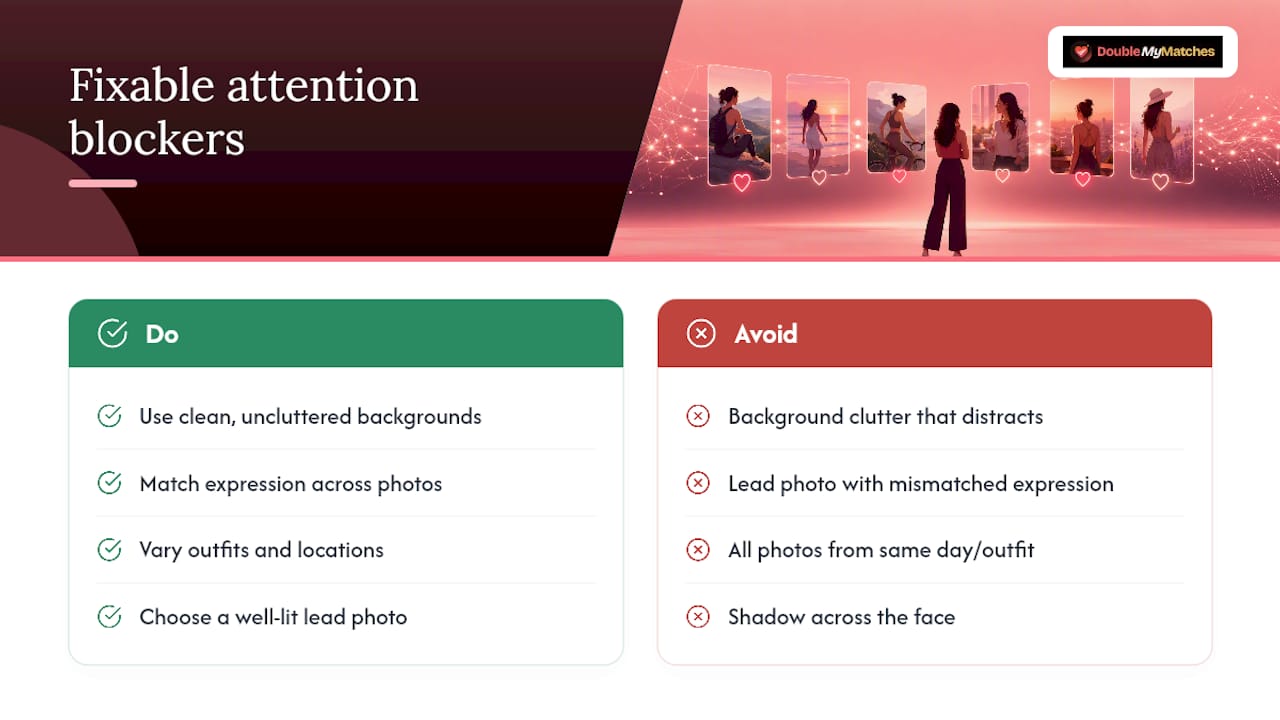
After reviewing enough profiles, certain problems show up again and again: background clutter that pulls focus off the face, an expression in photo one that doesn't match the tone of the rest of the set, or a lineup where every photo was taken on the same day in the same outfit. We call these attention blockers, and they're usually fixable in minutes once you know to look for them.
One anonymised case stuck with the team: a profile ranked in the bottom third of its own six photos for the lead spot, purely because of shadow across half the face. Reordering to a better-lit shot from the same day, taken seconds apart, was the only change made. Nothing else in the lineup moved. Every photo submitted for analysis is discarded afterwards, never stored, never used to train anything.
— The Team @ DoubleMyMatches
Get a private, ranked photo lineup in minutes
Sorting your camera roll by eye only gets you so far. You can't unsee your own face the way a stranger swiping in half a second does, which is exactly the gap DoubleMyMatches is built to close: private AI analysis that ranks your photos, flags the ones quietly working against you, and hands you a ready-made lineup in the order that performs best.
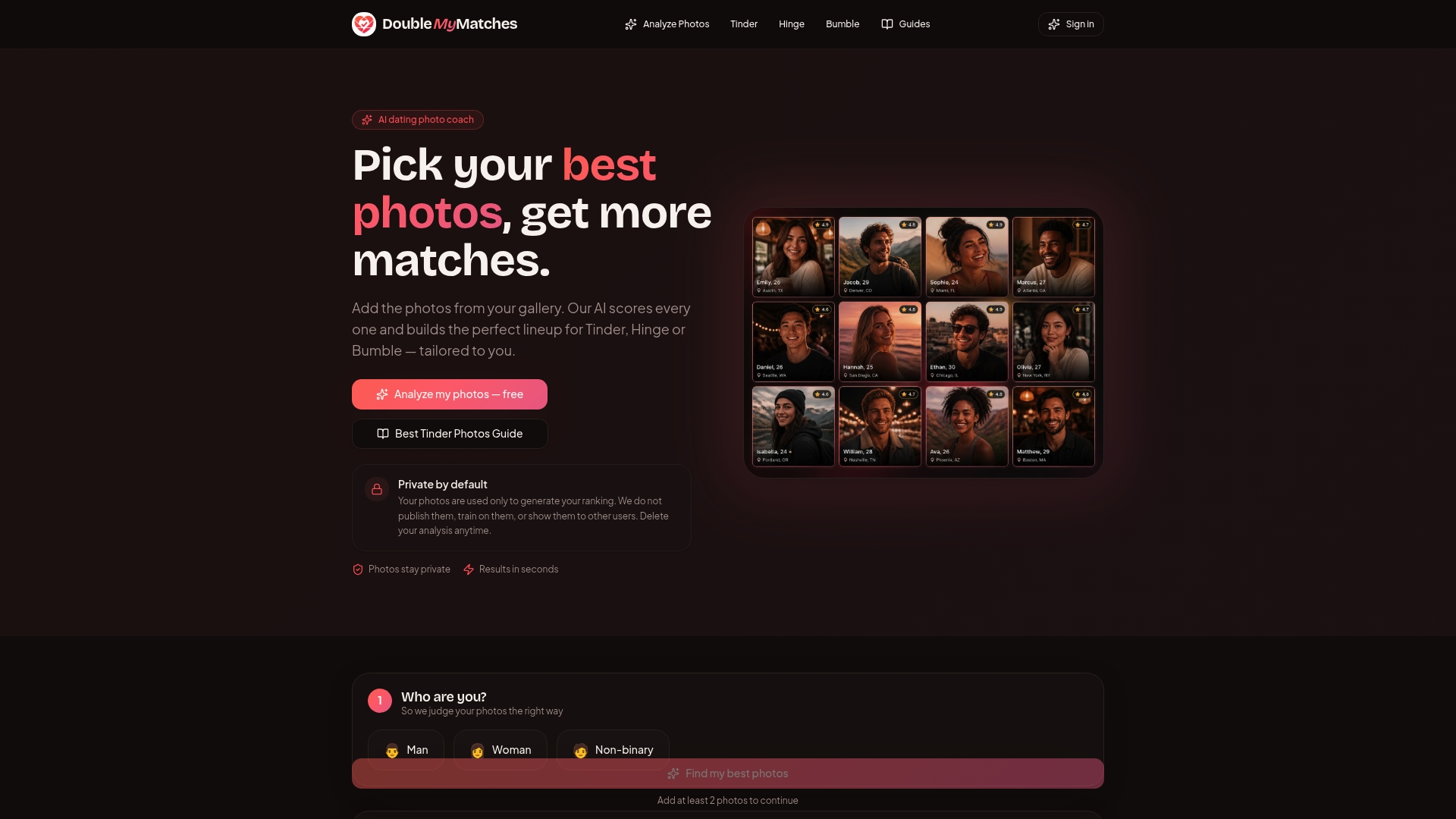
It's built for anyone who's tired of guessing which photo to lead with, whether you've got six decent options or sixteen and can't decide. You upload your photos, get an instant ranked order plus notes on why each one scored the way it did, and every image is discarded after analysis. One purchase, one clear answer.
If you want to see where your current photos actually stand before changing anything, start with the profile picture tester and get your ranked lineup today.
Sources
- Physical attractiveness far outweighs other traits in online dating success
- The impacts of media richness, blurriness, and beautification of online dating profile visual elements on dating outcomes
- Life at Tinder | How Tinder® uses AI to rank profile photos