

Per-photo feedback gives every image on your profile its own score for approachability, attractiveness, and quality, plus a short note explaining why. Test your current set tonight, promote the highest-scoring photo to lead position, and cut whatever scores lowest before you add anything new. That single swap is often the fastest way to see more matches this week.
TL;DR:
- Using per-photo feedback can help identify and swap out low-scoring images to improve your profile’s overall appeal and increase match rates.
- Photos should be recent, well-lit using natural light, and show your face clearly without coverings for optimal approachability and attractiveness scores.
- Focus on distinct signals in your profile, including a clear headshot, full-body shot, activity photo, social proof image, and one that sparks conversation.
- Avoid adding more than five photos, as excess images tend to dilute profile quality and reduce engagement, with a preferential emphasis on genuine context over posed expressions.
- Trust scores only after at least 30 ratings per photo, and prioritize images that show natural expression and authentic context to create a trustworthy profile.
Table of Contents
- How does per-photo feedback dating actually work?
- What do approachability and attractiveness scores actually mean?
- How do you use per-photo scores to build your five-photo set?
- What makes a dating photo score well?
- Should you smile or look serious in your lead photo?
- What's the fastest way to run a per-photo test tonight?
- Why trust this per-photo feedback approach?
- The gap between a perfect score and an actual date
- Get your own per-photo scores in minutes
- Sources
- FAQ
How does per-photo feedback dating actually work?
Most photo testing tools ask you to upload four to six images at once, ideally the exact set you're considering for your profile rather than every holiday snap you own. You'll usually be asked your gender and the audience you're dating, so results reflect the people who'll actually swipe on you.
From there, two rating styles dominate:
- AI raters score lighting, expression, and composition in seconds, spotting patterns like harsh shadows or an awkward crop.
- Human raters add nuance an algorithm misses, such as whether an outfit reads as try hard or whether a background feels staged.
Scores are typically normalised, adjusted so one harsh rater doesn't tank your results, which is also why you'll often see breakdowns by age group or gender. On privacy, reputable tools test your photos anonymously and never post them publicly. Several services advertise a strict discard policy, processing your images once and deleting them rather than storing or reusing them.
What do approachability and attractiveness scores actually mean?
Each trait score tells you something different about why a photo works or doesn't, and treating them as one blended "good photo" number wastes the most useful part of the feedback.
- Approachability measures how safe and easy to talk to you look. A tense jaw or crossed arms can tank this even in a technically sharp photo.
- Attractiveness and confidence capture posture, eye direction, and overall presence rather than raw looks.
- Quality and lighting cover the technical basics: focus, exposure, and resolution.
- Context and social proof reflect what's happening around you: a dog, a hiking trail, friends in the background.
A photo scoring low on approachability but high on quality usually needs an expression fix, not a re-shoot. Short free-text notes ("harsh overhead lighting", "too far from camera") tell you exactly which lever to pull. Filtering results by your target demographic matters too. A photo that lands well with one age group can score noticeably differently with another.
How do you use per-photo scores to build your five-photo set?
Ranking by score alone is a trap if you skip the written notes. A photo can top the list yet carry a note flagging a distracting background or an outdated look, both worth fixing before you crown it your lead image.
- Sort every photo by its overall score, then read the accompanying notes before deciding anything.
- Check your set against five core signals: a clear headshot, a full-body shot, an activity or hobby photo, a social proof shot with friends or family, and one that hints at a conversation starter.
- Cut your lowest-scoring photo before adding a replacement. Removing a weak image tends to lift a profile's overall performance more than bolting on another strong one, since a single bad photo drags down the whole impression.
- Put your highest-scoring approachable photo first, then order the rest to alternate faces with context, so the profile doesn't read as five near-identical headshots.
Pro Tip: If two photos tie on score, give the lead slot to whichever one shows your face most clearly. Match algorithms and human swipers both reward instant clarity over mood.
Once your five slots are filled, resist the urge to keep testing new candidates every week. Re-test only when you've swapped photos or your appearance has genuinely changed.
What makes a dating photo score well?
Certain fixes reliably move a photo's score, whether the rater is a human panel or an AI model.
- Natural light beats artificial light almost every time. Shoot near a window or outdoors in soft, indirect sun rather than under a ceiling bulb.
- Get close enough that your face reads clearly, even on a small phone screen; distant, blurry faces consistently score lower on approachability.
- Let your expression happen rather than posing for it. A candid laugh mid-conversation usually beats a rehearsed smile.
- Skip sunglasses, hats, or anything covering your eyes in at least your primary photo, since raters can't judge approachability on a face they can't see.
- Keep photos recent. Guides consistently recommend images no older than six to twelve months, since outdated photos erode trust the moment someone meets you in person.
Pro Tip: If a photo scores badly on lighting or crop, retake it. If the note is about your expression or the setting, a fresh shot in the same spot with a different moment usually solves it faster than editing the original.
Should you smile or look serious in your lead photo?
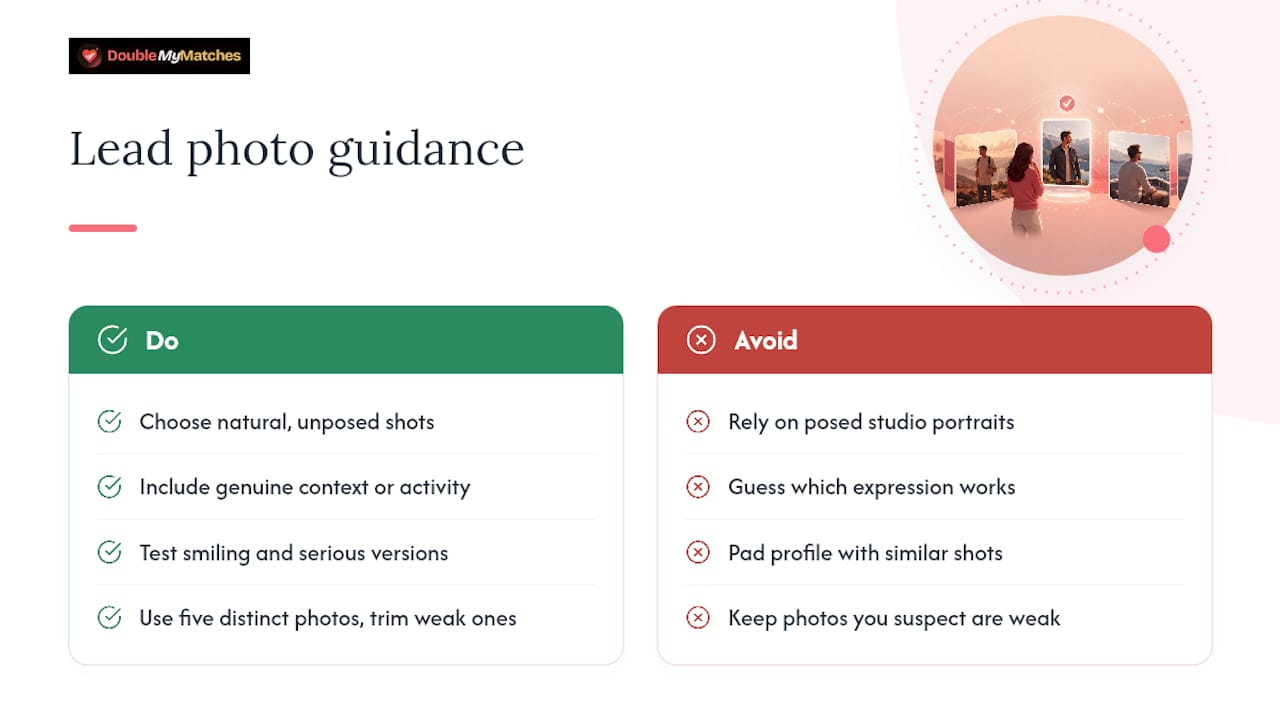
Advice on smiling versus a serious expression is genuinely mixed, and pretending otherwise does readers a disservice. Research from the University of British Columbia found non-smiling, confident expressions sometimes outperform big grins, while broader platform analysis has favoured smiling, relaxed shots; a later Photofeeler replication found the gap between the two was smaller than either camp claims. The consistent thread across the evidence is that natural beats posed, and photos with genuine context, doing something, somewhere, tend to beat static studio-style portraits regardless of expression.
Eye contact follows a similar pattern: looking at the camera reads as confident to some raters and intense to others, so the safer move is testing both versions rather than guessing.
On photo count, the evidence converges more cleanly. A five-photo profile covering distinct signals performs better than a longer set padded with similar shots, largely because of negativity bias: one weak photo pulls the whole impression down further than a strong photo lifts it up. That's the practical case for trimming rather than endlessly adding.
What's the fastest way to run a per-photo test tonight?
You don't need a complicated process to get useful results, just a bit of discipline about what you upload and how you read the output.
- Pick four to six candidate photos and set your target audience (age range, gender) so scores reflect real matches, not generic raters.
- Run the test and wait for enough responses. Aim for at least 30 ratings per photo before trusting a score, since smaller samples swing wildly on a single harsh or kind rater.
- Read scores alongside the written notes, not in isolation, then drop your lowest performer.
- Reorder the surviving photos with your best approachable shot leading, and re-test the new set once you've swapped anything in or out.
Why trust this per-photo feedback approach?
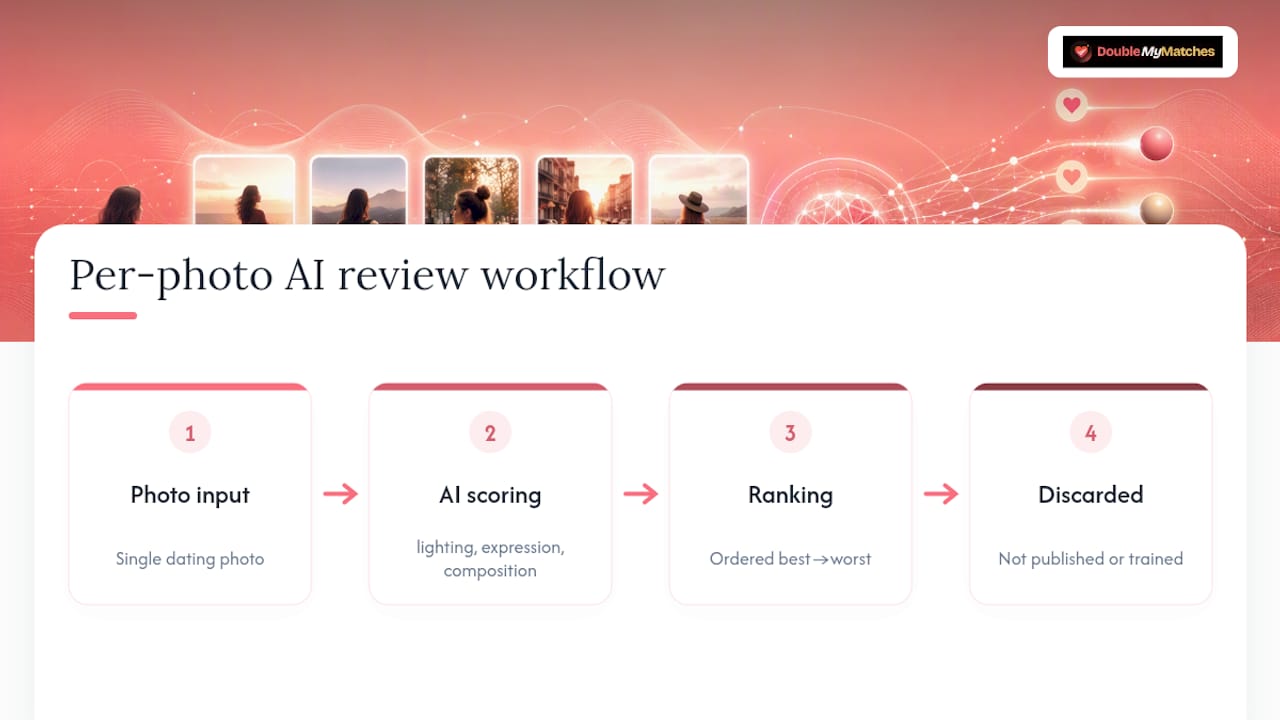
An AI Dating Photo Coach tool scores individual photos for lighting, expression, and composition, then ranks them best to worst for popular dating apps. Analyses typically follow a privacy policy where photos are reviewed once and then discarded, never published or used to train AI.
Photos alone aren't the whole story, though. Daters with thoughtful, longer prompt answers are roughly twice as likely to land a match compared with those relying on photos alone, so pair a stronger photo lineup with a profile that gets real matches rather than treating the two separately.
The gap between a perfect score and an actual date
Per-photo scores are genuinely useful for one thing: getting more people to open your profile and start a conversation. They can't predict chemistry, timing, or whether someone likes your sense of humour once you're actually talking.
We'd rather see you use a 7-out-of-10 photo that looks like you than a heavily edited 9 that doesn't. Scores are a diagnostic tool, not a licence to fake it, and the moment your appearance changes meaningfully, it's worth re-testing rather than clinging to an old lineup that no longer matches reality.
— The Team @ DoubleMyMatches
Get your own per-photo scores in minutes
Reading about scoring criteria is useful, but running your own photos through it is what actually changes your match rate. This service offers a workflow matching this guide: upload candidate photos privately, get instant per-photo scores across lighting, expression, and composition, and receive a ranked lineup indicating the best photo to lead your profile.
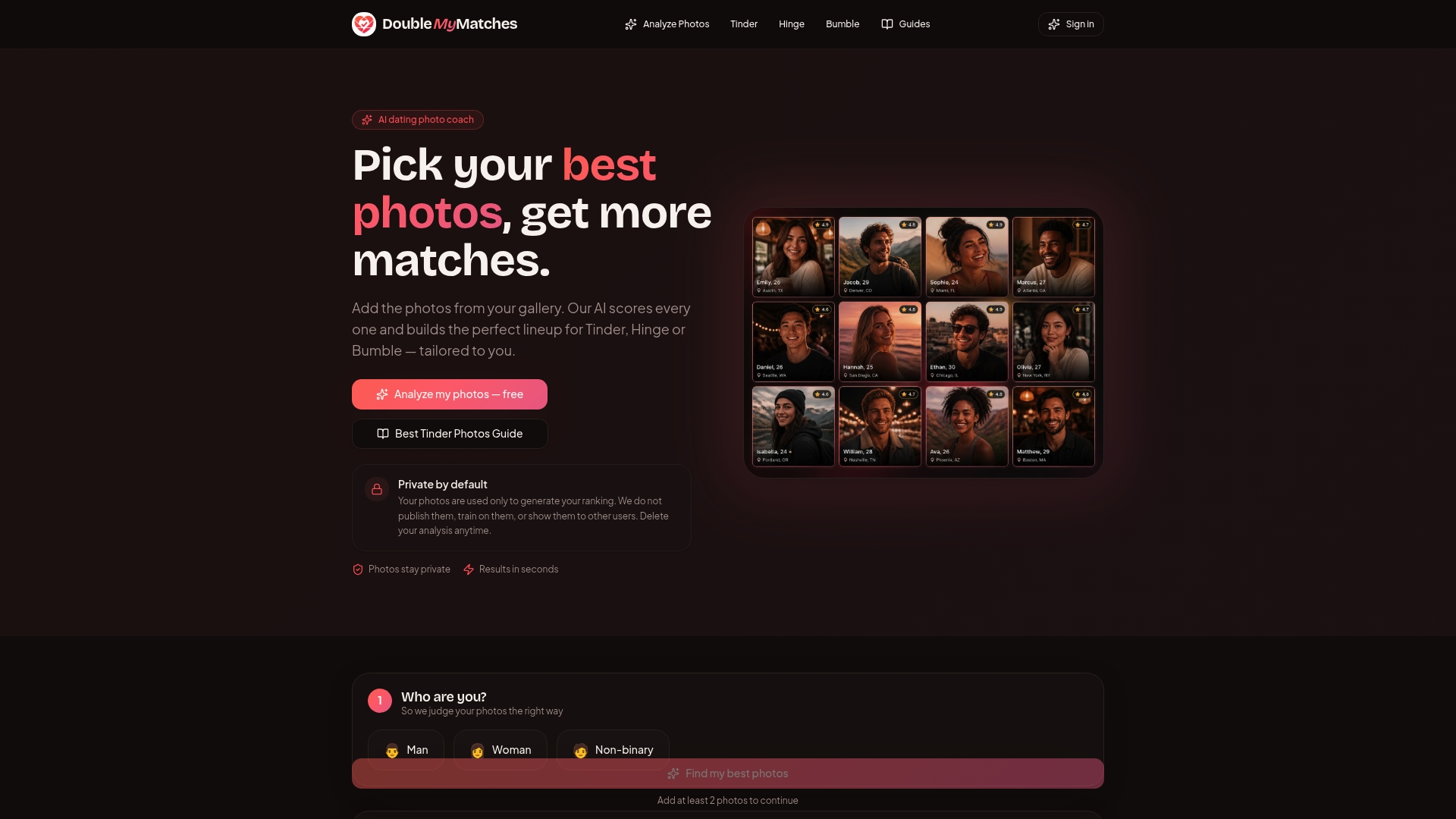
Every report comes with the same discard policy covered above, your photos are analysed once and never published or reused. If you're deciding between tools, our breakdown of Photofeeler versus an AI photo analyser explains the practical differences. When you're ready to see your own scores, start with the dating photo analyser and get your ranked results in minutes. Pair whatever changes you make with sharper prompt answers, the photos open the door, but a decent conversation starter is what keeps someone talking once they've matched.
Sources
This guide draws on published research and testing-service data on photo perception, sample sizes, and profile structure, including Keeper's photo testing methodology, PhotoLike.ai's review of dating photo research, and Tinderprofile.ai's guide to dating app photos. Further detail on pairing photos with stronger prompts comes from British GQ's reporting on dating app photo advice.
FAQ
What is the 3-3-3 rule in dating apps?
There's no single agreed definition of a "3-3-3 rule" in dating app research, so treat any version you see online as informal advice rather than a tested standard. The consistent, evidence-backed rule that does hold up is aiming for around five photos covering distinct signals rather than following a numbered formula.
What does GGG mean in dating?
GGG stands for "good, giving, and game", a phrase describing an open, generous attitude towards a partner, most associated with sex and relationships columnist Dan Savage. It's a personality shorthand, not something a photo score can measure.
Is nine photos too many for a Tinder profile?
Nine photos is more than most testing evidence supports; a tighter set of around five images covering distinct signals tends to outperform a longer, repetitive gallery. Extra photos only help if each one adds new information rather than duplicating an angle you've already shown.
Is Photofeeler a legitimate way to test dating photos?
Photofeeler is a genuine, widely used photo testing platform that collects human ratings on traits like attractiveness and competence. It's one of several legitimate options in the category, alongside AI-based tools like DoubleMyMatches, which prioritises instant scoring and a strict one-time privacy policy over crowd voting.
How many ratings do I need before trusting a photo score?
Aim for at least 30 ratings per photo before treating a score as reliable, since smaller samples can swing heavily based on one or two outlier raters. Normalised scoring, which several testing tools use, helps smooth out unusually harsh or generous individual reviewers.