

Yes, private, one-time deletion is genuinely possible, but only if the service you choose actually commits to it in writing. DoubleMyMatches is built around exactly this promise: your photos are analysed and then discarded, never published, or used to train its AI. Before you upload anywhere, check the privacy policy for an explicit deletion clause, or simply ask support to confirm it in writing.
TL;DR:
- Most privacy-focused services purge uploaded photos within hours or a few days, but longer retention for logs or backups can occur without clear disclosure.
- Verification should include a specific deletion timeframe, confirmation that images are not used for training, and a direct support contact for privacy questions.
- On-device analysis minimizes exposure since images never leave the phone, though cloud processing can be safe if it enforces strict deletion policies.
- Asking providers about their deletion process in writing and testing their responsiveness offers better protection than relying solely on privacy policy claims.
- DoubleMyMatches guarantees photos are analyzed and discarded without being used for training or published, with a straightforward $7 full report option.
Table of Contents
- What "delete photos after analysis" actually means for dating-photo AI
- What happens between upload and deletion
- How do you verify a service actually deletes your photos?
- Safe alternatives when you want zero cloud exposure
- What the Team at DoubleMyMatches wants you to know
- Steps to clear your own devices and caches after using any AI tool
- How to vet an AI dating-photo service before you trust it
- What GDPR and CCPA actually give you as a user
- The gap between a privacy promise and a privacy practice
- Get a private, one-time photo analysis with DoubleMyMatches
- Sources
- FAQ
What "delete photos after analysis" actually means for dating-photo AI
This isn't about clearing your camera roll or emptying an app's cache. When people search for delete photos after analysis in the context of dating-photo tools, they mean something more specific: what happens to the picture after you upload it to an AI service that scores your Tinder, Hinge, or Bumble photos for lighting, expression, and composition.
That's a different question entirely from managing storage on your phone. You're trusting a third party with your face, and you want a straight answer on whether that image gets kept, sold, used to train a model, or genuinely wiped.
A few things distinguish a proper privacy-first service:
- Analysis-only processing. Your photo is scored and ranked, then removed. It's never added to a public gallery or dataset.
- No training use. The AI that scores your photos doesn't learn from them afterwards. What you upload stays out of future model versions.
- On-device versus cloud processing. Some tools process images locally on your phone, which limits exposure by design. Cloud-based analysis (the more common setup for detailed scoring) needs a clear deletion policy to offer the same protection, because your photo does leave your device.
Neither approach is inherently wrong. Cloud processing tends to allow more detailed, app-specific scoring because it can run heavier models. The trade-off is that you're relying on the provider's word, which is why verification matters more than the marketing copy.
What happens between upload and deletion
A photo doesn't vanish the second an AI finishes scoring it. There's a lifecycle, and understanding it helps you judge whether a provider's deletion claim is credible or just a line in a privacy policy nobody enforces.
- Upload and transient storage. Your photo lands in temporary storage, sometimes called an ephemeral object store, built to hold data only long enough to process it.
- Processing. The AI scores lighting, expression, composition, and app-specific appeal. This usually takes seconds to minutes.
- Caching and logging. Some systems generate logs or temporary caches during processing. These are the parts a provider needs to actively clean up, not just the original file.
- Purge. The image and any related cache entries are deleted. A well-built system verifies the purge with a logging event rather than just marking a file for later removal.
The gap between step 3 and step 4 is where trust breaks down. "Flagged for deletion" is not the same as "physically purged." A file marked for deletion can sit in a backup or a queue for days before it's actually gone, and a provider can technically be truthful while still holding your image far longer than you'd assume.
Retention in genuinely privacy-focused setups tends to run from a few hours to a few days at most. Longer holds usually signal a safety or compliance reason, not neglect. Tinder, for example, retains a small number of audit images from its photo verification feature for account-safety purposes, tied to how long your account stays active. That's a reasonable exception when it's disclosed. It's a red flag when it isn't.
Pro Tip: Ask specifically whether "delete" means the file is removed from active storage only, or whether backups and logs are purged too. The honest answer usually gives away how mature the provider's process really is.
How do you verify a service actually deletes your photos?
Don't take a privacy page at face value. Check for these before you upload anything:
- A specific deletion clause, not a vague line about "protecting your data."
- A stated timeframe, for example "deleted within 24 hours of analysis" rather than "as soon as possible."
- A visible support contact, so there's a real person to ask if something feels off.
- Some form of deletion confirmation, whether that's an automated email, a support ticket reference, or an API response showing the file no longer exists.
If a provider doesn't give you a straight answer to any of the above, that's worth noting on its own.
It's worth emailing support directly and asking three things: when exactly your photo will be deleted, whether it will ever be used to train their AI, and whether backups exist that fall outside that deletion window. A provider with a serious privacy stance will answer all three without hedging.
Watch for red flags: an "opt-out" clause buried in the terms instead of clear opt-in consent, no named contact for privacy questions, or language that says images "may be used to improve our services" without defining what that means. The Electronic Frontier Foundation has argued that dating apps need proper opt-in consent before using photos for AI processing at all, and that principle should guide what you accept.
Pro Tip: Save the email confirming deletion terms before you upload. If a dispute ever comes up, you want written proof of what you were promised.
Safe alternatives when you want zero cloud exposure
Deletion policies solve most privacy concerns, but not every situation calls for uploading your actual face to any server, however trustworthy the provider claims to be. A few alternatives are worth knowing:
- On-device analysis tools that score your photos locally, without ever sending the image to a server. Fewer detailed metrics, but zero cloud exposure.
- Professional photographer sessions, where you manually delete the images from the photographer's device or drive once you've picked your favourites.
- Anonymised or blurred test images, useful if you just want to see how a service's interface or scoring categories work before committing your real photos.
Deletion, even done properly, has limits. Once a photo has been processed, biometric features extracted from it (facial geometry, for instance) could theoretically persist in a separate dataset if the provider isn't strict about isolating that step. Screenshots taken by anyone with access, and caches held by browsers or third-party plugins, sit entirely outside a provider's control. Deletion covers what the service itself holds. It doesn't erase every copy that might exist elsewhere, which is exactly why choosing a provider with a narrow, clearly stated process matters more than any single promise.
What the Team at DoubleMyMatches wants you to know
Privacy shouldn't be a footnote you dig for in page nine of a terms document. DoubleMyMatches was built around a specific promise: your photos are analysed by AI and then discarded, not published, not added to a training set, not sitting in some folder six months later. That commitment is explained plainly on the privacy and AI training breakdown on the DoubleMyMatches blog, which walks through exactly what happens to an uploaded photo and why.
Feedback is tailored by gender and by app, whether you're optimising for Tinder, Hinge, or Bumble, and the founder handles support directly rather than routing you through a ticket queue. Some users report improved match rates after acting on their scored feedback. That combination, honest scoring plus a genuine deletion policy, is what a privacy-first analysis should look like.
— The Team @ DoubleMyMatches
Steps to clear your own devices and caches after using any AI tool
A provider deleting its copy of your photo is only half the picture. You uploaded that image from somewhere, and it's worth cleaning up your own trail too.
Start with your camera roll: delete the specific photos you uploaded if you no longer need the originals, and empty your phone's "recently deleted" folder, which typically holds images for 30 days on iOS and a similar window on Android.
Check your browser cache if you uploaded via a website rather than an app. Clearing browsing data (specifically cached images and files) removes any locally stored thumbnail or preview the site generated during upload.
If you used cloud backup services like iCloud Photos or Google Photos, deleting a photo on your phone doesn't always remove it from the cloud copy instantly, so check that the sync has actually completed. Finally, review app permissions: if you granted a photo-analysis app access to your full camera roll rather than a single image, revoke that access afterwards through your phone's settings so it can't re-access anything later.
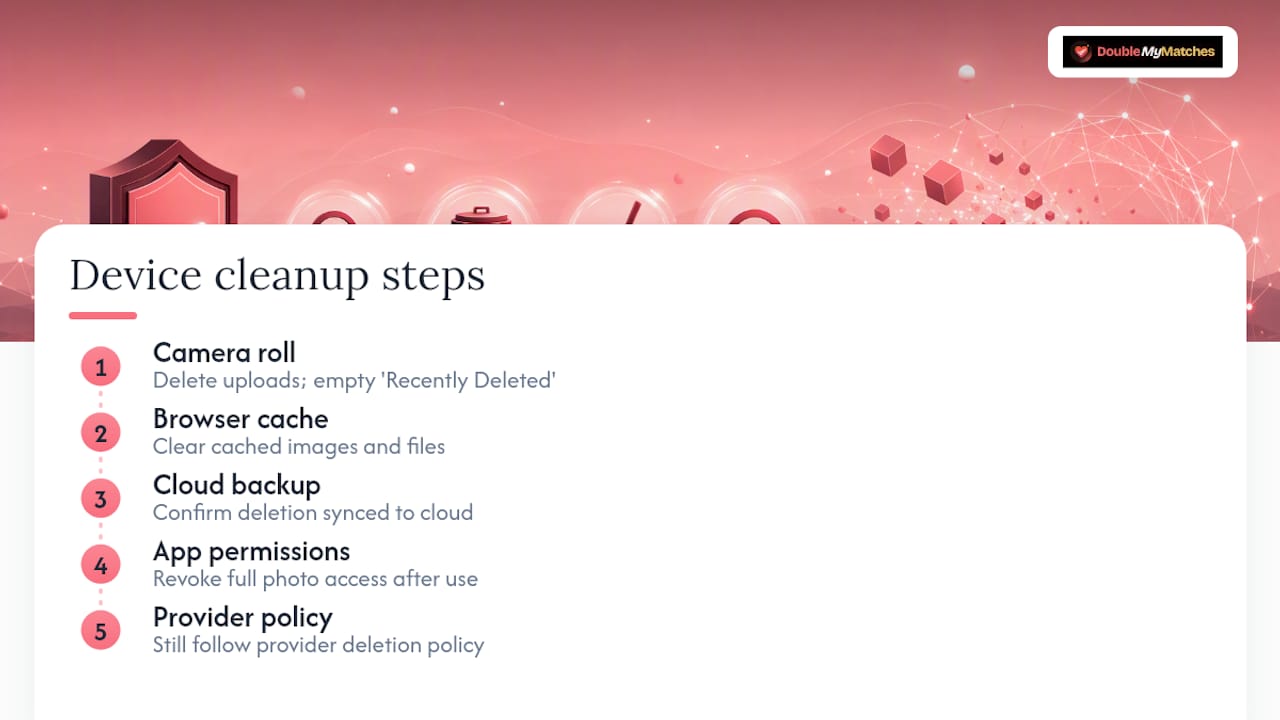
None of this replaces a provider's own deletion policy. It just means you're not leaving a parallel copy sitting somewhere you forgot about.
How to vet an AI dating-photo service before you trust it
Not every service marketing itself as "AI-powered" and "private" backs that up with real practice. A few criteria separate the trustworthy ones from the rest.
Look for a privacy policy that names deletion explicitly, with a timeframe, rather than generic language about "data protection." Check whether the company states plainly that photos are never used for model training. A vague "we may use your data to improve our services" clause is not the same as a firm no.
Confirm there's a real, named point of contact for privacy questions, not just a generic contact form that disappears into a queue. Look for evidence the company has thought about retention windows and audit trails, similar to how Microsoft documents its AI restyle transparency practices for image processing features, showing exactly what gets logged and when it's purged.
History matters here too. OkCupid once shared up to 3 million user photos with a third-party AI vendor without adequate consent. That case is a useful reminder that a platform's size or reputation doesn't guarantee careful handling of your face. Smaller, privacy-focused services that state their deletion process clearly often deserve more trust than a big name with a buried, ambiguous policy.
What GDPR and CCPA actually give you as a user
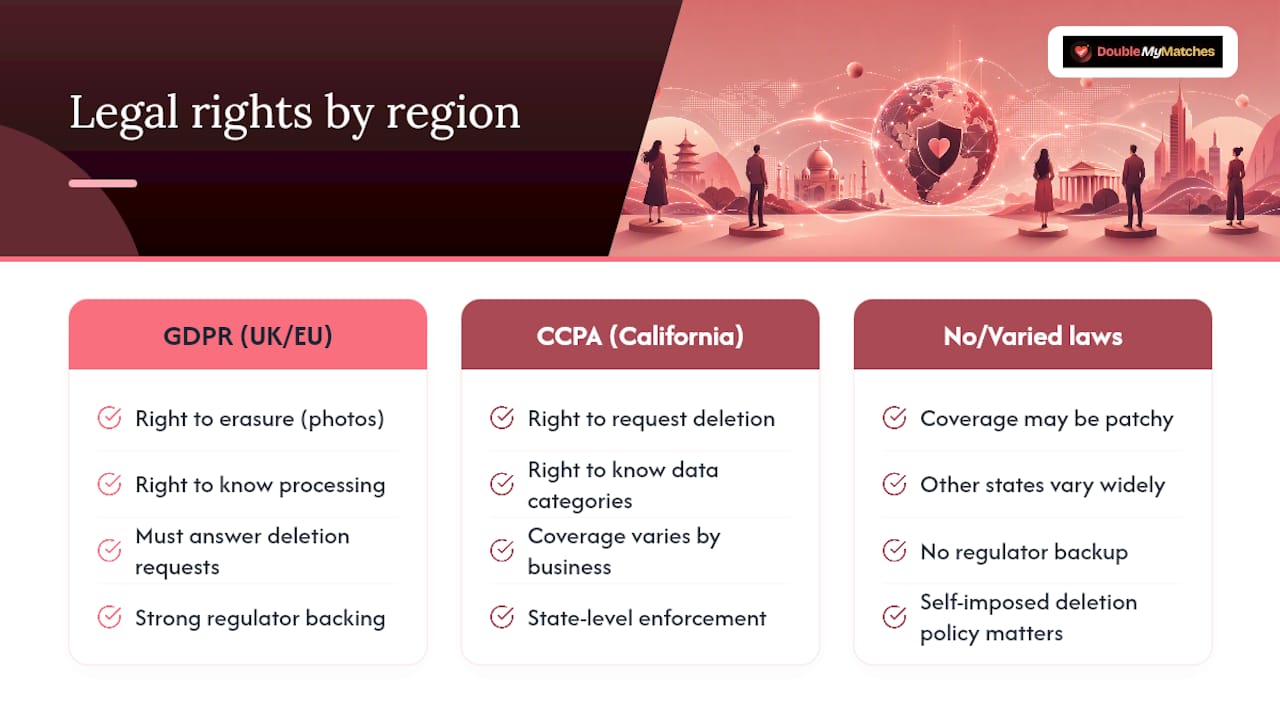
If you're in the UK or EU, GDPR gives you the right to request erasure of your personal data, including photos, and a right to know what a company does with data it processes about you. A dating-photo AI service operating in these regions has to be able to answer a deletion request, not just claim one happens automatically.
In the US, the CCPA gives California residents similar rights: the ability to request deletion of personal information and to know what categories of data a business collects and shares. Other US states have introduced comparable laws, though coverage varies, so it's worth checking whether a given service operates under any of these frameworks at all.
None of this stops a company from writing a weak privacy policy. What it does is give you legal standing to ask for deletion and to push back if a company ignores that request. Privacy advocates have pointed out that dating apps specifically need to build in proper opt-in consent before processing photos with AI at all, rather than relying on buried opt-out clauses that most people never read. If a service operates in a region with no clear data protection law, that's exactly when a strong, self-imposed deletion policy matters most, because there's no regulator standing behind you if it fails.
The gap between a privacy promise and a privacy practice
Most advice on this topic stops at "read the privacy policy," which is true but not especially useful. Privacy policies are written by lawyers to minimise liability, not to give you a plain answer. The actual signal worth watching for is specificity: a provider that names a deletion timeframe, names what it never does with your photo, and gives you a real person to ask, is behaving differently from one that hides behind broad, reassuring language.
The conventional wisdom treats "the app claims it deletes your data" as good enough. It isn't. Tinder's own AI Photo Selector states biometric data is deleted after the feature closes, and that's a reasonable claim from a major platform, but it doesn't remove the value of asking your own provider the same question directly. Verification costs you one email. Skipping it costs you nothing until it doesn't.
What should come first, before you even think about which service scores your photos best, is confirming what happens to the image once the scoring is done. Get that answer in writing, then worry about lighting and composition.
— The Team @ DoubleMyMatches
Get a private, one-time photo analysis with DoubleMyMatches
DoubleMyMatches is built for exactly the situation this article covers: you want honest, detailed feedback on your dating photos without handing your face over to a company that might keep it indefinitely. Your photos are analysed, scored, and then discarded, with no publishing and no training use, so you get the confidence boost without the privacy trade-off other services ask you to accept.
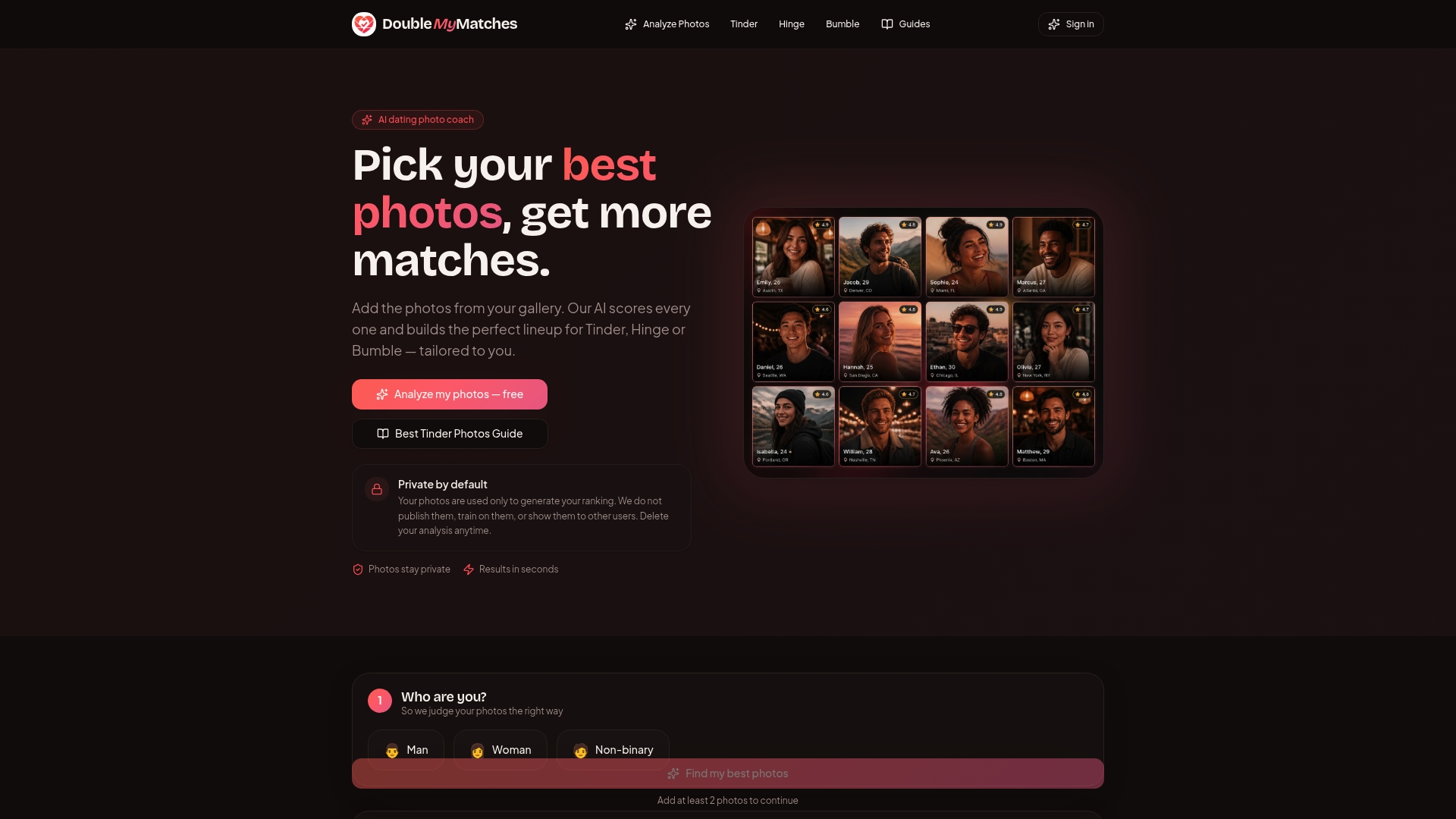
Getting started takes three steps. Upload your photos to the dating photo analyzer, get instant scoring and a best-to-worst lineup within minutes, then decide which report fits you. The Full Report costs $7 as a one-off, giving you per-photo feedback and a full ranked lineup. If you want to test changes after acting on that feedback, Retest & Lock In is $17 one-off. Frequent daters can check the 12-Month Pass for ongoing access, with pricing available on the site.
Read the deletion policy in full on the main landing page before you upload, or try the profile picture tester first if you want to see the flow with a single photo before committing.
Sources
For more on how dating apps handle AI and photo privacy, the TechCrunch coverage of Tinder's AI Photo Selector explains how a major platform frames on-device processing and deletion. The EFF's piece on dating-app consent lays out why opt-in matters more than opt-out. For a cautionary case study, AdGuard's report on OkCupid's AI data sharing is worth reading before you trust any policy at face value. If you want a deeper look at what to check before uploading anywhere, DoubleMyMatches' guide on blocking unwanted AI training covers the practical steps.
- TechCrunch: Tinder AI photo selection feature launches
- Electronic Frontier Foundation: Dating apps need to learn how consent works
- Tinder help: Photo check and photo verification data and privacy information
- AdGuard: Not OK, Cupid – OkCupid used user photos for AI training
FAQ
Does DoubleMyMatches delete my photos after analysis?
Yes. DoubleMyMatches analyses your photos to generate scoring and feedback, then discards them, without publishing them or using them to train its AI.
How long do AI dating-photo services usually keep uploaded images?
Privacy-focused services typically purge images within hours to a few days of processing, though some retain limited audit data for account-safety reasons, which should always be disclosed.
What should I ask a service before uploading my photos?
Ask for a specific deletion timeframe, confirmation that images won't be used for AI training, and what backup or log data might exist outside that window.
Is on-device photo analysis safer than cloud-based analysis?
On-device processing limits exposure since your photo never leaves your phone, but cloud-based analysis with a clear, enforced deletion policy can offer comparable privacy while allowing more detailed scoring.
Can I request deletion of my photos under GDPR or CCPA?
Yes, GDPR gives EU and UK users the right to request erasure of personal data, and CCPA gives California residents similar deletion rights, though coverage varies by US state.
How much does DoubleMyMatches' photo analysis cost?
The Full Report costs $7 as a one-off, and Retest & Lock In costs $17 one-off, with 12-Month Pass pricing available on the DoubleMyMatches site.