
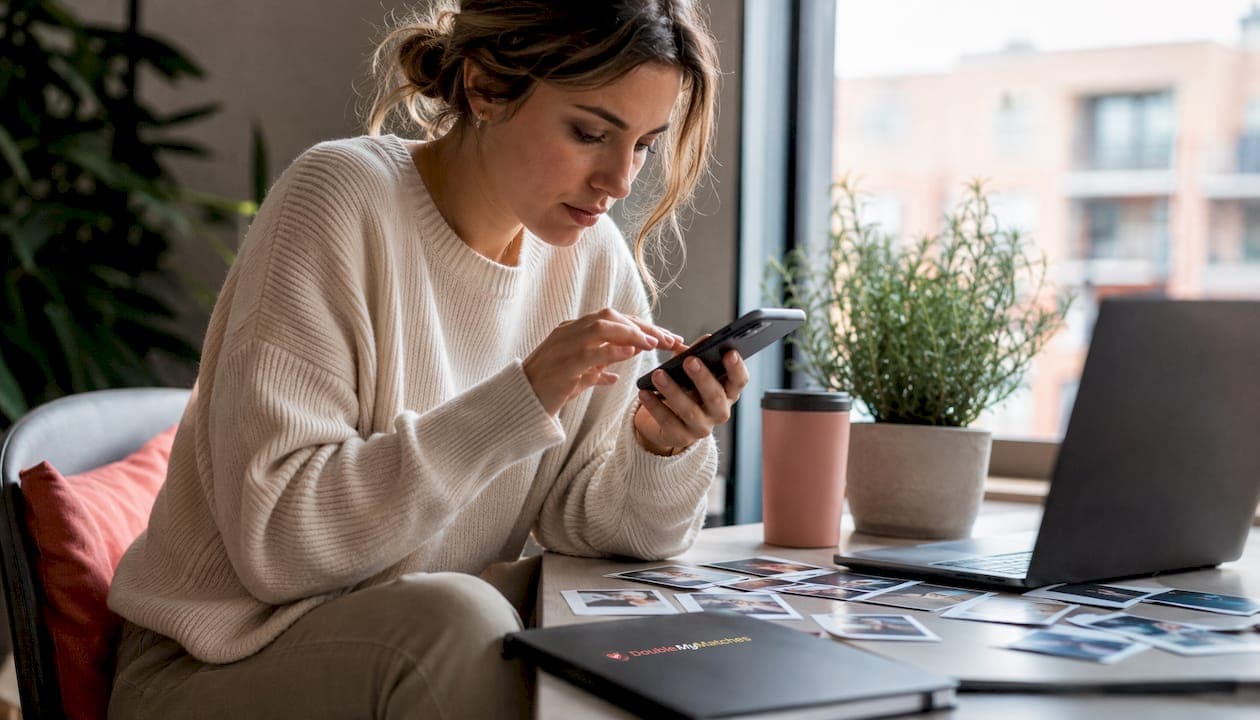
Dating photos are the primary decision driver on every major dating app, accounting for around 80% of swipe decisions. That figure alone explains why choosing dating photos is hard: you have roughly 1.7 seconds to communicate who you are, how you look, and whether you are worth a conversation. Most people scroll past dozens of profiles without reading a single word of the bio. Your photos carry the entire first impression, and getting that selection wrong is far more costly than most people realise.
Why is choosing dating photos so psychologically difficult?
The core problem is not vanity. It is a well-documented psychological phenomenon called the hyperpersonal model, which describes how photos become the sole communication channel in a low-context digital environment. When someone views your profile, they have no tone of voice, no body language, and no shared history to draw on. Every judgement they form comes entirely from your images. That places enormous weight on a handful of photographs.
The second layer of difficulty is selection bias rooted in personal context. You know the backstory of every photo you own. You remember that the holiday shot was taken on a terrible day, or that the group photo followed an argument. A stranger sees none of that. They see a moment. You see a memory, and that gap creates paralysis. You over-analyse images that would read perfectly well to someone who has no context at all.
There is also a real emotional cost. Dating apps require users to package their authentic lives into a product for public evaluation. That feels uncomfortable because it is uncomfortable. The fear of judgement, the worry about self-worth, and the pressure to appear both attractive and genuine all collide at the moment you sit down to pick your photos. Understanding this conflict is the first step toward making better choices.
- Hyperpersonal model pressure: Photos carry 100% of the communication load in a lean media environment.
- Personal context bias: You evaluate your photos with years of backstory that strangers do not have.
- Emotional vulnerability: The act of selecting photos triggers fear of rejection before anyone has even swiped.
- Cognitive overload: Too many options and no clear criteria lead to decision fatigue and poor final choices.
Pro Tip: Ask a friend to pick their top three photos from your camera roll without any explanation from you. Their instinctive choices often outperform your own carefully considered selections because they see what strangers see.
How do technical factors make photo selection harder?
Photography introduces a second set of problems that most people never consider. Wide-angle smartphone lenses distort facial features, making noses appear larger and faces rounder than they are in person. This means a selfie taken at arm's length can genuinely misrepresent your appearance, and you may not even realise it. The result is a photo that feels familiar to you but reads as unflattering to everyone else.
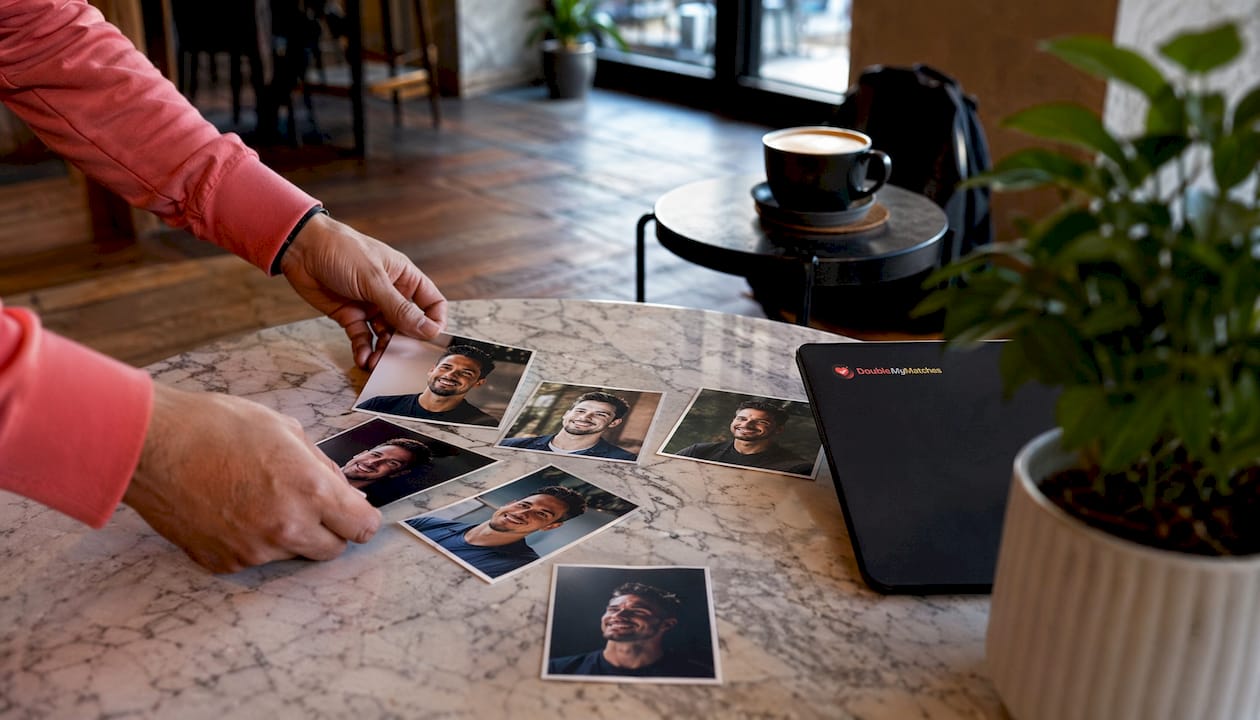
Professional photographers identify light, angle, and expression as the three variables that determine whether a photo works. Wardrobe, location, and editing are secondary. Natural light from a window or taken outdoors on an overcast day produces even, flattering results without any technical knowledge required. A slight upward angle from just above eye level is consistently more flattering than a low shot looking up.
Expression is the hardest variable to control in a DIY setting. Professional portrait photographers know that the keeper rate in a portrait session is low. You need many frames to capture one genuinely authentic smile. A forced grin reads as forced. A genuine smile, one that reaches the eyes, communicates warmth and approachability in a way that no filter can replicate. DIY photos fall short here because most people take three shots and pick the least bad one.
Here is a simple technical process that removes most of the guesswork:
- Shoot outdoors or near a large window on a cloudy day for soft, even light with no harsh shadows.
- Ask someone to take the photo from a few feet away using the rear camera, not the front-facing selfie lens, to avoid lens distortion.
- Take at least 20 frames per setting so you have genuine expressions to choose from, not just posed ones.
- Check the angle before shooting. The camera should sit just above your eye line and point slightly downward.
- Skip heavy filters. A small brightness or contrast adjustment is fine. Anything that changes your skin tone or facial structure will create a mismatch when you meet someone in person.
Pro Tip: Set your phone to burst mode and capture 10 rapid frames while laughing at something genuinely funny. Burst shots catch natural micro-expressions that posed photos never will.
What does the data say about which photos actually work?
The research on dating photo selection is more specific than most people expect. Adding a second photo increases match rates by 51%, and moving from two photos to four adds another 39%. That means the difference between a one-photo profile and a four-photo profile is substantial. After seven photos, returns diminish. The optimal range sits at 4–6 photos, giving you enough variety to tell a story without overwhelming anyone.
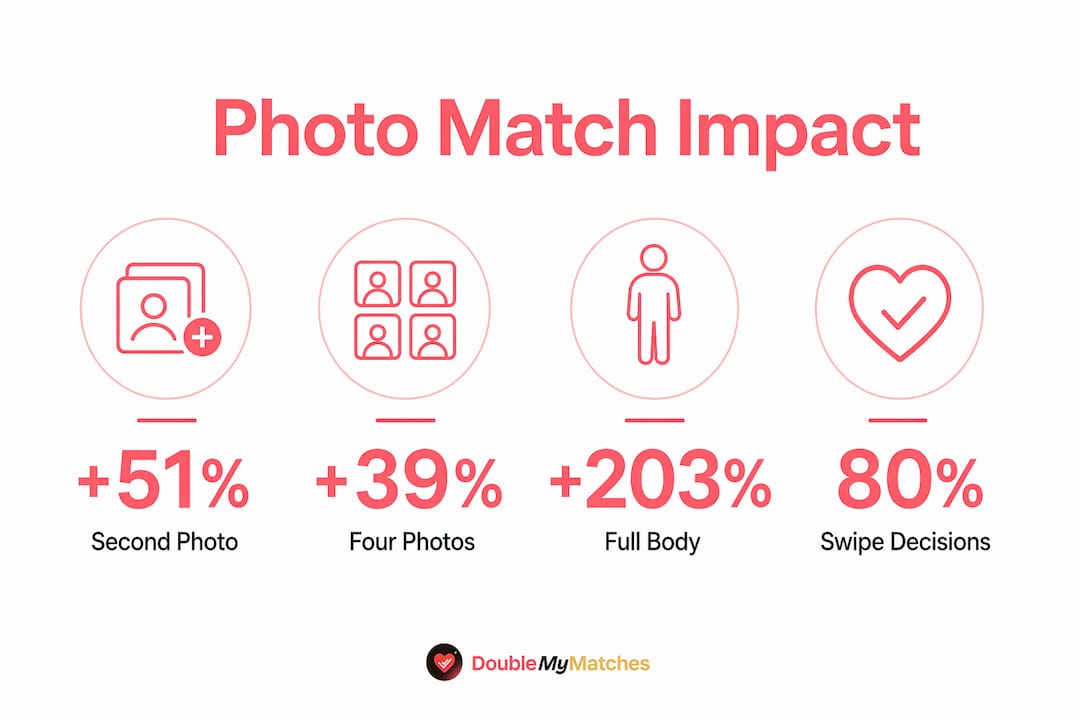
Photo content matters as much as quantity. A clear full-body shot can increase match rates by up to 203%. That is not a marginal improvement. It reflects the fact that people want to know what you actually look like, and withholding that information reads as evasive. Activity-based photos generate three times more engagement than static poses, and outdoor photos boost matches by 29% compared to indoor settings.
| Photo type | Effect on match rate |
|---|---|
| Adding a second photo | +51% |
| Moving from 2 to 4 photos | +39% additional |
| Including a full-body shot | Up to +203% |
| Activity-based vs static pose | 3x more engagement |
| Outdoor vs indoor setting | +29% |
Group photos deserve a specific note. They work well as supporting images because they signal a social life and likeable personality. They fail as lead images because they create confusion about which person you are. Your first photo should always be a solo, clear, well-lit image where your face is the obvious focal point. Use photo variety strategies to build a set that covers solo, activity, social, and full-body shots across different settings.
What practical steps reduce photo selection stress?
The biggest mistake people make is treating photo selection as an open-ended task. Without a clear process, you will spend hours scrolling through your camera roll, second-guessing every option, and ending up with a set that reflects your anxiety rather than your personality. A defined process removes most of that friction.
- Set a time limit. Give yourself 20 minutes to make your final selection. A timer prevents the overthinking spiral that produces worse decisions the longer it runs.
- Use clear criteria. Each photo should be recent (within 12 months), well-lit, solo or clearly featuring you, and free of heavy filters or misleading crops.
- Aim for 6 photos with a specific purpose. One strong lead shot, one full-body image, one activity or hobby photo, one social photo with friends, one travel or outdoor shot, and one that shows genuine laughter or warmth.
- Get one external opinion. Ask a trusted friend to rank your shortlist. Brief them to focus on warmth and clarity, not perfection. Overcritical feedback from the wrong person makes the process harder, not easier.
- Remember what photos are for. They are an invitation to a conversation, not a complete biography. A photo that makes someone curious enough to read your bio has done its job.
The self-bias in photo selection is real and well-documented. Knowing this does not eliminate it, but it does give you permission to trust external feedback over your own instincts when the two conflict. Your gut feeling about a photo is shaped by memory. A stranger's reaction is shaped by the image alone. The stranger's reaction is the one that matters.
Pro Tip: Print your shortlisted photos as small thumbnails and view them from a metre away. This mimics how someone sees your profile on a phone screen and reveals which images have genuine visual impact at small sizes.
Key takeaways
Choosing dating photos is hard because personal bias, technical limitations, and emotional pressure all work against clear decision-making at the same time.
| Point | Details |
|---|---|
| Photos drive swipe decisions | Around 80% of swipe choices are based on photos, decided in roughly 1.7 seconds. |
| Personal context creates bias | You evaluate photos with backstory that strangers do not have, leading to poor selections. |
| Technical quality matters | Light, angle, and expression determine photo effectiveness more than wardrobe or location. |
| Optimal quantity is 4–6 photos | A full-body shot and activity-based images significantly increase match rates. |
| Process beats instinct | A timed, criteria-based selection process produces better results than open-ended scrolling. |
Our honest view on photo selection pressure
We have seen thousands of profiles at DoubleMyMatches, and the pattern is consistent. The people who struggle most with photo selection are not the ones with the fewest good photos. They are the ones who care the most and have no clear framework for making a decision.
The pressure to "get it right" is real, but it is also slightly misdirected. No single photo set is perfect. The goal is a set that is honest, warm, and clear enough to attract the right people and start a conversation. Perfection is not the standard. Authenticity is.
What we have found is that the biggest gains come from fixing obvious technical problems, not from agonising over which of two similar photos is marginally better. Bad lighting, a selfie taken too close, a group photo as the lead image: these are the issues that cost matches. Fixing them takes less effort than most people expect.
Be kind to yourself in this process. Choosing photos that represent you well is genuinely difficult, for the psychological reasons covered here and for practical ones. The fact that you are thinking carefully about it already puts you ahead of most people on any given app.
— The Team @ DoubleMyMatches
How DoubleMyMatches can help you choose better photos
Knowing the theory behind photo selection and applying it confidently are two different things. DoubleMyMatches bridges that gap with AI-powered photo analysis that scores your images on lighting, expression, composition, and overall appeal.
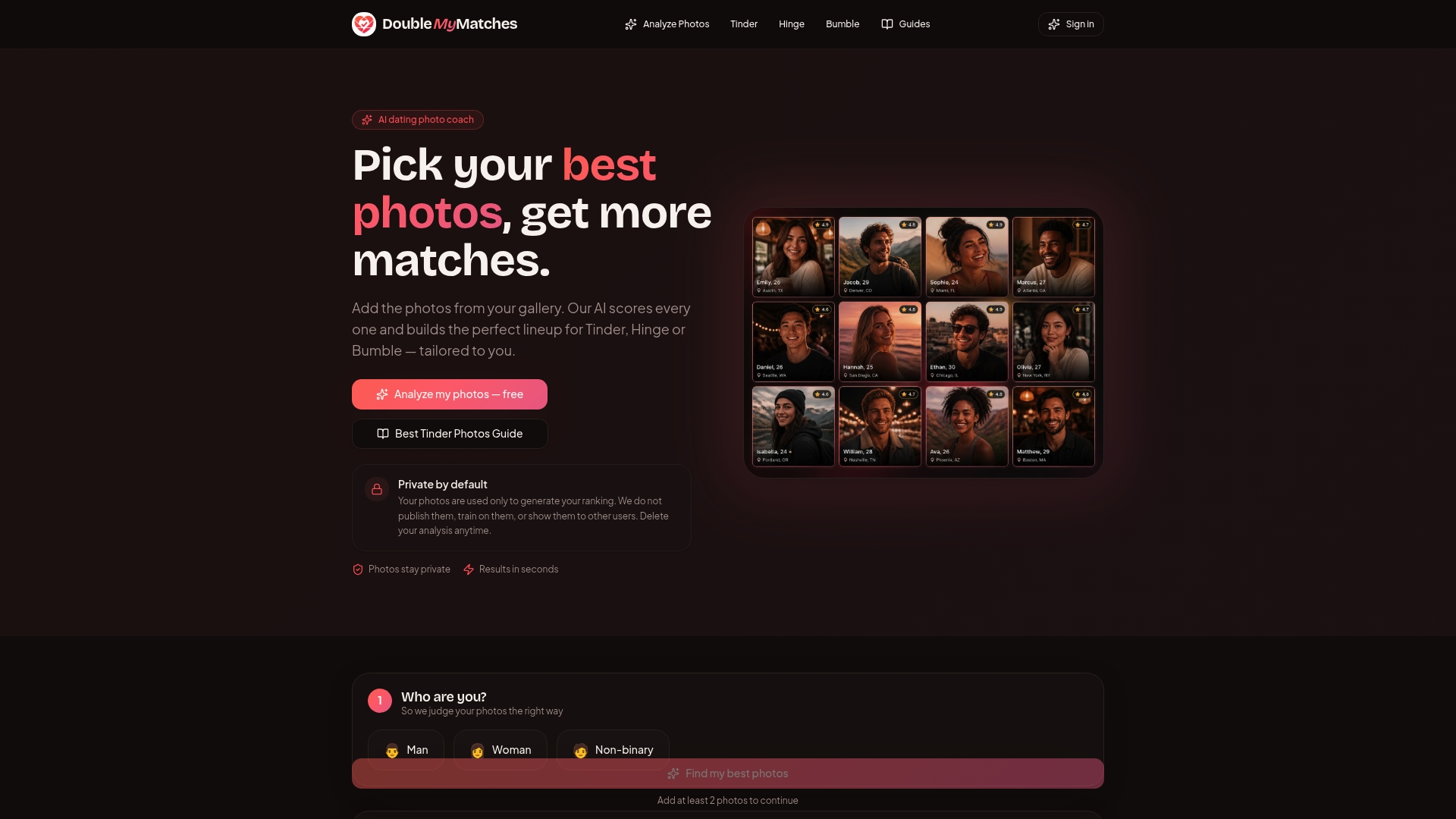
You can use the free Tinder photo review to get an instant ranking of your current photos, or run your full set through the dating profile photo rater for a detailed score on each image. The AI identifies which photos are working and which are costing you matches, without any guesswork on your part. Your photos are analysed and then discarded. They are never stored or used to train the AI. The result is clear, private, and fast feedback that gives you the confidence to upload your best set.
FAQ
Why do dating photos matter more than the bio?
Profile photos account for around 80% of swipe decisions, and most users decide within 1.7 seconds. The bio is rarely read unless the photos have already created a positive impression.
How many photos should I use on a dating profile?
The optimal number is 4–6 photos. Adding a second photo lifts match rates by 51%, and four photos adds a further 39%, but returns drop off after seven.
Should I include a full-body photo?
Yes. A clear full-body shot can increase match rates by up to 203%. Omitting it often reads as evasive, which reduces trust before a conversation has started.
Why do I find it so hard to pick my own photos?
You evaluate your photos with personal context that strangers do not have. This selection bias causes you to over-analyse images that would read clearly to someone seeing them for the first time.
What is the single biggest technical mistake in dating photos?
Using the front-facing selfie camera at close range. Wide-angle smartphone lenses distort facial features, making faces appear rounder and noses larger. Shooting with the rear camera from a few feet away eliminates this problem entirely.