
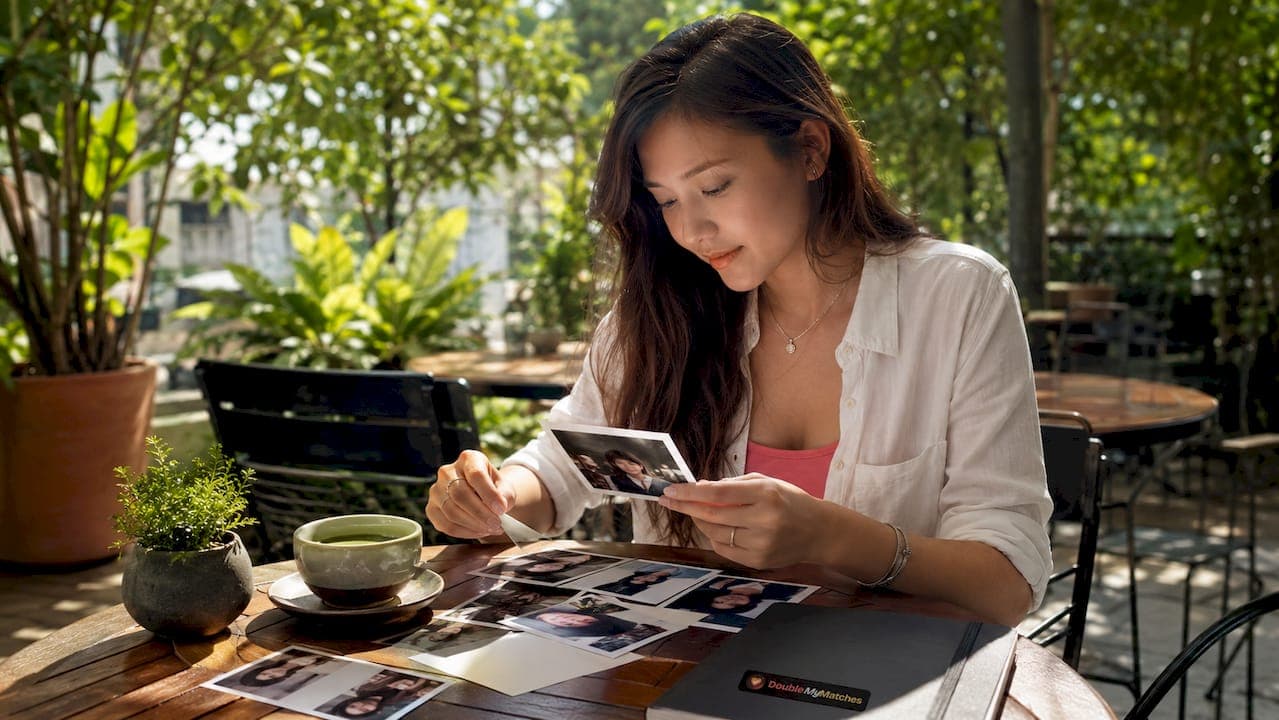
Self-bias in photo selection is defined as the tendency to choose photos of yourself based on internal psychological preferences rather than how others actually perceive you. The formal term for this is self-selection bias, and it is one of the most common reasons dating profiles underperform. Research shows that people consistently pick worse photos of themselves than uninvolved strangers do, because internal hyper-critical focus distorts judgement. Cognitive biases like the mere exposure effect and confirmation bias drive this distortion. Understanding what self-bias in photo selection means is the first step to fixing it, and fixing it directly improves your match rate on platforms like Tinder, Hinge, and Bumble.
What self-bias in photo selection means psychologically
Three cognitive biases work together to make you a poor judge of your own photos.
The mere exposure effect is the most powerful of the three. You see your face every day in the mirror, but that image is reversed. A 1977 study by Mita et al. found that subjects prefer their mirror image, while friends prefer the true photograph they see more often. When you look at a real photo of yourself, it feels subtly wrong because it does not match the reversed version you are used to. That discomfort has nothing to do with the photo's quality.
Confirmation bias compounds the problem. If you already believe your nose is too wide or your smile is awkward, you will scan every photo looking for evidence of that flaw. You find it, even when no one else would notice. This is not vanity. It is a cognitive shortcut that protects your existing self-image by confirming what you already believe.
Negativity bias then amplifies the damage. A single minor blemish can overshadow a genuinely strong photo, causing you to reject it entirely. Your brain assigns disproportionate weight to perceived negatives. The result is a shortlist of "safe" photos that avoid your insecurities rather than photos that project confidence and warmth.
- The mere exposure effect makes reversed photos feel more comfortable than accurate ones.
- Confirmation bias directs your attention to flaws others do not see.
- Negativity bias causes you to discard strong photos over minor, invisible imperfections.
- All three biases work simultaneously, making self-assessment unreliable by default.
Pro Tip: When reviewing your own photos, cover your face with your thumb and assess the overall energy of the image first. Lighting, posture, and expression matter far more than the detail you are fixating on.
Why self-selected photos underperform on dating profiles
The core problem is that you inspect photos, while everyone else reads them.
When you look at a photo of yourself, you zoom in mentally on a specific feature. You notice the shadow under your chin, the slight asymmetry of your expression, or the way your hair sits. Viewers on dating apps do not do this. Social judgements form within 100 milliseconds of seeing a face, based on overall impression rather than detail. Credibility, approachability, and warmth are all assessed in that first glance. The minor flaw you rejected the photo for was never part of that calculation.
Self-bias leads directly to choosing "safe" photos over strong ones. A safe photo is one where you feel least exposed. It might be a slightly distant shot, a group photo where you are not the focus, or a heavily filtered image. A strong photo communicates personality, warmth, and confidence at a glance. Clients often select versions of the same safe image, cycling through near-identical shots while ignoring more effective options.
Pro Tip: Ask yourself: "Does this photo show who I am, or does it just hide what I dislike?" If the honest answer is the latter, it is a safe photo, not a strong one.
Here is how safe and strong photos differ in practice:
| Feature | Safe photo | Strong photo |
|---|---|---|
| Distance from camera | Far or mid-distance | Close enough to read expression |
| Expression | Neutral or closed smile | Genuine, open smile or engaged look |
| Setting | Generic or blank background | Activity, travel, or social context |
| Editing | Heavy filter or smoothing | Natural, well-lit, minimal editing |
| Focus | Avoids perceived flaws | Communicates personality and energy |
| Viewer impression | Forgettable | Memorable and trustworthy |
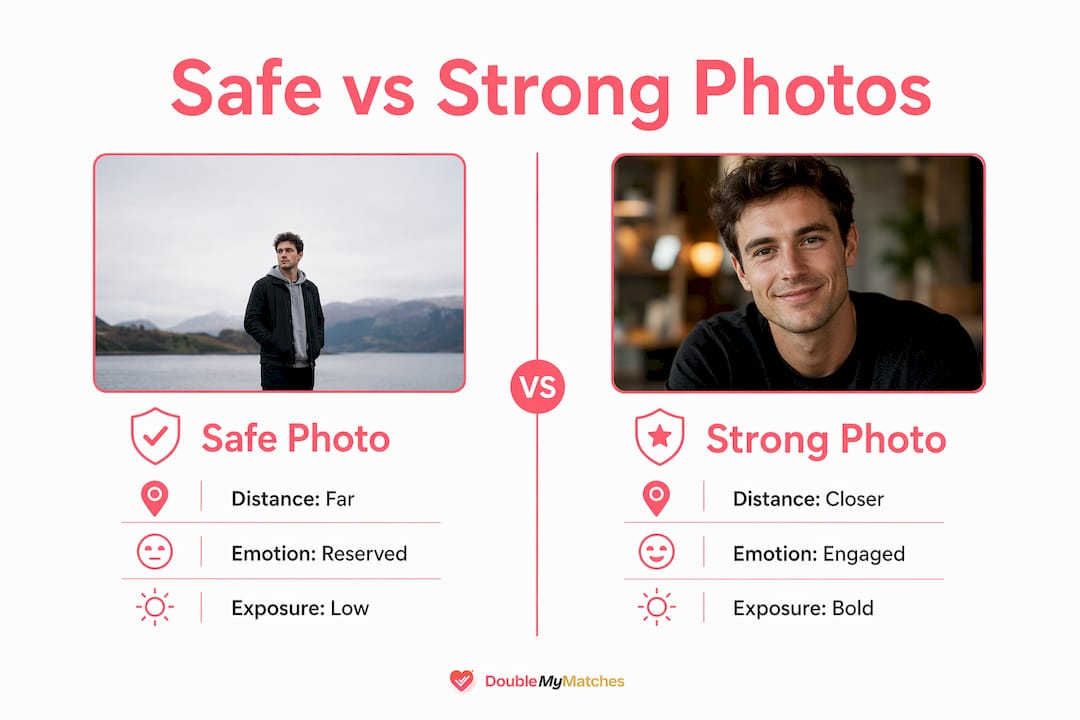
The gap between safe and strong photos is not about physical appearance. It is entirely about what the photo communicates in the first fraction of a second.
How to overcome self-bias when choosing your dating profile photos
The most reliable fix is to remove yourself from the decision entirely.
Blind selection by three uninvolved people from a shortlist of 5–10 photos consistently outperforms self-selection. The key word is "uninvolved." Close friends and family carry their own biases about how you look. A colleague, an acquaintance, or an AI tool gives you a more neutral read. Your own opinion of your photos is the least reliable signal available, because you are comparing images against harsh internal standards no one else applies.
Follow these steps to build a bias-resistant selection process:
- Gather at least 10 candidate photos. Include shots you would normally dismiss. The photo you hate most is often the one others respond to best.
- Remove yourself from the shortlisting stage. Ask three people who are not close friends to pick their top three from the full set without knowing your preferences.
- Do not explain your insecurities before they choose. Priming them with your concerns introduces their bias on top of yours.
- Accept the external verdict. If two out of three people choose the same photo, use it. Your discomfort with it is self-bias, not evidence the photo is weak.
- Use an AI photo rating tool. Services like DoubleMyMatches assess your photos on factors like lighting, expression, and composition without emotional attachment. The dating photo analyser scores your images the way a neutral viewer would.
- Rotate and test. Upload your externally chosen photos and track which ones generate the most matches over two weeks. Data beats gut feeling every time.
Additional habits that reduce photo selection bias over time:
- Look at your photos on a small screen, not zoomed in on a desktop. This mimics how others actually see them.
- Wait 48 hours before making a final selection. Emotional distance reduces negativity bias.
- Use the profile picture tester to compare photos side by side with AI scoring before committing.
- Practise seeing your photos as a stranger would, by covering identifying features and assessing mood and energy only.
Common misconceptions about photo selection bias
Self-bias is not the same as low confidence or vanity, and it is worth separating these clearly.
Misconception 1: Self-bias means you are insecure. Self-selection bias is a cognitive distortion that affects almost everyone, including people with high self-esteem. Self-bias acts as a protective mechanism for ego and self-esteem, amplifying negative perceptions regardless of how confident you feel in daily life. It is a wiring issue, not a confidence issue.
Misconception 2: Better editing will fix the problem. Photo editing rarely resolves self-bias because the audience reads overall character, not the tiny imperfections you are trying to correct. Smoothing your skin or adjusting your jaw angle does not change the energy a photo communicates. Viewers respond to expression, posture, and lighting far more than to skin texture.
Misconception 3: You need to feel comfortable in the photo. Your comfort with a photo is largely driven by mirror-familiarity bias. Mirror-familiarity bias is a deep cognitive effect where lifelong exposure to reversed images causes discomfort with authentic photos. The photo that feels slightly off to you is often the one that looks most natural to everyone else. Comfort is not the goal. Effectiveness is.
Misconception 4: Self-bias only affects bad photos. Self-bias causes people to reject genuinely strong photos. The better the photo, the more exposed it can feel, which triggers more self-critical scrutiny. This is why the photo you are most reluctant to use is frequently the one worth testing first.
Key takeaways
Self-selection bias is the single biggest reason people undermine their own dating profiles, and removing yourself from the photo selection process is the most effective fix.
| Point | Details |
|---|---|
| Self-bias distorts photo judgement | Cognitive biases like mere exposure and negativity bias make self-assessment unreliable. |
| Safe photos underperform | Photos chosen to hide insecurities communicate less warmth and personality than strong ones. |
| First impressions form in 100ms | Viewers read overall energy, not the minor flaws you fixate on when inspecting your own photos. |
| External selection outperforms self-selection | Three uninvolved people choosing from a shortlist consistently pick more effective photos than you will. |
| AI tools provide neutral feedback | Services like DoubleMyMatches score photos on lighting, expression, and composition without emotional bias. |
Our honest view on self-bias and photo selection
The Team @ DoubleMyMatches
The most common thing we see is not bad photos. It is good photos being rejected by the person in them.
People come to us having already dismissed their best images. They have a folder of shots taken by a professional or a friend, and they have quietly ruled out the strongest ones because something felt wrong. That feeling is almost always self-bias, not evidence. The photo that makes you wince because your expression looks "too much" is usually the one that reads as warm and genuine to everyone else.
The mindset shift that actually helps is this: the photo is not for you. It is for the person swiping. Your job is not to feel comfortable with it. Your job is to give that person the clearest, most honest signal of who you are. The photos that do that best are rarely the ones you would choose on your own.
We have also noticed that people who trust external feedback, even when it feels uncomfortable, see better results faster. Not because the feedback is always perfect, but because it breaks the loop of self-critical inspection. Once you accept that your judgement on your own photos is compromised by design, you stop fighting the process and start getting better outcomes.
The common mistakes on Hinge profiles we see most often trace back to exactly this: self-bias in photo selection, repeated across every image slot.
— The Team @ DoubleMyMatches
How DoubleMyMatches helps you choose photos without self-bias
Self-bias is hard to see in yourself. That is precisely what makes external feedback so valuable.
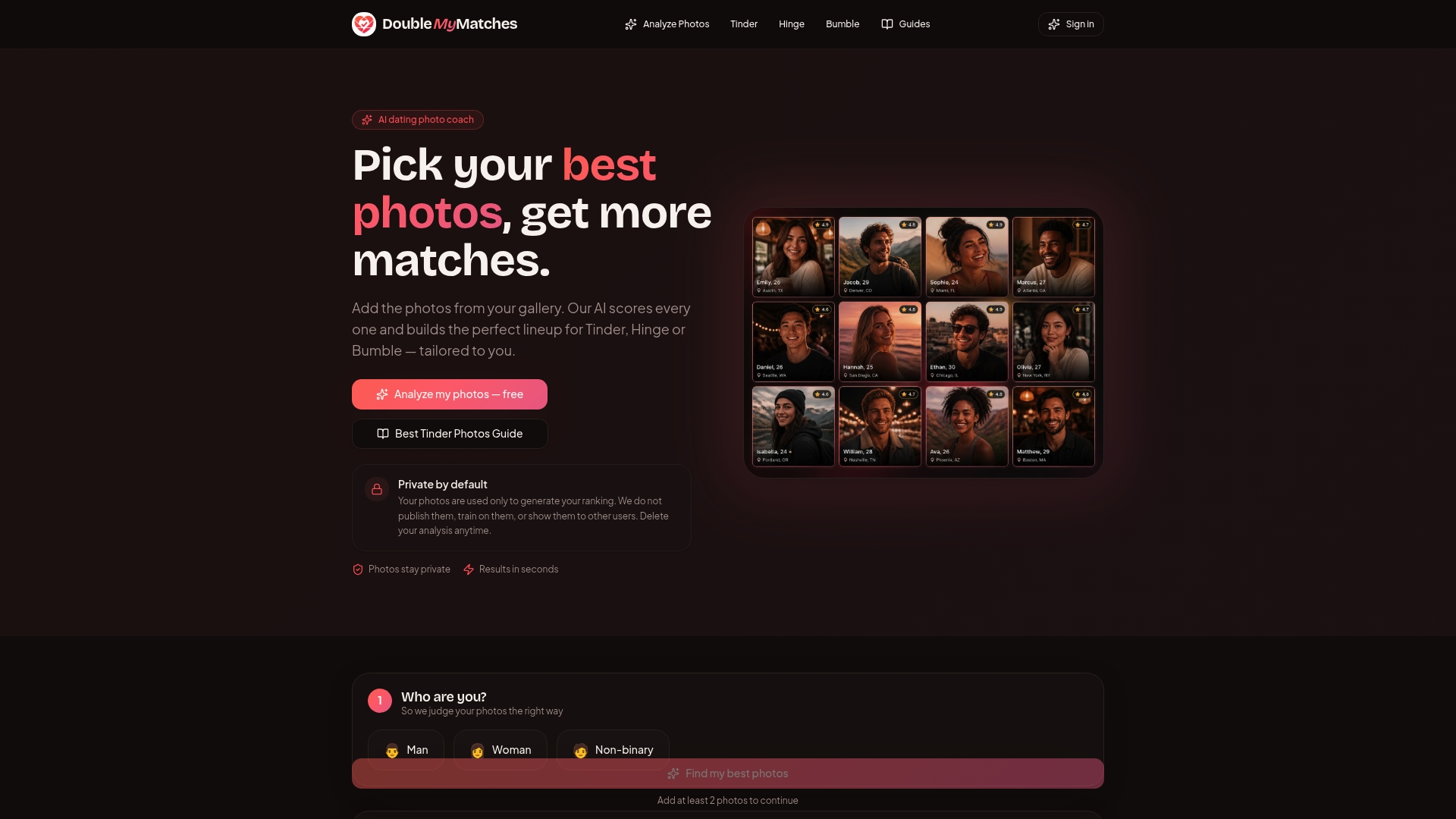
DoubleMyMatches uses AI to assess your dating photos on the factors that actually drive right-swipes: lighting, expression, composition, and the overall impression your photo creates in under a second. The AI Tinder profile review gives you honest, ranked feedback on your photos without the emotional baggage you bring to the process yourself. You upload your photos, the AI scores them, and you get a clear picture of which images are working and which ones your self-bias has been protecting. Your photos are analysed and then discarded. They are never published or used to train the AI. The result is objective feedback you can act on immediately, with no guesswork involved.
FAQ
What is self-bias in photo selection?
Self-bias in photo selection is the tendency to choose photos based on internal psychological preferences rather than how others perceive them. It is driven by cognitive biases including the mere exposure effect, confirmation bias, and negativity bias.
Why do strangers pick better photos of me than I do?
Strangers assess your photos the way all viewers do, by reading overall impression rather than inspecting details. Studies show that uninvolved people consistently choose more representative and effective photos than the subject themselves.
Does editing my photos fix self-bias?
No. Editing addresses surface details, but viewers form impressions based on expression, posture, and energy rather than minor imperfections. Photo editing rarely resolves the underlying bias that causes poor photo selection.
How does self-bias affect my dating profile specifically?
Self-bias causes you to choose "safe" photos that hide perceived flaws rather than strong photos that communicate personality and warmth. Safe photos generate fewer matches because they make weaker first impressions in the 100ms window where judgements form.
How can I reduce self-bias when choosing my dating photos?
Use a blind selection process: gather 10 or more candidate photos and ask three uninvolved people to choose their favourites without knowing your preferences. Alternatively, use an AI photo rating tool to get neutral, data-driven feedback on which images perform best.