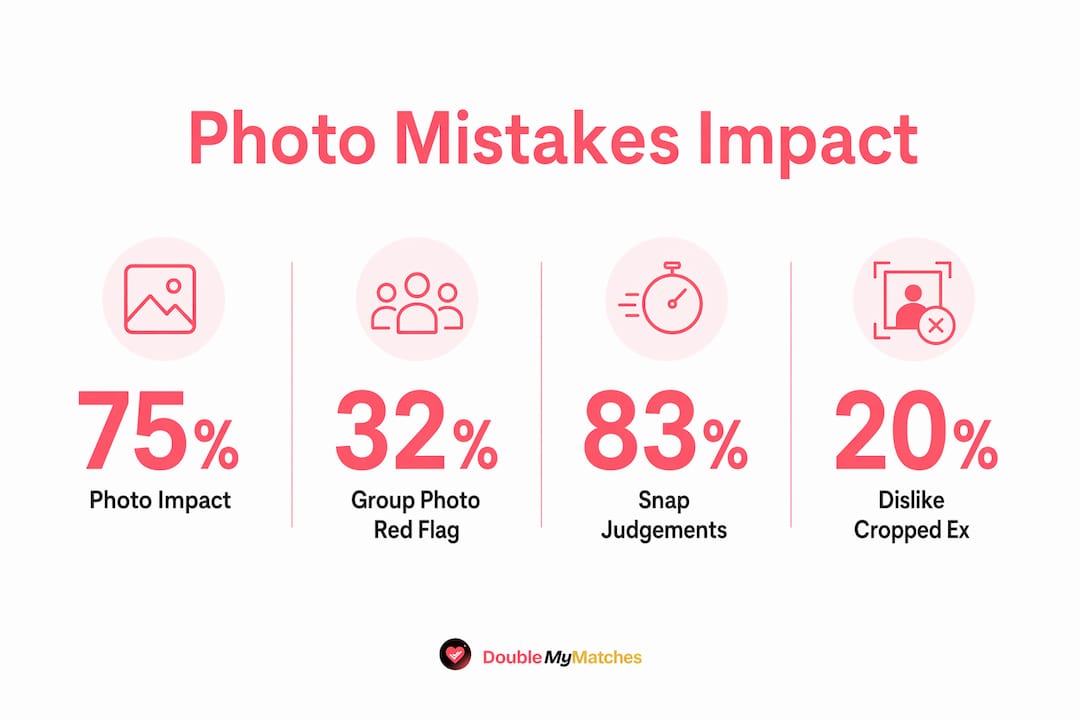
Your photos are doing roughly 75% of the work on your dating profile. Not your bio. Not your prompts. Your photos. Research from Kennesaw State University confirms you have about 15 seconds and five photos before someone swipes left, and the verdict is usually locked in well before they reach your bio.
The good news? Most of the damage is avoidable. Poor photo quality, obscured faces, bad lighting, and zero variety are the main culprits. Fix those, and your match rate can shift noticeably. Here is exactly what is going wrong and how to put it right.
The biggest photo mistakes that kill matches at a glance:
- Bathroom mirror selfies (disliked by 42% of women and 23% of men)
- Group photos as the lead image
- Sunglasses or hats covering the eyes
- Heavy filters or AI-enhanced edits
- Blurry or low-resolution images
- No smile or flat expression
- Awkward cropping that cuts off limbs or the face
- Cluttered or distracting backgrounds
- Only selfies with no social context
- Outdated photos that no longer look like you
Common photo mistakes that kill your match rate
1. Bathroom mirror selfies
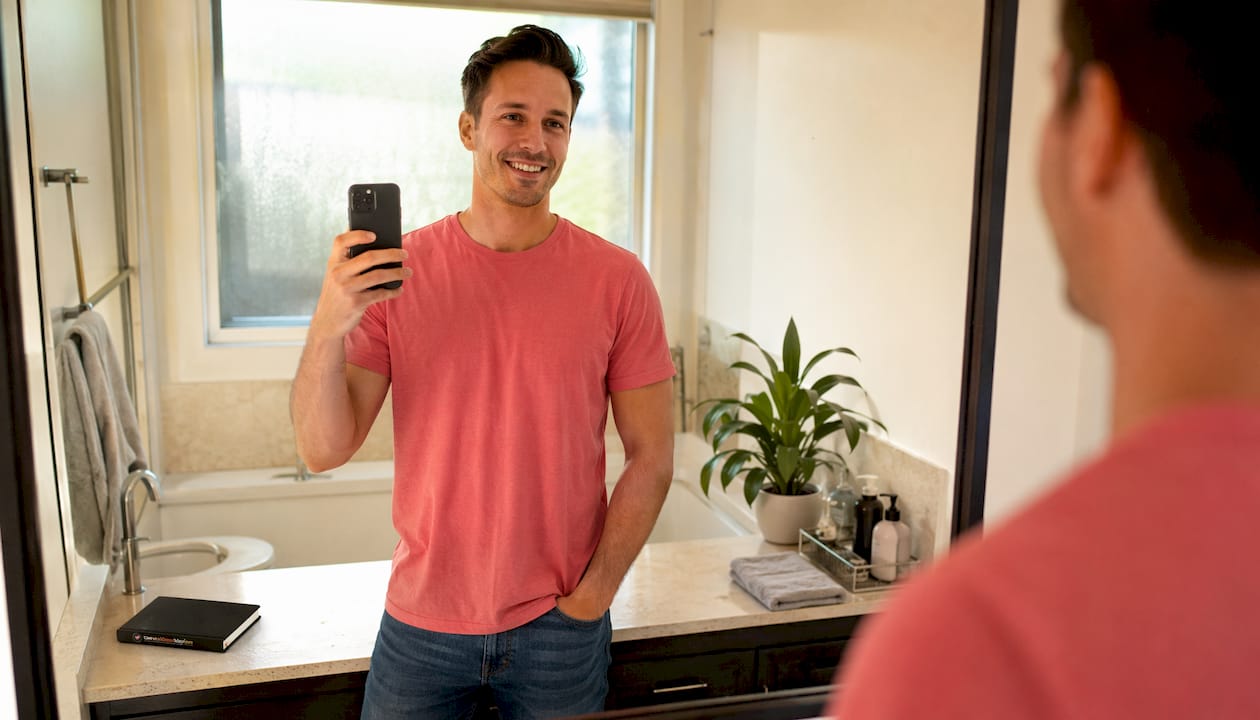
Bathroom selfies are one of the most common photos on dating apps and one of the most damaging. The Wisp survey of 1,200 daters found that 42% of women and 23% of men actively dislike them. A smudged mirror, cluttered background, and harsh overhead lighting all signal carelessness before you have said a word. The message it sends is not "I'm confident." It is "I couldn't be bothered."
2. Poor lighting that obscures your face
Overhead indoor lighting is the single most common lighting mistake. Ceiling lights cast shadows directly into your eye sockets, flatten your features, and make you look tired or unapproachable. Front-facing light — a window during the day or golden-hour outdoor light — fixes this instantly. Correcting the light direction does more for a photo than any digital brightening tool.
3. Only posting selfies with no social context
A profile full of selfies tells a viewer very little about who you actually are. Photos that show you doing something real — hiking, cooking, at a gig — signal that you have a life and a personality. Variety also matters algorithmically: apps like Hinge surface profiles where viewers engage with multiple photos, and a range of genuine contexts encourages that engagement.
Pro Tip: Ask a friend to take a few candid shots of you doing something you enjoy. Candid photos almost always outperform posed selfies because the expression is natural.
4. Wearing sunglasses or hats in every photo
Covering your eyes is one of the fastest ways to lose a swipe. The brain needs a clear face read in roughly 100 milliseconds to form a first impression, and sunglasses block the most expressive part of your face. One photo with sunglasses can work as part of a varied set. Leading with one, or having them in every shot, removes the warmth and eye contact that drive right-swipes.
5. Leading with a group photo
Group photos confuse viewers about who the profile belongs to, and 32% of men and 31% of women flag them as a red flag. The brain spends the first impression window trying to work out which person you are. By the time it resolves, the viewer has moved on. Group shots can appear later in your set to show social warmth, but never in the first slot.
6. Using outdated or heavily filtered photos
Filters reduce trustworthiness, even when viewers cannot consciously identify them. Research published in Computers in Human Behavior found that filtered photos rate lower on authenticity even when the viewer cannot articulate why. The practical result: filters reduce your reply rate rather than improve it. Plain, unfiltered photos taken in ordinary light now outperform polished, edited ones. Outdated photos create a different problem: when you meet someone and look noticeably different, trust collapses immediately.
7. Lack of variety in settings or outfits
Profiles where all photos show the same pose, outfit, or location consistently underperform. Variety signals that you have a full life. One indoor shot, one outdoor, one social, one activity-based: that combination tells a richer story than six near-identical headshots. It also keeps viewers engaged across multiple photos, which helps with algorithmic ranking on dating apps.
8. Low resolution or blurry images
Dating photos are displayed at roughly 350 pixels wide on a mobile screen. If your face is not clear and recognisable at that size, the photo loses swipes regardless of how good the composition is. Blurry images also signal low effort, which viewers read as a proxy for how much care you take generally. Use the highest resolution your phone allows, and avoid heavy compression.
9. No smile or flat expression
A full, genuine smile — the kind that reaches your eyes — outperforms every other expression. Closed-mouth smirks do fine. Neutral or serious expressions underperform noticeably. If you struggle to produce a natural smile on demand, get someone to make you laugh with the camera ready. The candid laugh photo nearly always wins.
10. Awkward cropping that cuts off limbs or the face
Cropping that removes your hands, arms, or part of your face creates an unsettling impression. Face-perception research is clear: a photo without a fully visible face cannot do the work of the first-impression window. Cropped-head photos belong nowhere in a dating profile, particularly not in the first two slots.
11. Distracting or cluttered backgrounds
Cluttered backgrounds — a messy bedroom, a busy bar, the inside of a car — consistently underperform clean ones. "Clean" does not mean blank; it means the background is one identifiable thing: a coastline, a brick wall, a park. The car interior shot is particularly damaging because it signals the photo was taken in 30 seconds as an afterthought.
12. Cropped photos that once included an ex
The Wisp survey found that 20% of men and 22% of women dislike photos that are clearly cropped from a couples shot. The visible arm around your shoulder or the half-face at the edge of the frame raises immediate questions. It also reads as laziness. Taking a few new photos is worth the effort.
How UK daters react to bad photos: what the research shows
83% of dating app users make snap judgements based on profile photos alone, according to a survey by UK-based dating app Wisp. Most do not read the bio until after the photo has already passed or failed. That means your photos are not just important; they are doing almost all of the work.
The psychology behind this is explained by the hyperpersonal communication model. Professor Minhao Dai of Kennesaw State University describes it this way: in a lean media environment like a dating app, there are no distractions and no opportunities to show personality in real time. Every visual cue gets amplified. Minor photo flaws become proxies for character judgements about trustworthiness and reliability. A blurry photo does not just look bad; it reads as careless.
The 2026 Kennesaw State study also found that men and women are evaluated differently. Women's profiles benefit from polished, well-composed photos. Men's profiles gain more from photos that signal personality traits: a photo with a dog, a travel shot, or an activity image consistently performed well because viewers used words like "kind," "trustworthy," and "reliable" when describing those profiles. For men, looking perfect matters less than looking like a real person with a life.
Filter detection has also shifted in recent years. Viewers can now detect AI enhancement and heavy filtering at well below conscious threshold. The result is a small but consistent drop in trustworthiness ratings, even when the viewer cannot explain why the photo feels off. Unfiltered, ordinary-light photos now outperform polished ones in the current environment.
Key takeaways
Poor photos are the primary reason most dating profiles underperform: fixing lighting, expression, and variety typically produces the most noticeable improvement in match rates.
| Point | Details |
|---|---|
| Photos dominate first impressions | Research confirms photos account for roughly 75% of profile decisions, made within about 15 seconds. |
| Bathroom selfies actively deter matches | 42% of women and 23% of men flag bathroom mirror selfies as a red flag in the Wisp survey. |
| Group photos confuse and lose viewers | About 31–32% of both men and women dislike group photos as lead images because they cannot identify the profile owner. |
| Filters reduce perceived trustworthiness | Viewers detect filter use subconsciously, lowering authenticity scores even when they cannot articulate why. |
| Variety and clarity drive engagement | Profiles with multiple clear photos in different settings outperform those with fewer or filtered images. |
The photo audit most people skip
There is a tendency to treat dating photos as a one-time task. Upload a few decent shots, leave them for a year, and wonder why the matches have dried up. The reality is that profiles left unchanged for more than a few months see declining reply rates, partly because the algorithm de-prioritises stale profiles and partly because regular users start recognising and skipping them.
The fix is not a complete overhaul every month. It is a small, deliberate audit every two to three months. Look at each photo and ask three questions: Can a stranger identify you clearly in under a second? Does the photo convey warmth through your expression or eye contact? Does it tell the viewer something true about your actual life? Most profiles, when audited honestly, fail on the second and third questions. Replacing two photos usually moves the needle more than rewriting the entire bio.
What the research consistently shows is that clarity and warmth outperform glamour. A slightly imperfect photo where you are laughing genuinely, lit by a window, with a clean background, will outperform a polished studio shot where you look great but feel distant. The importance of good profile pictures is not about looking your best in an abstract sense. It is about looking approachable, real, and engaged.
The hardest part of improving your photos is that you are not a neutral judge of your own face. Research on self-bias in photo selection shows that people consistently choose photos that reflect how they see themselves rather than how others perceive them. That gap is where most profiles lose matches without ever knowing why. Getting an objective read on your photos, whether from a trusted friend or an AI photo analysis tool, closes that gap faster than any amount of self-assessment.
If you want to know exactly which of your current photos are working and which are costing you matches, DoubleMyMatches analyses your photos with AI, scoring them on lighting, expression, and composition, then ranks them from strongest to weakest. Your photos are analysed and then discarded; nothing is stored or used for training. It takes a few minutes and gives you a clear, honest picture of where you stand.