
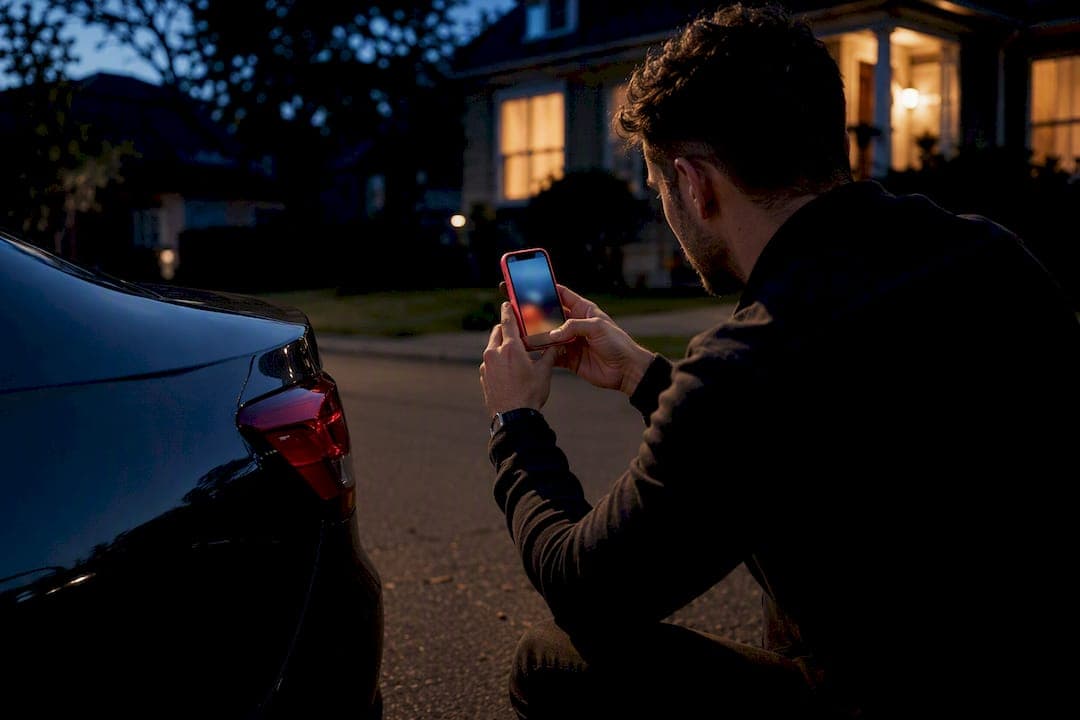
A car photo can lift your swipe rate, but it just as often damages match quality unless the shot genuinely reads as yours. The safest move is to include one incidental car photo at most, only if it tells a real story about you, and to test the change rather than assume it will work.
TL;DR:
- Car photos with high-tier models like Mercedes-Benz C-Class and Range Rover Sport can increase match rates, but results vary depending on presentation and context.
- Lifestyle framing that shows shared experiences, such as road trips or outdoor adventures, tends to outperform static, boastful car shots in attracting genuine interest.
- Authenticity issues arise when car photos appear staged, rented, or unrelated to the person, risking trust and potential match damage, especially among younger daters.
- Testing different profile setups with A/B methods and using photo analysis tools can help determine whether a car image genuinely improves match quality or harms it.
- Prioritizing personality-rich photos over possession shots generally yields better engagement and more meaningful interactions on dating apps.
Table of Contents
- Posing with a car on Tinder: what the studies actually found
- Why car photos help some men: status cues that actually land
- Why car photos hurt some men: the authenticity trap
- How to pose with a car the right way
- Better alternatives that usually outperform a car photo
- Testing your own lineup before you commit
- Balancing confidence with authenticity
- Get an honest, private read on whether your car photo is helping or hurting
- Sources
Posing with a car on Tinder: what the studies actually found
The evidence is mixed, and that's the honest headline. Carwow's social experiment tested more than 100 images and found that photos with higher tier cars scored noticeably higher for attractiveness than the same person with a budget car or no car at all. That sounds like a green light for posing with your car on Tinder, until you look at the sample size and the artificial swipe conditions, which don't fully mirror how real users judge a profile with six photos and a bio attached.
Click4Reg's swipe-style testing, reported by Carscoops, went further and named names.
A Mercedes-Benz C-Class reportedly pulled a high number of matches in one UK experiment. Range Rover Sport also performed well.
Other outlets summarising similar tests found smaller or non-existent effects depending on the model and the photo's context, which tells you the car itself is only ever half the story.
- Carwow's controlled test showed a real uplift from certain vehicles, but on a small volunteer sample.
- Click4Reg's swipe test flagged specific models, though results vary by presentation and city.
- Independent write-ups from outlets like Mix 97 confirm the pattern exists but caution against treating any single model as a guaranteed win.
Why car photos help some men: status cues that actually land
Car photos work as a form of social signalling. A nice car suggests stability, and some swipers read that as a proxy for security or ambition, which is why certain models moved the needle in the studies above. That effect is real, but it's narrow, and it depends heavily on who's swiping.
Context does most of the heavy lifting. A car parked outside a house looks like a flex. The same car loaded with camping gear on a coastal road looks like a life you'd want to be part of. Lifestyle framing, not the badge on the bonnet, is what makes the photo believable.
The audience split matters too:
- Casual daters tend to respond faster to status cues, including cars, watches, and branded settings.
- Relationship-seeking users weight personality and warmth signals higher, and a bare car photo with no story often does nothing for them.
- Photos showing a car mid-adventure (road trip, festival, camping trip) tend to outperform static "here's my car" shots because they hint at a shared experience rather than a possession.
Why car photos hurt some men: the authenticity trap
Here's where the risk sits. Younger daters in particular have grown sceptical of wealth signalling on dating apps, partly because of a wave of catfishing and financial scam stories tied to flashy profiles. Yahoo Lifestyle's reporting puts it plainly: a Porsche photo can now read as a red flag rather than a green one, especially with women who've seen the "rented supercar for a photoshoot" trick before.
The tells are usually obvious once you know what to look for:
- A car with no visible connection to you (rental plates, dealership backdrop, or you're not even touching it).
- Multiple photos featuring the same car, or the car more prominent than your face.
- Close-up shots of a badge or logo, which reads as status-chasing rather than lifestyle.
- A car that clashes with the rest of your profile (student union photos next to a supercar, for instance).
Poor-quality car photos also attract a different kind of attention, often more transactional and less genuinely interested in you as a person.
Pro Tip: Open your camera roll and count how many photos feature your car as the main subject. If it's more than one, you've likely got a flex problem, not a photo problem.
How to pose with a car the right way
If you're keeping a car photo, treat it as a supporting shot, not your headline image. Here's how to make it work.
- Decide first: one photo, maximum. Never run two car shots in the same lineup. If you can't decide which one, that's usually a sign to cut both and test without.
- Shoot in daylight, outdoors. Harsh flash and dim garage lighting flatten faces and make the whole scene look staged.
- Keep yourself centred and in motion. Leaning against the car mid-conversation, loading a bike into the boot, or walking away from it beats a stiff standing pose every time.
- Avoid logo close-ups. Frame wide enough that the car is context, not the subject. Nobody swipes right for a badge.
- Dress like you would for the activity, not for a shoot. A jumper and jeans read as authentic; a suit next to a hatchback reads as confusing.
- Check the story holds up. If someone asked "is that really your car?", would your answer sound natural? If not, don't post it.
Before you upload, run a quick sense check on the whole set:
- Does the rest of your profile support the idea that the car is genuinely yours (same location, same general lifestyle)?
- Do your other five or six photos show variety, faces, activities, social settings, so the car doesn't dominate?
- After swapping it in, are you tracking whether matches actually improve, or just assuming they will?
Composition details like backdrop and framing matter more than people expect. A cluttered street versus a clean, well-lit driveway can change how the whole photo reads, which is worth thinking through using a proper guide to dating photo backgrounds before you shoot.
Better alternatives that usually outperform a car photo
If you're not sure the car photo is pulling its weight, swap it for something that shows more of you. Hobby shots, action photos, and genuine social moments consistently perform better because they reveal personality and shared interests rather than just possessions.
- A photo mid-hobby (climbing, football, cooking) beats a static car shot because it invites a conversation starter.
- Travel photos with your face clearly visible and some context (a market, a hike, a city street) show you're adventurous without the flex.
- Group photos where you're clearly the focal point signal social proof without looking staged.
Check examples of Tinder photos that actually get matches for men if you want a clearer picture of what "authentic" looks like in practice, and avoid the common photo mistakes that quietly kill matches while you're rebuilding your lineup.
Testing your own lineup before you commit
Don't guess. Swap your main photo for 48 to 72 hours, track matches and message replies, then swap back and compare. It's a simple version of A/B testing, and it removes the guesswork that fuels most of the forum debates about whether cars "work."
Behavioural testing tells you what happened, and apps like the iGirl App Review: Visual-First AI Girlfriend — Verdict help understand how visual cues impact dating success. It doesn't always tell you why. That's where an AI photo analyser complements the test, scoring lighting, composition, and expression on each shot so you know whether a dip in matches came from the car itself or from something fixable, like a shadow across your face.
- Track raw matches over your test window.
- Track message quality, not just quantity. A spike in matches with fewer replies usually signals a lower-quality audience.
- Feed the winning shots into a private Tinder photo analyser to check the technical basics before you draw conclusions.
A short-term jump in swipes often correlates with a drop in conversation depth, so measure both, not just the headline number.
Balancing confidence with authenticity
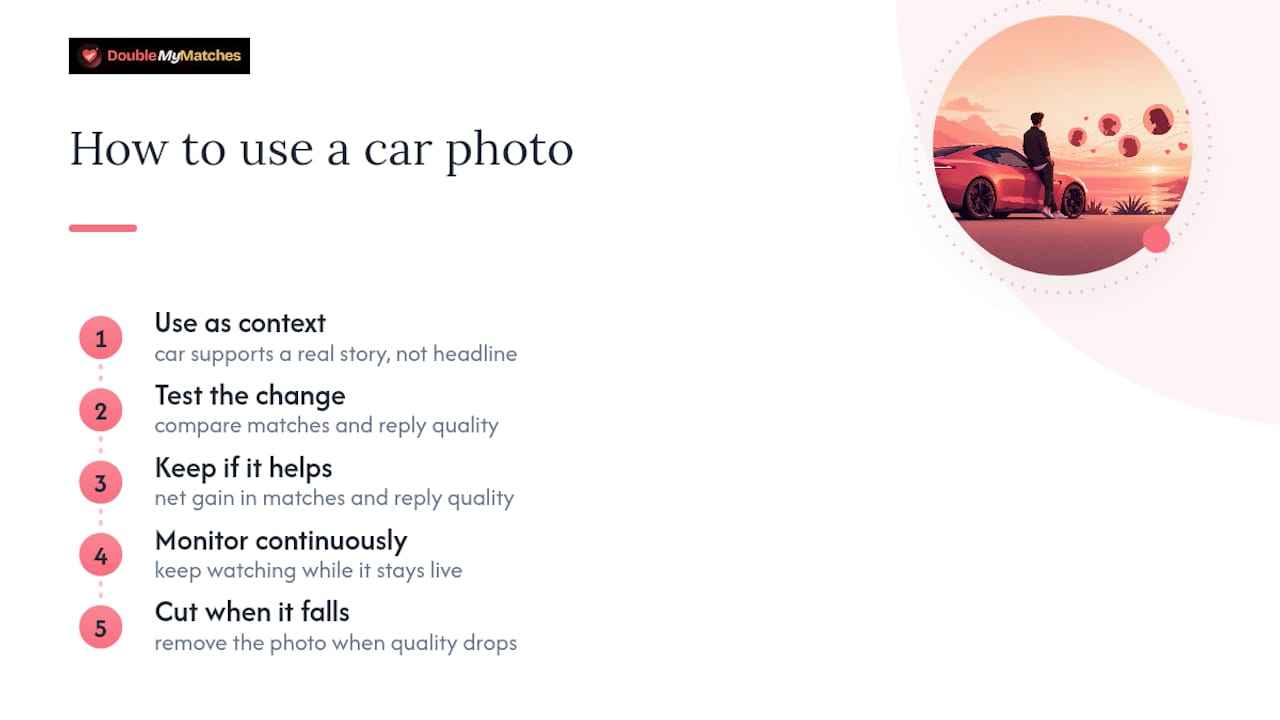
Possessions work best as context, not as your headline. A car photo that supports a real story, a road trip, a hobby, a shared memory, can earn its place. One that exists purely to signal status usually costs you more in trust than it gains you in swipes.
If you test the change and the data genuinely shows a net gain in matches and reply quality, keep it, but keep watching. The moment quality drops, cut it. Confidence sells; props don't.
— The Team @ DoubleMyMatches
Get an honest, private read on whether your car photo is helping or hurting
There are tools that provide an objective test beyond forums and gut feeling: instant, private scores for every photo in your lineup, ranked best to worst for the dating app you're using.
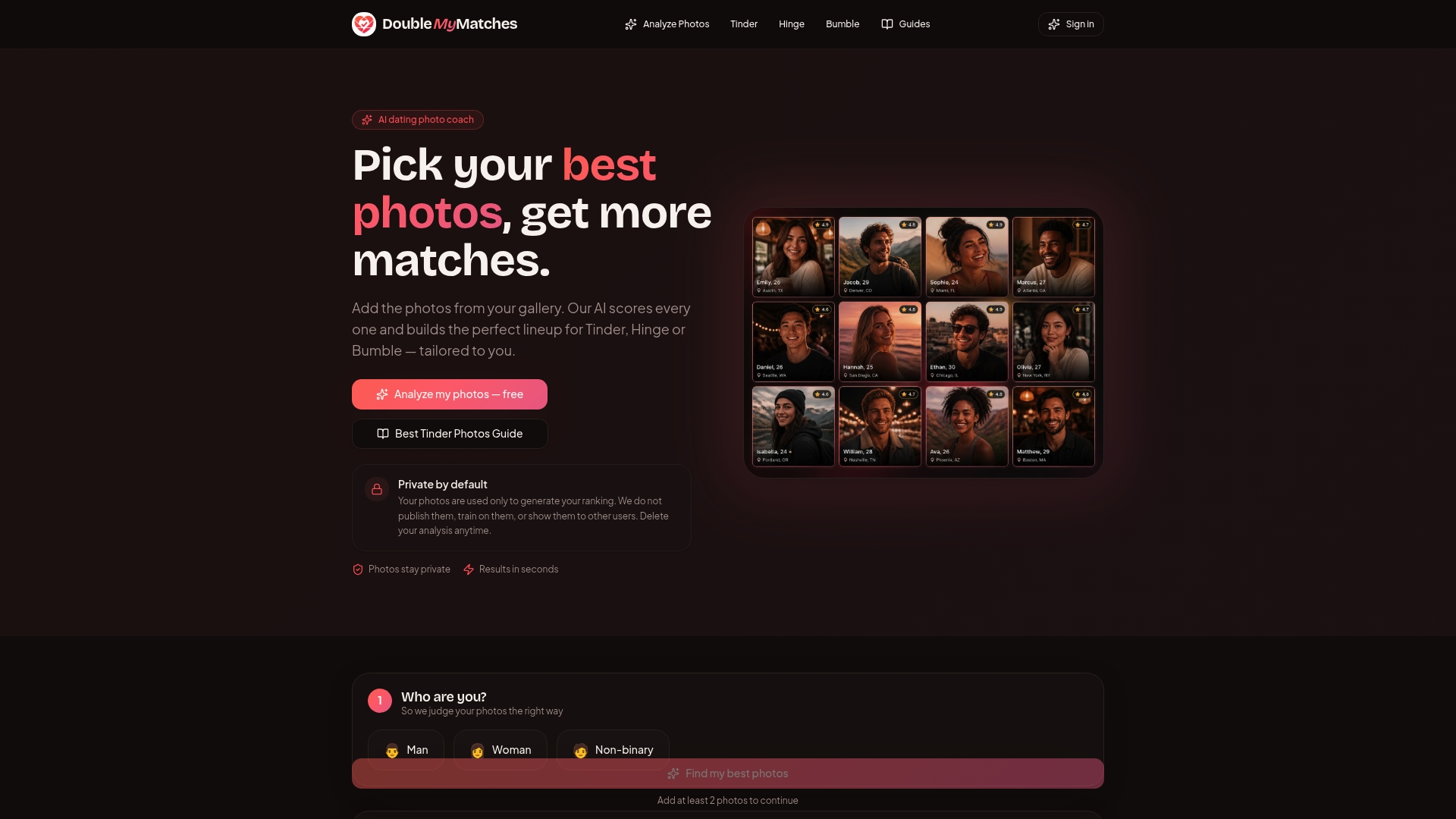
Instead of guessing whether that car shot is pulling its weight, upload your current set and see exactly how it scores on lighting, expression, and composition, then compare it against your other photos before you commit to a change. Analyses are private: photos are scored and discarded, never published or used to train the AI. If you've read this far wondering whether your Mercedes photo is secretly costing you matches, that's precisely the kind of question a dating photo analyser is built to answer. Get your report, see your best-to-worst ranking, and swap with evidence instead of a hunch.
Sources
- New rules of cartraction | Carwow
- UK study finds which cars are more likely to help land you a Tinder date | Carscoops
- That Porsche photo is sabotaging your dating app success | Yahoo Lifestyle