

If your lead photo clearly shows your face, wins on lighting and doesn't crop out anything important, keep it. If it's blurry, dark, or you're wearing sunglasses, swap it now and retest. Instant AI feedback checks three things every time: lighting, expression, and composition. You can get that verdict privately in seconds, with no guesswork involved.
TL;DR:
- Instant AI photo analysis provides results within 30 to 60 seconds, scoring lighting, expression, composition, and overall suitability for dating profiles.
- Improving the lead photo by fixing lighting and ensuring full face visibility often yields the most significant match rate increases.
- Reordering photos to prioritize the best face shot and removing images with poor scores across multiple dimensions can improve overall profile appeal.
- A small change, such as retaking a poorly lit or obscured face shot, can boost scores without requiring a complete photoshoot overhaul.
- Combining AI feedback with occasional human opinions enhances accuracy, especially for niche audiences or specific demographic preferences.
Table of Contents
- How instant dating photo feedback works
- What feedback looks at: lighting, expression, composition and context
- How to act on instant feedback: a simple workflow to update your profile
- Practical tips and quick fixes you can do right now
- Why trust instant AI feedback: DoubleMyMatches evidence and privacy practice
- Examples of common feedback and how to interpret them
- Comparison of popular instant feedback tools and their best use cases
- Why instant feedback beats guessing, and where it still falls short
- Get your own instant, private photo verdict
- Sources
- FAQ
How instant dating photo feedback works
Instant dating photo feedback follows a simple loop: you upload a photo, an algorithm scans it, and you get scores plus written notes back within moments. There's no waiting for strangers to vote and no awkward group chat asking "which one's better?"
Here's the typical workflow:
- Upload your photos — usually five to six, covering a mix of close-ups and full-body shots.
- Automated analysis runs — the tool checks lighting quality, facial expression, framing, and background clutter.
- You receive scores and notes — each photo gets a rating alongside specific comments ("harsh shadow on face" or "genuine smile detected").
- You get an ordering recommendation — which photo should lead your profile, and which should follow.
Instant AI analysers typically return results within 30 to 60 seconds, scoring lighting, composition, authenticity, and slot order in one pass. That speed is the whole point. You're not filling out a survey or waiting for a panel; you get a verdict fast enough to act on before you've even finished your coffee.
Pricing splits into two camps. A quick, free check usually gives you a single score or a rough grade. A paid, detailed report goes further, breaking down every photo across all three dimensions and telling you exactly what to fix. For anyone serious about their dating profile picture review, the detailed version is worth the small outlay, because vague feedback rarely changes behaviour.
What feedback looks at: lighting, expression, composition and context
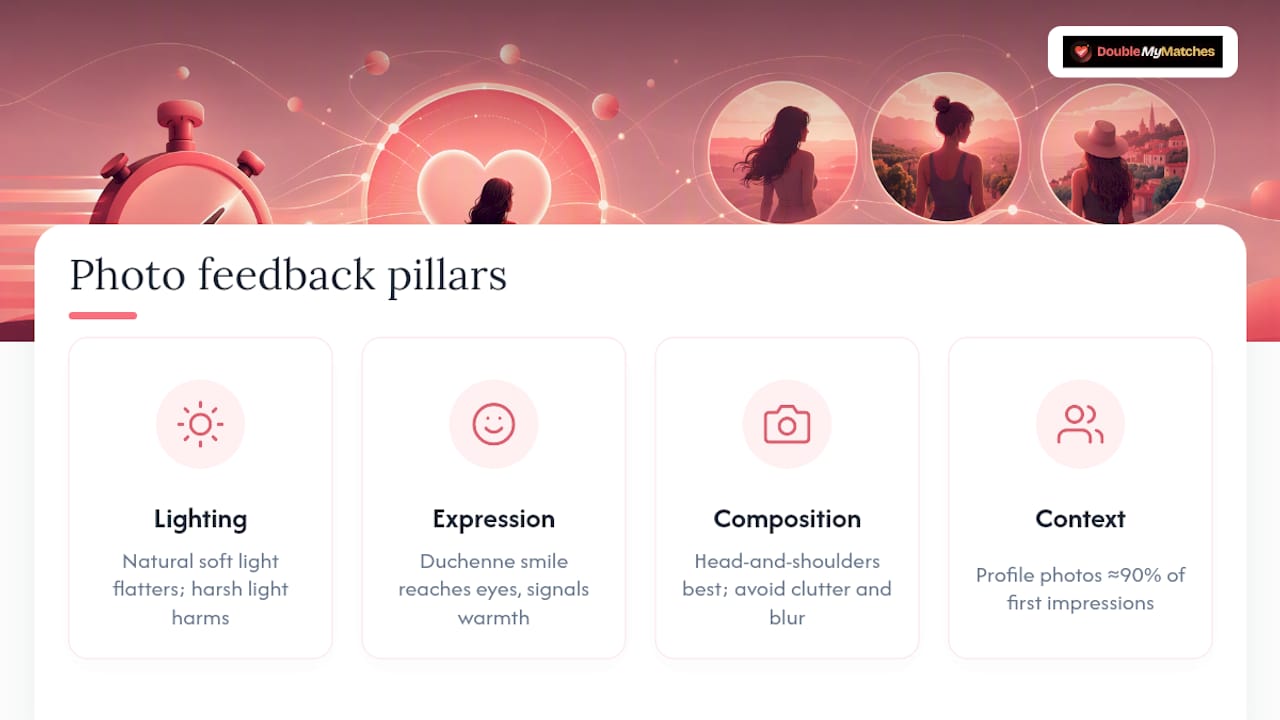
Every credible instant feedback tool scores against the same three pillars, because these are the things a stranger's brain processes before they've even registered your face properly.
Lighting makes or breaks a photo before anything else registers. Golden hour, soft window light, or open shade all flatter your skin and eyes. Harsh overhead lighting, direct flash, or backlighting that turns your face into a silhouette do the opposite; they're the most common reason a decent photo scores badly.
Expression signals warmth and approachability. A genuine smile, sometimes called a Duchenne smile because it reaches the eyes and not just the mouth, reads as trustworthy. A flat stare or a forced grin reads as distant, even if you didn't mean it to.
Composition covers framing and clarity. Head-and-shoulders shots work best as a lead photo because they show your face without ambiguity. Cluttered backgrounds, awkward crops, or blurry focus all drag your score down regardless of how good you look.
Context matters more than people expect. Data from over 10 million swipes shows profile photos account for roughly 90% of first impressions, and the strongest lineups mix genuine smiles, natural light, and variety across six photos. Activity shots and pets can help if they're secondary images that add colour to your story. As a lead photo, though, they usually hurt you, because the viewer's brain is trying to answer one question: "What does this person actually look like?" Anything that delays that answer costs you a swipe.
How to act on instant feedback: a simple workflow to update your profile
Getting a score is only half the job. What you do with it decides whether your match rate actually moves.
- Fix your lead photo first. If your top photo scores low on lighting or expression, that's your priority. Nothing else matters until this is sorted.
- Reorder before you delete. Sometimes a photo scoring well isn't bad, it's just misplaced. Move your strongest face shot to position one before you assume anything needs binning.
- Cut anything scoring poorly across two or more dimensions. One weak score might be forgivable. Two or three usually means the photo is doing more harm than good.
- Build a six-photo lineup with variety. Lead with a clear face shot, follow with a full-body or activity photo, then fill the remaining slots with variety: social settings, hobbies, a different angle.
- Retest after every change. Swap one photo, rerun the analysis, and compare scores. This is how you learn what's actually working rather than guessing.
Some fixes take five minutes. Bad lighting on an otherwise good photo? Retake it by a window today. But if every photo in your set has the same underlying issue, like consistently poor framing or the same dull background, that's a sign you need a proper session, not another quick snap on the sofa.
Pro Tip: Track your match rate for a week after each change, not just after a single day. Dating apps take time to redistribute your profile, so a two-day judgement is almost always premature.
Practical tips and quick fixes you can do right now
You don't need a professional photographer to fix most of what's dragging your scores down. Five changes make the biggest difference, and you can do all of them today.
- Change your lead crop so your face fills more of the frame; a distant full-body shot as photo one wastes your best asset.
- Keep your face fully visible. Sunglasses, hats, and low-angle shots that obscure your eyes all cost you approachability points.
- Swap patterned clothing for solid colours. Busy prints distract the eye and compete with your face for attention.
- Fix your lighting before anything else. Move to a window, face the light, and avoid overhead fixtures that cast shadows under your eyes.
- Aim for a genuine reaction, not a posed grin. Think of something that actually makes you laugh right before the shutter goes.
For a fast retake: stand near a window with the light in front of you, not behind. Keep your hands relaxed rather than crossed or stiff at your sides; pockets work if you're stuck. To get a real smile rather than a performance one, have someone say something ridiculous just before they take the shot.
Avoid these completely: mirror selfies (the phone always ruins the composition), group photos as your lead (matches waste time working out which person is you), and heavy filters that smooth skin into something unrecognisable. All three consistently score poorly across every instant feedback tool worth using.
App-specific tweaks matter too. On Tinder, lead with your clearest solo face shot since swiping happens fast. On Hinge, use prompts alongside photos that reinforce your personality rather than just your looks. On Bumble, where women message first, an approachable, warm expression outperforms anything that looks staged or overly polished.
Pro Tip: If you're testing multiple lead photos, change only one variable at a time, lighting, then expression, then background so you know exactly what moved your score.
Why trust instant AI feedback: DoubleMyMatches evidence and privacy practice
Instant feedback tools are only useful if you trust what they're telling you, and trust comes down to two things: accuracy and privacy.
- Some tools score photos against core dimensions like lighting, expression, and composition, tailored to what tends to perform well on popular dating apps such as Tinder, Hinge, and Bumble.
- Photos can be analysed once and then discarded. Nothing is published, and nothing is used to train the underlying model.
- Users report meaningful jumps in match rate after acting on their reports, echoing a wider pattern where photo changes have pushed match rates from 25% up to 43% in similar tests elsewhere.
- AI feedback is directional, not gospel. It's excellent at catching technical issues fast, lighting problems, poor framing, weak expressions, but it can't replicate the nuance of a demographic-specific human panel.
If your target audience is narrow (a specific age group, a specific type of match), pairing instant AI scoring with a small round of human votes gives you the most complete picture. Use AI to catch the obvious problems fast, then lean on human feedback for the final call on your lead photo when it matters most.
Examples of common feedback and how to interpret them
Most instant feedback reports repeat the same handful of notes. Knowing what they actually mean saves you from overreacting or ignoring something important.
"Face partially obscured" usually means sunglasses, a hat brim, or an awkward angle is hiding part of your eyes or mouth. Fix: retake with your face fully visible and lit evenly.
"Low lighting score, uneven shadows" points to mixed light sources, like a window on one side and a lamp on the other, casting conflicting shadows across your face. Fix: use one dominant light source, ideally natural.
"Low authenticity/expression score" often flags a posed or forced smile rather than a natural one. Fix: retake with genuine laughter or a candid moment rather than a held pose.
"Cluttered background" doesn't mean the photo is bad, it means the background is competing with you for attention. Fix: reshoot against a plainer wall, or crop tighter if possible.
"Photo works better as secondary, not lead" is one of the most common and most ignored pieces of feedback. A photo can score reasonably well and still be wrong for position one if it's a group shot, an activity shot, or a full-body shot where your face is too small. Fix: reorder rather than delete.
The pattern across almost all of these: the fix is rarely "take a completely new photo." It's usually a small adjustment, light, angle, crop, order, that moves the score meaningfully without needing a whole new photoshoot.
Comparison of popular instant feedback tools and their best use cases
Different instant feedback tools solve slightly different problems, and knowing which one fits your situation saves time.
Fast AI scoring tools are built for speed. You get a score and basic notes within under a minute, which suits anyone who wants a quick sanity check before uploading a new photo. These tools are best when you just need to know "is this obviously bad?" rather than a deep breakdown.
Detailed AI photo reports, the category DoubleMyMatches sits in, go further: full lineup ranking, per-photo notes across lighting, expression, and composition, and a recommended photo order. This suits anyone actively rebuilding their profile rather than tweaking one image.
Demographic voting panels work differently entirely. Instead of an algorithm, real people from a specific age group or background rate your photos, with platforms like Keeper recommending around 30 ratings per photo for a stable score. This suits people targeting a narrow demographic where AI's general patterns might miss local taste. It's slower and sometimes public, which matters if privacy is a concern.
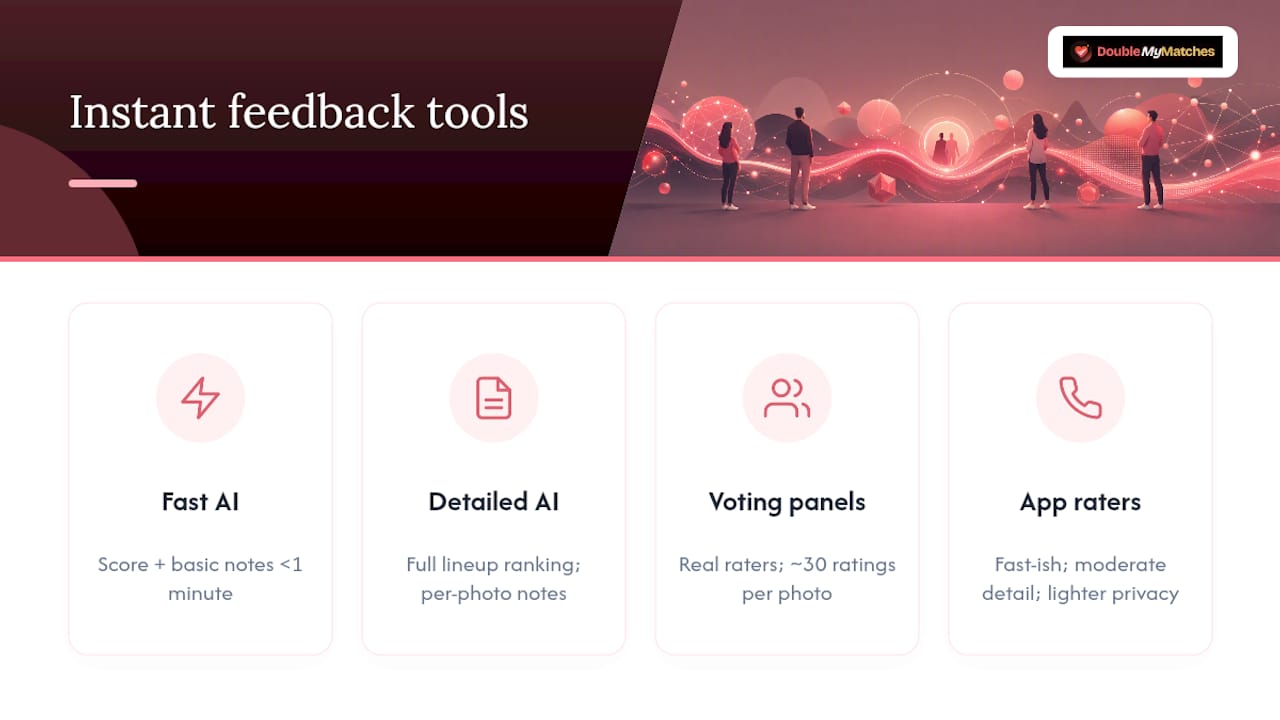
App-based instant raters, available through mobile app stores, offer a middle ground: fast enough for casual use, detailed enough to catch obvious problems, though usually lighter on privacy assurances than dedicated one-time analysis services.
For most people wanting a private, fast, and specific verdict without waiting on strangers' opinions, a detailed instant AI report remains the most practical starting point.
Why instant feedback beats guessing, and where it still falls short
The biggest mistake people make with dating photos isn't picking a bad picture. It's trusting their own judgement about which photo is good. You're too familiar with your own face to see it the way a stranger does, and a stranger only needs about two seconds to form an opinion before swiping. That's the gap instant feedback closes: it replaces your biased instinct with a consistent, repeatable standard.
Where conventional advice falls short is treating photo selection as a one-off decision. Most people upload five photos once, then never revisit them. But scores change as trends shift and as your own photos age. Treating your lineup as something to retest every few months, not something to set and forget, is the actual discipline that separates people getting consistent matches from people wondering why their profile went quiet.
What should you prioritise first? Fix the lead photo. Every other adjustment, order, variety, secondary shots, matters far less than whether your first image passes the two-second test. Get that right before you touch anything else.
— The Team @ DoubleMyMatches
Get your own instant, private photo verdict
Reading about lighting scores and expression markers only gets you so far. At some point, you need your actual photos scored, ranked, and told to your face which one is holding you back. This service is built for exactly that moment: upload your photos and get a ranked lineup with targeted fixes, including which photo should lead and which ones are quietly costing you matches.
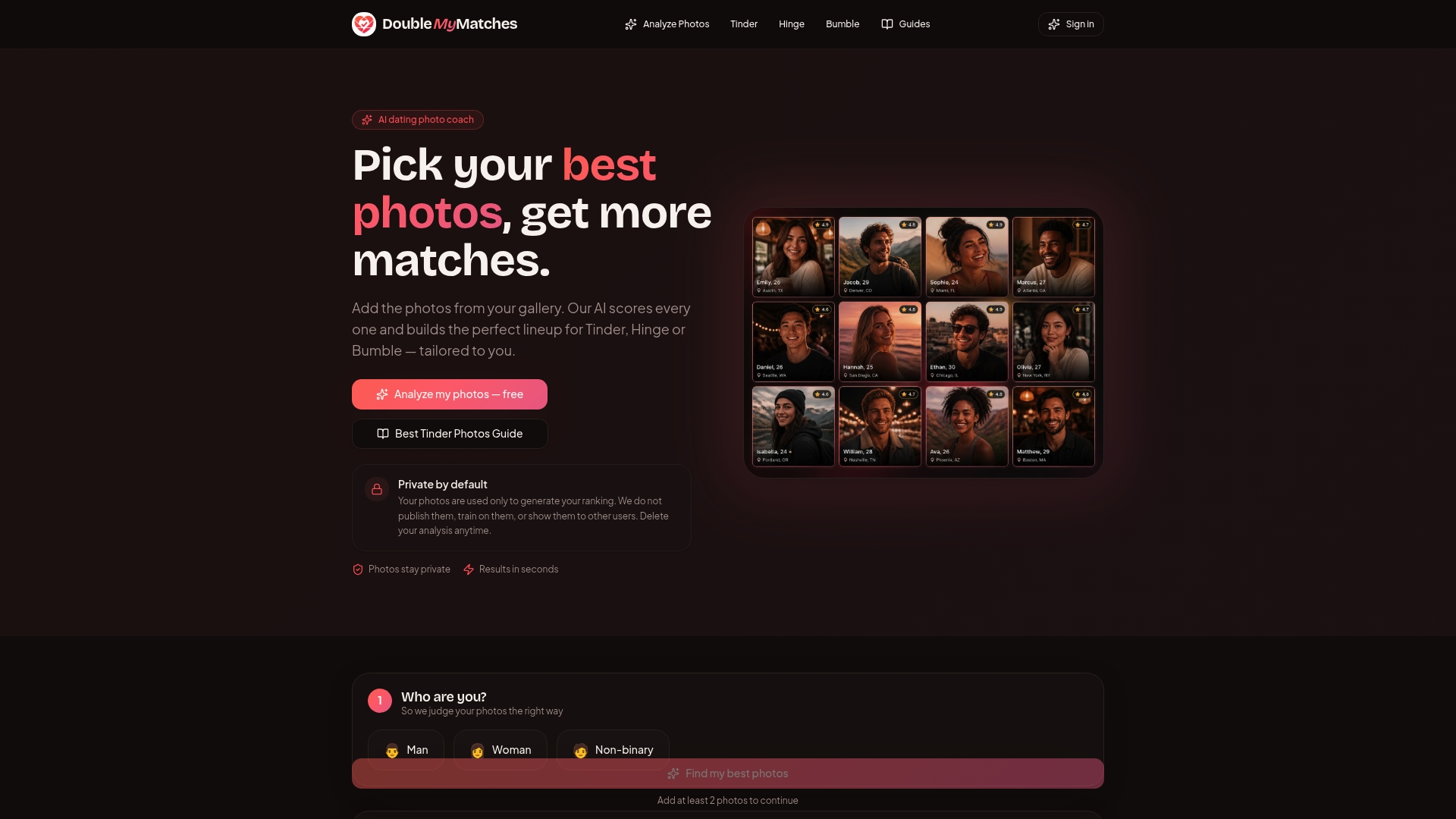
Analyses can be one-time. Photos are reviewed, scored, and then discarded, never stored, never used to train the underlying model, and never shared. Turnaround can be immediate, so you are not waiting days for a verdict. After purchase, you typically get a single detailed report, with options to buy bundles or an annual unlimited pass for those who refresh their profile often.
If you're ready to stop guessing which photo is quietly working against you, get your dating photo analyzer report today and find out exactly what to fix.
Sources
For deeper detail on the data behind photo-driven match rates, LensCherry's analysis of over 10 million swipes is worth a read, alongside Keeper's guidance on demographic photo testing. For lighting technique specifically, Lemonshark Studio's practical lighting guide covers setups you can replicate at home with a single window.
- 12 Dating Photo Tips That Tripled Match Rates (2026 data) | LensCherry
- Dating profile photo test — Get rated by your target audience | Keeper
FAQ
How do you give useful feedback on a photo?
Focus on three concrete things rather than a vague "looks good" or "looks bad": lighting quality, facial expression, and framing. Specific notes ("the shadow under your eyes is too dark") are far more actionable than general impressions.
Is Photofeeler legit?
Photofeeler uses human voting rather than AI scoring, and it's a legitimate option for demographic-specific feedback, though it takes longer to gather enough votes for a stable result. For a faster, private alternative, an AI photo analyzer delivers scores in seconds rather than days.
Is it safe to put pictures on a dating app?
Reasonable caution matters: avoid images with visible personal details like your address or workplace, and check each app's own privacy settings. When using a third-party analysis tool, confirm whether photos are stored or discarded after review; DoubleMyMatches discards every photo once analysis is complete.
What's a red flag in online dating photos?
Photos that hide your face (sunglasses, low angles, heavy filters), group shots where you're hard to identify, and outdated pictures that don't match your current appearance are the most common red flags that cause matches to lose trust quickly.
How much does instant dating photo feedback cost?
Basic checks are often free, while detailed reports covering your full photo lineup, scoring, and ordering recommendations usually come as a one-time paid purchase, with some services offering bundles for multiple reports.