

AI dating profile analysis audits your photos and bio, ranks every image by swipe potential, and returns prioritised fixes you can act on today. Services like DoubleMyMatches use computer vision and natural language processing to do in seconds what would take a human coach hours. Industry A/B tests show that small, targeted photo and bio changes can substantially affect match rates, and all reputable UK services operate under GDPR, meaning your images are handled with clear consent and deletion guarantees.
Here is what a typical analysis returns:
- Your photos ranked from strongest to weakest
- Per-photo scores for clarity, expression, lighting, and approachability
- A recommended lead photo
- Prioritised bio edits and conversation-hook suggestions
Table of Contents
- What does dating profile analysis actually check?
- How does the AI photo analysis pipeline work?
- What do your analysis results look like?
- What does research say about photos vs text?
- Privacy, GDPR, and what to check before you upload
- How to improve your dating profile using the analysis output
- What results should you realistically expect?
- AI analysis vs human expert review: which is better?
- Key takeaways
- A note from the team at DoubleMyMatches
- What DoubleMyMatches gives you right now
- Further reading and sources used in this guide
What does dating profile analysis actually check?
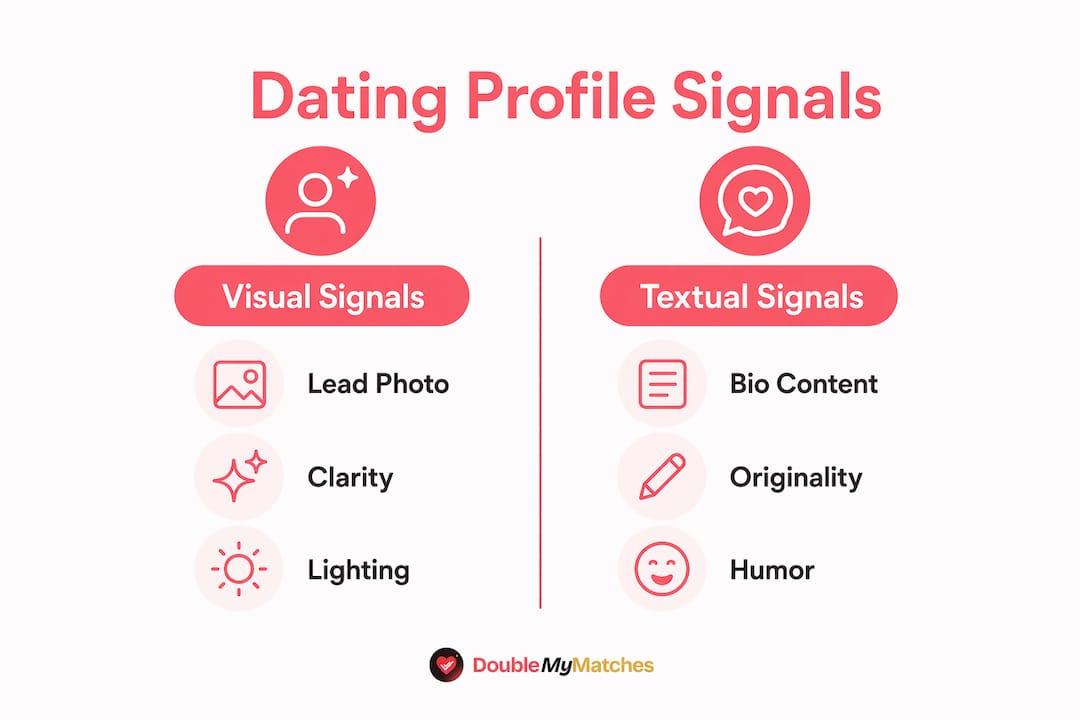
The analysis splits into two streams: visual and textual. Both matter, but they are not equal.
Visual signals
| Factor | What is checked | Why it matters |
|---|---|---|
| Face visibility | Eyes clear, no sunglasses, face fills frame | Primary driver of swipe decisions |
| Lighting | Natural vs artificial, exposure, contrast | Flat or harsh light reads as low effort |
| Expression | Genuine smile vs posed | Duchenne smiles increase attractiveness ratings |
| Composition | Framing, distance, background clutter | Busy backgrounds compete with your face |
| Photo variety | Headshot, full-body, hobby, social, candid | Profiles with six photos get about 40% more matches than those with three, according to industry A/B tests. |
| Friction photos | Group shots, mirror selfies, heavy filters | These create source ambiguity and reduce trust |
Textual signals
- Bio specificity: vague interests ("I love travel") score lower than concrete hooks ("ranking every ramen spot within 20 minutes of me")
- Disclosure level: research supports a Goldilocks balance — enough detail to seem open, not so much that curiosity disappears
- Conversation hooks: prompts and bio lines that give a match an easy opening question
- Stated intent: a brief, honest signal about what you are looking for filters better matches in
- Consistency: photos and text pointing in the same direction build trust
Visual fixes move the needle fastest. Bio edits matter most after your photos pass the first filter.
Pro Tip: Before uploading, check whether your lead photo answers three questions at a glance: what do you look like, does your face fill the frame, and is the background clean? If any answer is no, that photo should not be first.
How does the AI photo analysis pipeline work?
Understanding the steps helps you trust the output and prepare better inputs.
- Input ingestion. You upload screenshots from Tinder, Hinge, or Bumble. The system reads image dimensions, strips unnecessary metadata, and queues each photo for processing.
- Pre-processing. Each image is cropped to a standard aspect ratio, sharpened if blurry, and passed through a face-detection model to locate facial regions.
- Feature extraction. A convolutional neural network (CNN) maps facial landmarks (eye position, jaw line, mouth corners), measures lighting histograms, estimates head pose, and scores background complexity.
- NLP analysis. A language model reads your bio and prompt answers, scoring specificity, hook density, disclosure level, and consistency with your photo signals.
- Multimodal fusion. Visual and textual scores are combined into a single profile-level model, weighted by the relative impact each signal has on swipe behaviour.
- Scoring and normalisation. Each photo receives sub-scores; the model normalises them against a reference distribution so your rank is meaningful, not arbitrary.
- Ranking and recommendations. Photos are ordered best to worst. The system generates plain-English fixes for the top three issues, prioritised by expected impact.
Vision models can misread cultural clothing or accessories as approachability signals, and performance can vary across demographic groups. These are real limitations. A service worth using will flag low-confidence results rather than hide them.
Pro Tip: For the best scores, photograph yourself in natural daylight, facing a window, with a plain wall behind you. This single change removes the two most common flags: poor exposure and a competing background.

What do your analysis results look like?
A good output is specific enough to act on without needing a translator.
- Overall profile score (e.g. 67/100) with a short summary of the biggest gap
- Per-photo sub-scores for clarity, expression, lighting, and approachability
- Ranked photo order from strongest to weakest, with the suggested lead photo highlighted
- Three prioritised fixes, each tied to a specific photo or bio element
A typical fix reads like this: "Swap your lead photo with image 3. Your face is clearer, the background is neutral, and your expression is more natural. Crop tighter to remove the left-hand wall." That is the level of detail worth expecting.
Low-confidence flags appear when face detection is ambiguous (a distant shot, heavy shadow, or partial face). These are not failures; they are honest signals that the photo needs a retake rather than a minor edit.
Pro Tip: Treat the ranked list as a prioritised checklist: swap first, remove friction photos second, then consider retakes. Removing a weak photo often lifts your profile score more than adding a new one.
What does research say about photos vs text?
The evidence is consistent: photos act as a gatekeeper. Eye-tracking studies show that pictures attract initial attention and largely determine whether someone reads the bio at all. Photos and text are processed relatively independently, which means a weak lead photo can bury an excellent bio entirely.
On the text side, original, concrete self-disclosure increases perceived intelligence and humour, improving dating intention. UC Berkeley research found that profiles signalling curiosity about a potential partner, rather than just listing personal qualities, were rated significantly more appealing. The practical takeaway: fix your photos first, then write a bio that asks as much as it tells.
| Signal type | Primary effect | Optimisation priority |
|---|---|---|
| Lead photo | Determines whether bio is read | First |
| Photo set variety | Builds a rounded impression | Second |
| Bio specificity | Converts swipes to messages | Third |
| Conversation hooks | Reduces friction for first message | Fourth |
Privacy, GDPR, and what to check before you upload
UK users are protected by GDPR, which means any service processing your photos must meet clear standards. Before uploading, confirm the following:
- Explicit consent: the service must state clearly what your photos will be used for
- Purpose limitation: photos should be used only for analysis, nothing else
- Deletion guarantee: images should be deleted after analysis, not stored indefinitely
- No training use: your photos should not be used to train the AI unless you have opted in
- Secure transfer: look for TLS encryption on any upload page
- Clear privacy policy: a named data controller and a contact address for deletion requests
DoubleMyMatches deletes photos after analysis and does not use them for model training. That is the standard to expect from any reputable service.
Pro Tip: If privacy is a concern, upload watermarked screenshots rather than original files. Ask the service for written confirmation of deletion — a short email reply is sufficient and any legitimate provider will send one.
How to improve your dating profile using the analysis output
Turn the results into a prioritised action list and work through it in order.
- Swap your lead photo to the highest-ranked image from the analysis.
- Remove friction photos: group shots where you are hard to identify, mirror selfies, heavily filtered images, and distant travel shots.
- Add a clear full-body shot if you do not already have one.
- Add a candid or hobby photo that shows you doing something specific.
- Tighten your bio to a moderate disclosure level with one concrete conversation hook.
Before/after example: replacing a group lead photo with a clean headshot removes source ambiguity immediately. The viewer knows who you are in under a second, which is all the time you have.
For A/B testing, change one variable at a time and measure over at least one week. Track swipe-right rate, match velocity, and message rate. Keep your swiping behaviour consistent so you are not comparing different activity levels.
Pro Tip: Shoot new photos between 9–11 AM or 3–5 PM on a bright day. Soft directional light at those times flatters most skin tones and avoids the harsh midday shadows that tank lighting scores.
For a full walkthrough of photo selection step by step, the DoubleMyMatches blog covers the sequencing process in detail.
What results should you realistically expect?
Most people see a measurable change within 48 hours to two weeks, depending on how active they are on the app and how significant the photo swap was.
Metrics worth tracking:
- Swipe-right rate (visible on Tinder Gold and Bumble Boost)
- Match velocity: how many matches per day compared to your baseline
- Message rate: what percentage of matches send or reply to a first message
- Reply quality: are conversations going further than one exchange?
Confounding factors are real. Location, app algorithm updates, time of day, and how often you swipe all affect outcomes. Change one variable at a time, document your baseline before making edits, and give each change at least a week before drawing conclusions. No analysis tool guarantees matches, but removing avoidable friction consistently improves results.
For context on how app algorithms affect your visibility, it is worth reading alongside your analysis results.
AI analysis vs human expert review: which is better?
Neither is strictly superior. They solve different parts of the problem.
AI analysis is fast, consistent, and objective. It scores every photo against the same criteria every time, catches technical issues (poor exposure, cluttered backgrounds, ambiguous face detection) without ego, and returns results in minutes. It scales to any number of photos without fatigue. The weakness is context: a vision model can misread a cultural accessory as a negative approachability signal, or miss the warmth in a candid shot that a human would immediately notice.
Human expert review brings judgement, cultural literacy, and the ability to read tone. A good coach spots whether your bio sounds defensive, whether your photos tell a coherent story, and whether your stated intent matches your overall vibe. The trade-off is cost, subjectivity, and turnaround time.
The most practical approach is to use AI analysis first. It handles the technical baseline quickly and cheaply, flagging the clear wins. Then, if you want a second opinion on tone, narrative, or demographic nuance, a human review adds genuine value on top of a technically clean profile.
Key takeaways
AI dating profile analysis works by auditing visual and textual signals, ranking your photos by swipe potential, and returning specific fixes that remove friction before a viewer ever reads your bio.
| Point | Details |
|---|---|
| Fix the lead photo first | The first photo drives roughly 70% of the swipe decision; everything else is secondary. |
| Photos act as gatekeepers | Eye-tracking research confirms photos are processed before text; a weak lead buries a strong bio. |
| Remove before you retake | Deleting friction photos (group shots, mirror selfies) often lifts your score more than adding new images. |
| Bio follows photos | Apply the Goldilocks disclosure rule: specific enough to spark curiosity, not so detailed that nothing is left to discover. |
| DoubleMyMatches | Provides AI photo scoring, ranked photo order, and a deletion guarantee — upload screenshots to get your ranked results. |
A note from the team at DoubleMyMatches
Most people who come to us have already tried rewriting their bio three times. The photos have barely changed. That pattern is almost universal, and it is the wrong order of operations. Photos are the filter. The bio is the follow-through.
What we have built with the AI Dating Photo Coach is a tool that tells you, clearly and without guesswork, which photo to lead with and what is holding the others back. The privacy side matters to us too: your photos are analysed and deleted. They are never stored, never published, never used to train the model. That is not a footnote; it is a design decision.
The results users report are not subtle. Swapping a lead photo based on the ranked output is consistently the single highest-impact change. If you want to see the before-and-after evidence, the DoubleMyMatches blog has the case studies.
What DoubleMyMatches gives you right now
Better matches start with knowing which photo to lead with. DoubleMyMatches gives you that answer in minutes. Upload your screenshots and the AI Dating Photo Analyser scores every image, ranks them from strongest to weakest, and tells you exactly what to fix: swap, crop, retake, or remove.
You get a ranked photo order, per-photo scores across clarity, expression, and lighting, tailored retake guidance, bio prompt suggestions, and a full privacy guarantee. Photos are analysed and deleted. No storage, no training, no exceptions.
Ready to see your ranked results? Upload your photos now and get your first report in under two minutes.
Further reading and sources used in this guide
Peer-reviewed research
- What People Look at in Multimodal Online Dating Profiles — eye-tracking and impression-formation study; primary source for the photo-as-gatekeeper effect
- Originality in online dating profile texts (PLOS ONE) — evidence that concrete, original bio text improves perceived attractiveness
- The Goldilocks rule of online dating profiles (PsyPost) — research on optimal self-disclosure levels in dating bios
- Feeling Known and dating profile appeal — UC Berkeley Haas — Schroeder and Fishbach research on signalling curiosity about a partner
Industry and practitioner sources
- How to optimise your dating profile for maximum matches (DateScout) — A/B test figures on match-rate shifts, photo count effects, and specific photo mistakes
- Dating app profile optimisation tips (DatingHelpAI) — practitioner guidance on platform-specific optimisation
- AI dating profile analyser product page (DatingHelpAI) — workflow and output examples for profile analysis tools
DoubleMyMatches resources
- AI Dating Photo Coach — product overview and privacy guarantee
- Benefits of profile photo analysis — case studies and before/after results
- Photo variety guide — guidance on building a balanced photo set
Before uploading photos to any service, review its privacy policy to confirm deletion timelines and data-use terms. This article is general information; for specific legal questions about data rights under UK GDPR, consult the ICO guidance or a qualified professional.