
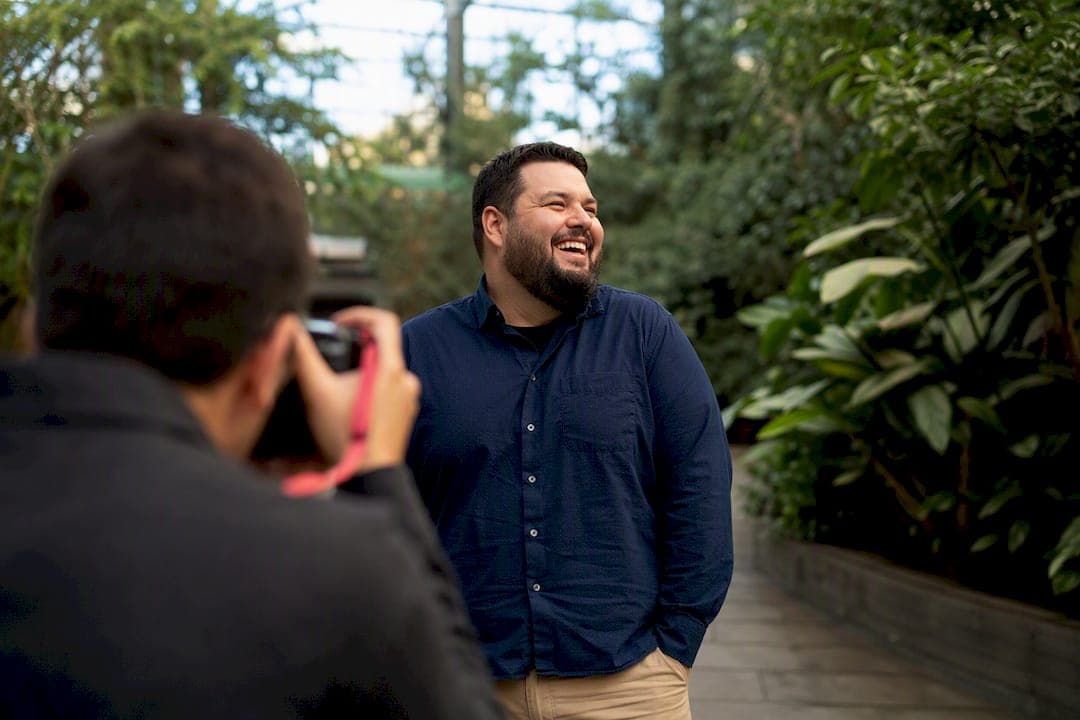
Fix light, angle and expression before anything else. Get one clean lead portrait, one honest full-body shot, and four more photos showing real variety, and your matches will improve fast. Wardrobe fit matters more than brand, and every photo needs to be recent. Get those pieces right and the rest of your profile takes care of itself.
TL;DR:
- Soft, directional lighting and shooting in open shade significantly improve photo quality and avoid harsh shadows that distort features.
- Positioning the camera 8 to 10 feet back at eye level reduces distortion and elongates the face, especially avoiding wide-angle selfie effects.
- Using natural, relaxed poses such as the three-quarter turn or leaning against a wall helps add depth and comfort to full-body photos.
- Wardrobe fit and solid, muted colors trump brand labels or busy patterns, enhancing visual clarity at small phone thumbnail sizes.
- Incorporating activity, social, or personal props creates engaging images that reveal personality and generate conversation starters for matches.
Table of Contents
- Dating photos for overweight men: why light, angle and expression matter most
- Poses that flatter a fuller frame
- Wardrobe rules that actually read well on a phone screen
- Building your six-photo lineup
- Running your own shoot, and when a professional earns their fee
- How to evaluate and test your photos objectively
- Skin and grooming details that photograph well
- Choosing backgrounds that work with your shape, not against it
- Using props and activities to show who you actually are
- Getting your head in the right place before the camera comes out
- Real examples: what actually works and why
- A short note from the Team @ DoubleMyMatches
- Want a second opinion on which photo should lead?
- Sources
Dating photos for overweight men: why light, angle and expression matter most
Every strong dating photo comes down to three variables you control completely: light, angle and expression. A photographer's guide to dating profile pictures puts these three ahead of anything else, including outfit or location, and that's the right order of priority.
Light should be soft and directional, never harsh. Stand facing a window indoors, or shoot outside in open shade (under a tree, near a building, just after sunrise or before sunset). Avoid direct sun, which carves harsh shadows across the face, and skip overhead bulbs, which do the same from above.
Angle is where most phone selfies go wrong. Holding the phone at arm's length forces a wide-angle lens close to your face, which distorts proportions and exaggerates a double chin. Hand your phone to a friend and have them stand 8 to 10 feet back, at your eye level. That distance alone, backed by the same photographer's guide, removes most of the unflattering distortion people blame on their body rather than the camera.
Expression is the hardest to fake and the easiest to fix with volume. A real smile reaches the eyes, and it rarely shows up on command.
- Have your photographer make you laugh between frames rather than asking for a "cheese" smile.
- Shoot 20 to 30 frames in one session to land 6 to 10 genuine keepers.
- Look just past the camera, not directly into the lens, for a more relaxed gaze.
Poses that flatter a fuller frame
Standing square to the camera, arms at your sides, is the single most common pose mistake. It flattens your shape and adds visual width. A three-quarter turn, where your body angles roughly 45 degrees away from the lens while your face turns back towards it, creates depth instead of a flat silhouette.
Try these three setups:
- The lean. Rest a shoulder against a wall or doorframe, cross one ankle over the other, and let your weight settle into the lean. This breaks up rigid posture instantly.
- The mid-walk. Get someone to catch you walking towards the camera, mid-stride, looking up and smiling. Movement photographs far more naturally than a static pose ever will.
- The seated lean-forward. Sit on a step or low wall, elbows resting near your knees, weight forward. This shortens visual distance and avoids the stiffness of sitting bolt upright.
Shift your weight onto one hip rather than standing centred and even. That small asymmetry, recommended across pose guidance for natural-looking dating photos, reads as relaxed confidence rather than a passport photo.
Pro Tip: Don't overcorrect your posture by throwing your shoulders back hard. For men carrying weight around the midsection, an exaggerated chest-out stance can push the stomach forward and make it more prominent. Aim for relaxed and upright instead, with weight settled on one hip.
Keep hands doing something: holding a coffee cup, resting in a pocket, touching a railing. Dangling arms with nothing to do is what makes most poses look wooden.
Wardrobe rules that actually read well on a phone screen
Fit outranks label, price and trend every time. A shirt that sits close at the shoulders and chest without pulling across the belly does more for your photos than any designer name. Look for structured fabrics with a bit of stretch, and get sleeves and collars tailored if you can, because loose, boxy clothing adds visual bulk rather than hiding it.
Colour choices matter more once your photo shrinks to a thumbnail on someone's phone. Dating profile guidance from Signal Studio NYC recommends solid, muted tones like navy, charcoal and deep green, which photograph cleanly at small sizes.
- Avoid pure white, which can blow out and flatten detail in bright light.
- Avoid pure black too, which swallows shape and makes edges hard to read.
- Skip busy patterns, checks and loud logos, which distract from your face in a small frame.
A textured jacket, a rolled cuff or an open button-down layered over a plain tee adds shape without competing for attention.
Building your six-photo lineup
Most dating apps show six photo slots, and each one should do a specific job. Randomly uploading your six best individual shots, without thinking about order or variety, is where a lot of otherwise decent photos get wasted.
- Lead portrait. A clear, well-lit head-and-shoulders shot with a genuine smile. This is your thumbnail, so it needs to be sharp and instantly warm.
- Full-body shot. One clean image showing your full frame, taken from the recommended distance to avoid distortion. Research on natural-looking poses links full-body images to noticeably higher match likelihood, partly because they remove any suspicion that you're hiding something.
- Activity shot. You doing something, hiking, cooking, playing a sport, that gives a match something concrete to ask about.
- Social shot. You with one or two friends, smiling naturally, showing you have a life outside the app.
- Second portrait. A different setting, outfit or expression from your lead shot, proving the first photo wasn't a fluke.
- Wildcard. Something personal, a hobby, a pet, a place you love, that starts a conversation.
Order matters. Never let a promising lead photo give way to a much less flattering second slot; that kind of reveal erodes trust fast. Check each image for lighting, a genuine expression and honest recency before it goes in.
Running your own shoot, and when a professional earns their fee
A DIY session can produce genuinely good results if you treat it like a proper shoot rather than a five-minute selfie session.
- Shoot during soft daylight, ideally an hour after sunrise or before sunset.
- Position your friend 8 to 10 feet away, camera at your eye level.
- Take 20 to 30 frames across two or three locations and outfits.
- Mix poses: standing three-quarter turn, walking, seated lean.
- Keep backgrounds simple so you stay the focus of the frame.
That 20 to 30 frame target lines up with what professional photographers recommend for landing 6 to 10 usable keepers, a rough 3 to 1 ratio between shots taken and shots worth keeping.
Where a professional session earns its cost is expression on demand. A skilled photographer knows how to prompt a laugh, catch it mid-frame and reset the pose in seconds, something a self-timer or a distracted friend rarely manages. If you've struggled to get a lead shot that feels natural, comparing a professional session against AI-based analysis helps you decide where to spend your time and money.
Pro Tip: Budget for at least one outfit change and 30 to 45 minutes of shooting time. Rushing a DIY session is the fastest way to end up with six photos of the same stiff pose from slightly different angles.
How to evaluate and test your photos objectively
You are the worst judge of your own dating photos, mostly because you already know the context behind each one. A photo that feels awkward to you might read as completely natural to a stranger scrolling past it.
Run a simple blind test: send three or four candidate shots to a handful of friends, no context, and ask which one they'd swipe on first. Small polls like this catch obvious problems (bad lighting, an odd expression) that you've stopped noticing.
- Ask friends to rank photos, not just approve or reject them.
- Compare results across at least five people to avoid one person's bias skewing the picture.
- Re-shoot rather than settle if every photo in a batch scores low.
AI-based photo ranking adds a layer of consistency human polls can't match, scoring each image on lighting, expression and composition the same way every time. DoubleMyMatches analyses your photos, ranks them best to worst, and then discards the images after the session, so nothing is stored or used to train the model. Treat the AI score as one input, not the final word. If a photo scores well but doesn't feel like you, trust your gut over the number, and use a proper pre-upload checklist to catch anything the ranking might miss.
Skin and grooming details that photograph well
Skin texture reads differently once light and a camera lens get involved, and that matters more at close range in a lead portrait than it does in the mirror. A fuller face tends to hold shine more visibly under indoor lighting, so a mattifying moisturiser or a light powder on the forehead, nose and chin can stop your skin looking greasy under flash or bright sun.
Facial hair grooming deserves five minutes before any shoot. A well-defined beard line or a clean shave sharpens your jawline far more than any camera angle can, and patchy, untrimmed stubble tends to draw the eye in a way that competes with your expression.
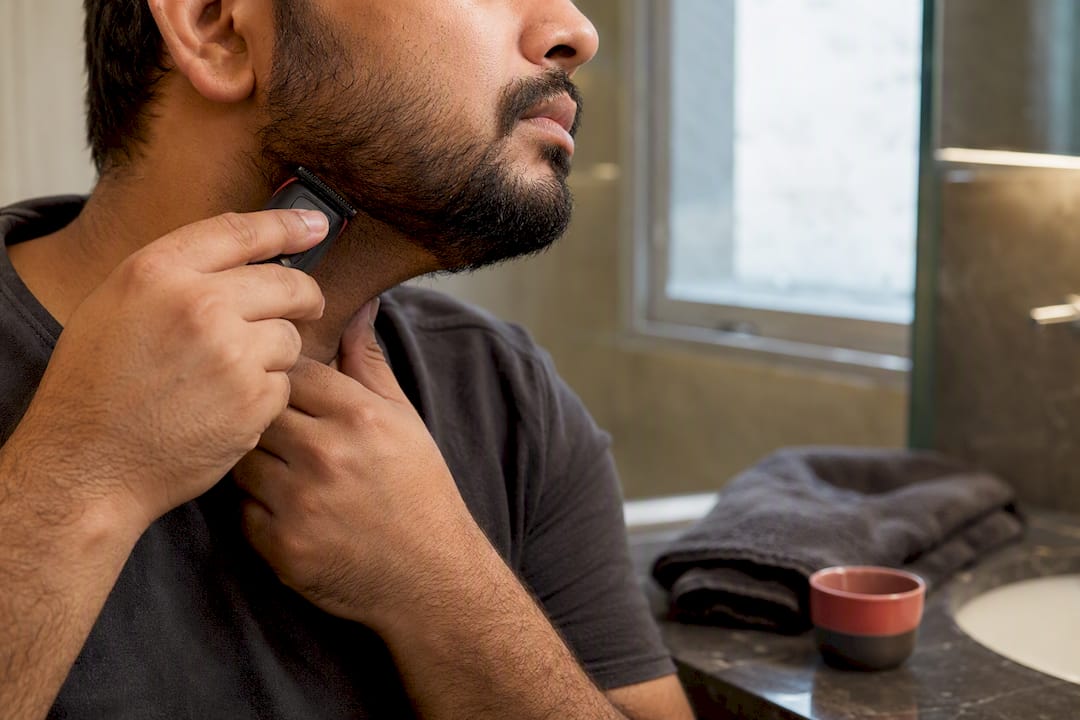
Trim nose and ear hair the night before, not the morning of, so any redness has time to settle. Chapped lips show up more clearly than you'd expect in close crops, so a plain lip balm applied 20 minutes before shooting avoids a dry, flat look in the lead portrait slot.
If you sweat easily, especially in warmer weather or after walking to a shoot location, give yourself ten minutes to cool down and pat your face dry before the camera comes out. A slightly flushed, damp forehead reads as tired in photos even when you feel fine. None of this is about looking like someone else. It's about making sure ordinary grooming habits translate clearly through a lens rather than getting lost or exaggerated by it.
Choosing backgrounds that work with your shape, not against it
Background choice affects how your body reads far more than most men expect. A cluttered background with strong horizontal or vertical lines, bookshelves, fences, tiled walls, can visually compete with your outline and make your shape harder to read clearly. Simple, uncluttered settings let the eye go straight to your face and posture instead.
Textured, natural backdrops work particularly well: brick walls, foliage, weathered wood, open water. These give visual interest without introducing competing shapes, and they tend to photograph consistently well regardless of body type.
Standing a few feet in front of your background, rather than pressed against it, adds separation and depth. This matters more for full-body shots, where being flush against a flat wall can flatten your silhouette and make you look wider than you are. A small gap between you and whatever's behind you, even just a metre, adds shadow and dimension that a phone camera can't fake in editing.
Outdoor settings with good natural light generally outperform indoor ones for full-body shots, since indoor lighting often forces you closer to walls and furniture, cramping the composition. A park path, a café terrace or a quiet street corner all give you room to include a genuine full-body frame without the background pressing in.
Avoid mirrors entirely for anything beyond a quick check shot. Mirror selfies almost always introduce phone-in-hand awkwardness and bathroom clutter, neither of which does your photos any favours.
Using props and activities to show who you actually are
A prop or an activity gives a match something to react to beyond your appearance, and it takes pressure off your face and body to carry the entire photo. Holding a coffee cup, standing next to a bike, mid-cast on a fishing trip: each of these gives context and a reason to swipe past "attractive" and into "interesting."
Activity shots work best when the activity itself is visible, not implied. A photo of you sitting on a bench isn't an activity shot just because you're outdoors; a photo of you actually hiking, cooking at a stove, or playing an instrument tells a story a static pose can't. Guidance on natural-looking men's dating photos points specifically to lifestyle frames like these as strong conversation starters, because they give a match an easy, low-pressure opener.
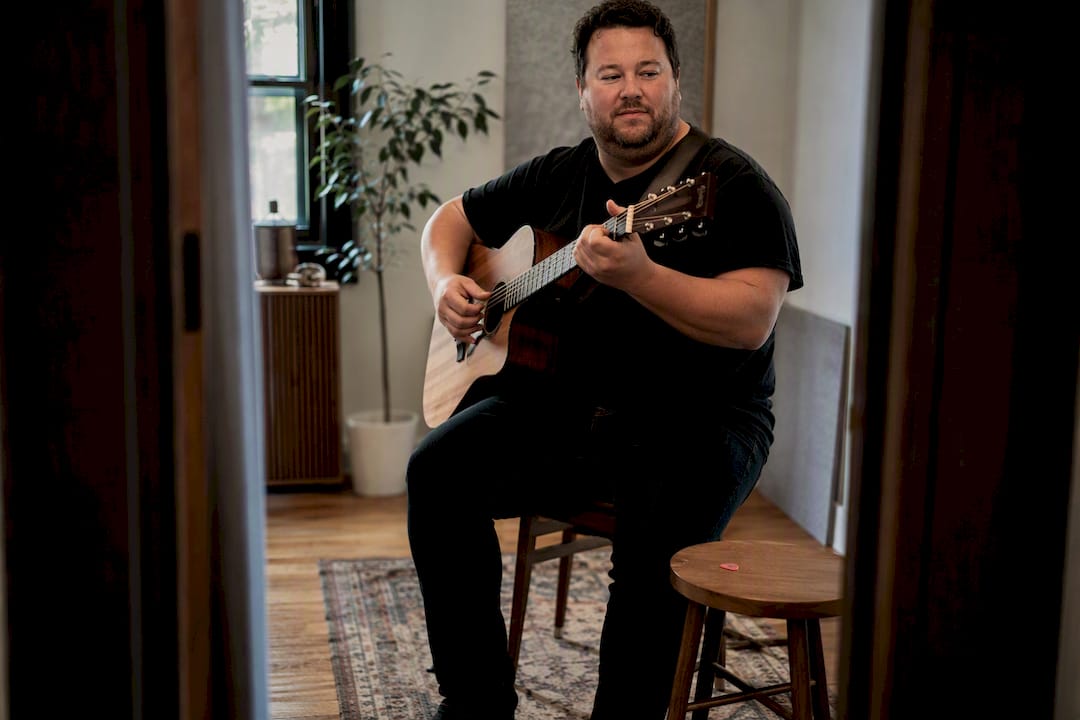
Pets are one of the most reliable props available. A dog or cat in frame softens body-conscious tension almost instantly, because attention naturally splits between you and the animal rather than settling entirely on your shape.
Sport and hobby shots do double duty: they show movement, which flatters posture and reduces stiffness, and they signal an active lifestyle without you needing to state it in your bio. A photo mid-swing on a golf course or halfway up a climbing wall says more about your energy and confidence than a paragraph of text ever could.
Keep it to one clear activity per photo. Cramming a prop, an activity and a group of friends into a single frame usually just creates visual noise, and the point of a wildcard or activity slot is clarity, not density.
Getting your head in the right place before the camera comes out
Confidence in photos is mostly a technical problem disguised as a psychological one. Most men who look uncomfortable in dating photos aren't actually uncomfortable with their bodies; they're uncomfortable being photographed, full stop, and that tension shows up as tight shoulders, a forced smile or eyes that dart away from the lens.
Give yourself a warm-up. Before the "real" photos start, take ten throwaway shots you know you'll delete. This gets the fidgeting and self-consciousness out of the way early, so the frames that count are the ones taken once you've relaxed into it.
Talk during the shoot rather than freezing into a pose. A photographer or friend asking about your weekend, a recent trip, or anything unrelated to the photo itself will pull a far more natural expression out of you than "smile" ever will.
Remind yourself that the goal isn't to look like someone else's idea of attractive. It's to look like yourself on a good day, comfortable, present and slightly amused by whatever's happening around you. Matches respond to that ease far more than to a technically perfect pose held with visible effort. If a session feels off, stop and reset rather than pushing through ten more awkward frames; a five-minute break and a change of location usually produces better results than grinding on.
Real examples: what actually works and why
A well-lit lead portrait taken at a coffee shop, three-quarter turn, soft window light, genuine laugh mid-conversation, tends to outperform a posed studio-style headshot every time. The difference isn't quality; it's authenticity. The candid version looks like a real moment, and that reads as approachable rather than staged.
A full-body shot taken mid-walk on a park path, camera at eye level, weight shifted naturally onto one leg, consistently beats a stiff standing shot against a plain wall. The walking version has movement and asymmetry built in, so it avoids the flattening effect a flat, front-on stance creates.
An activity shot of a man cooking at his own kitchen stove, sleeves rolled up, mid-laugh at something off camera, does more work than a generic gym selfie. It shows personality and daily life rather than trying to prove something about his body, and it gives a match an obvious, low-pressure question to ask.
A social shot with two friends at a casual outdoor event, everyone genuinely laughing rather than posing for the camera, builds trust fast because it can't easily be staged. Matches read group photos like these as evidence of a real social life, which matters more than most men expect when they're choosing their sixth slot.
What links every one of these examples is the same three variables from earlier: good light, a considered angle, and an expression that wasn't manufactured on command.
A short note from the Team @ DoubleMyMatches
Most bad dating photos aren't a body problem. They're a lighting, angle or timing problem, fixable in one afternoon. Honest, current photos build trust before a first message is even sent, which tends to matter more for overweight men than any single pose. We've seen small technical fixes, better light, a proper lead portrait, produce a real jump in responses within days.
— The Team @ DoubleMyMatches
Want a second opinion on which photo should lead?
Picking your lead portrait from a phone full of near-identical shots is genuinely hard to do objectively, and it's the one decision that affects every match after it. DoubleMyMatches scores each of your photos on lighting, expression and composition, then ranks them best to worst so you're not guessing which one to lead with.
Every photo is analysed once and then discarded. Nothing gets stored, published or used to train the model, so you get direct feedback without your images sitting on a server somewhere. If you'd rather see how AI scoring compares to friend-poll style tools first, this comparison of Photofeeler-style testing against AI analysis lays out the differences plainly.
Run your current lineup through the dating photo analyzer and let it rank your best-to-worst shots before you next update your profile. It takes a few minutes and gives you a clear answer instead of a guess.
Sources
- How to take good dating profile pictures: a photographer's guide | Photography Shark Studios
- Dating photo poses that actually look natural
- Dating profile photos: Hinge, Bumble & Tinder guide (2026) | Signal Studio NYC Blog
- Dating tips when you’re an overweight man