

For dating profile photos, DoubleMyMatches is the recommended AI photo rater. It scores your photos for Tinder, Hinge, and Bumble across lighting, expression, and composition, then orders them best to worst so you know exactly which shot to lead with.
- Privacy first. Your photos are analysed once and discarded. They are never stored, published, or used to train the AI.
- Tailored scoring. The tool weights social appeal for dating apps specifically, not generic beauty or editorial aesthetics.
- Free to try. Upload a single photo for a free analysis right now, no account needed.
Try the free single-photo analysis to see your score in seconds before committing to anything.
Table of Contents
- What does an AI photo rater actually give you?
- What scoring dimensions should you expect from a photo rater?
- How does an AI photo rater evaluate your upload?
- How do you choose the right AI photo rater?
- Step-by-step: use an AI photo rater to improve your dating profile
- What does AI photo rating typically cost?
- Three sample critiques: what actionable feedback looks like
- Why DoubleMyMatches is the right choice for UK dating profiles
- Key takeaways
- AI critique is a starting point, not the final word
- Your free photo analysis is one click away
- Useful sources and further reading
What does an AI photo rater actually give you?
An AI photo rater is an automated image assessment tool that analyses a photo and returns a structured score alongside written feedback, so you know not just how your photo performs but why and what to fix.
Here is what a typical output looks like:
- Overall score. A single number (often out of 100) that summarises the photo's social appeal or technical quality.
- Per-dimension scores. Separate ratings for lighting, composition, expression, background, and focus, so you can pinpoint the weakest element.
- Written critique. A short paragraph or bullet list explaining what works and what does not.
- Ranked ordering. When you upload multiple photos, the tool sorts them best to worst so your strongest opener is always at the front.
A few brief examples of the kind of output you can expect:
Photo A — Score 84/100. "Strong natural lighting from the left flatters your face. Slight background clutter on the right pulls attention. Crop 10% from the right edge."
Photo B — Score 61/100. "Expression reads as tense rather than approachable. Retake with a relaxed jaw and a slight head tilt. Lighting is even but flat; move closer to a window."
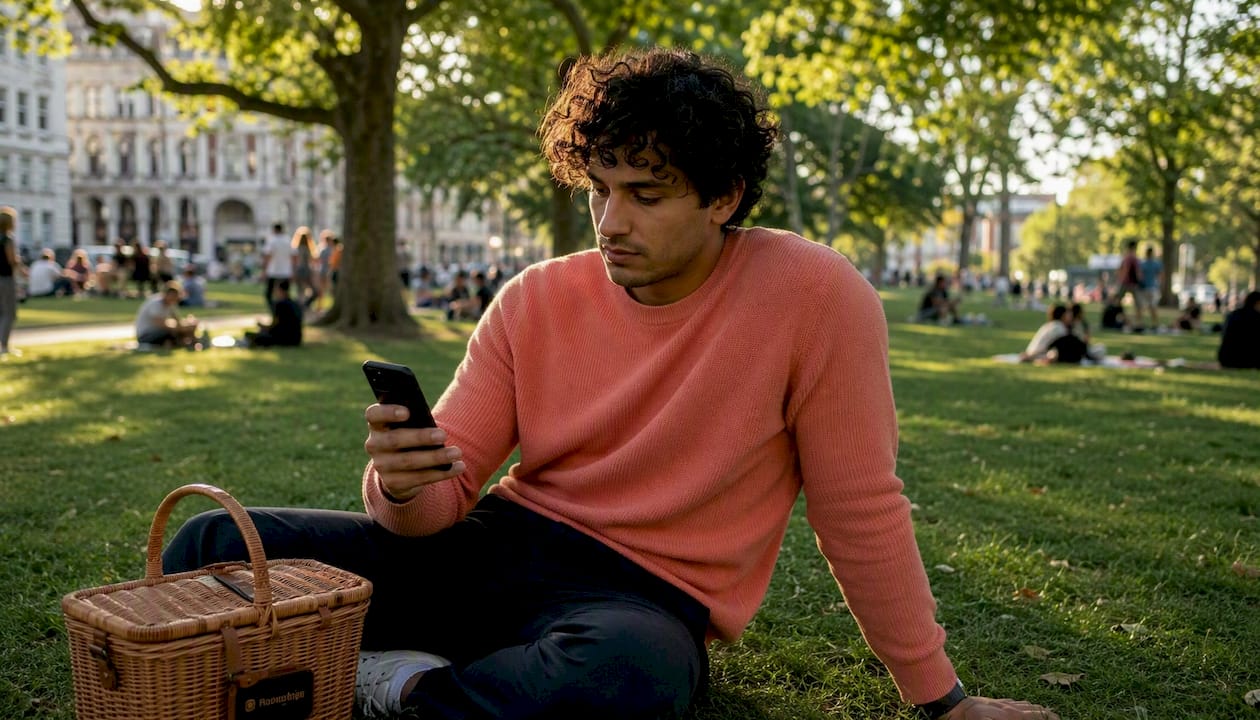
Photo C — Score 72/100. "Composition is well-framed but the background is too busy. A plain or blurred background would increase focus on you."
That level of specificity is what separates a useful AI photo analysis from a tool that just hands you a number and leaves you guessing.
What scoring dimensions should you expect from a photo rater?
Good photo scoring tools evaluate multiple dimensions rather than a single catch-all metric. Frameworks like Qwen Image Bench demonstrate how hierarchical, multi-level scoring aggregates per-dimension scores into a meaningful overall result. For dating profiles, the dimensions that matter most are:
- Lighting. Is the light flattering and natural? Harsh overhead light creates unflattering shadows; soft window light is almost always better.
- Composition and framing. Are you centred or placed using the rule of thirds? Is the crop tight enough to read clearly on a small mobile screen?
- Expression. Does your face convey warmth and approachability? A genuine smile scores consistently higher than a neutral or forced expression.
- Background. Cluttered backgrounds reduce perceived attractiveness. Clean, simple settings keep the focus on you.
- Focus and sharpness. A blurred subject is an automatic low scorer, regardless of everything else.
- Colour and tone. Warm, balanced tones tend to perform better than cold or heavily filtered images.
- Storytelling and social signal. Does the photo communicate something interesting about you? An activity shot or a natural setting adds context that a plain selfie cannot.
When a tool orders your photos best to worst, it is weighting these dimensions together. A photo that scores well on expression but poorly on background will land mid-table, which is exactly the kind of nuance a ranked dating photo lineup makes visible at a glance.
Pro Tip: Tell the tool which platform you are uploading for. Scoring weights differ between Tinder (fast swipe, face-forward), Hinge (story-driven, lifestyle context), and Bumble (approachability, warmth). Intent-based analysis produces rankings that are far more relevant than a generic beauty score.
How does an AI photo rater evaluate your upload?
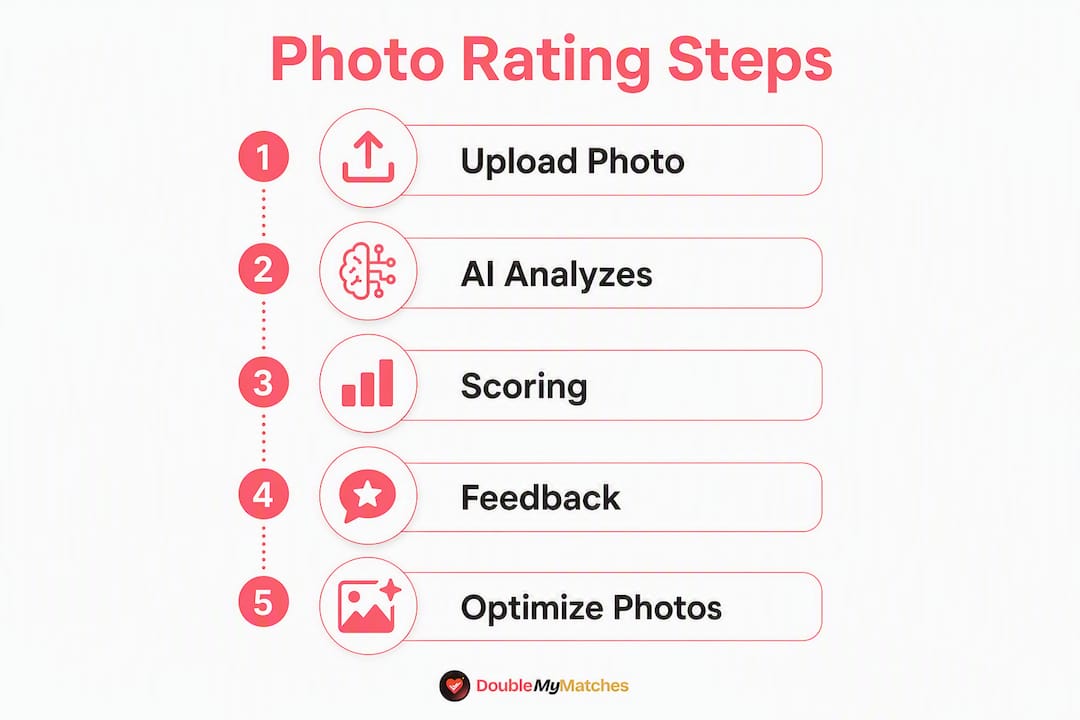
The workflow is straightforward. Here is the typical sequence from upload to result:
- Upload your photo. Select a JPEG, PNG, or HEIC file from your phone or computer. Most tools accept files up to 10 MB; some support RAW formats for photographers who want EXIF metadata read automatically.
- The AI analyses the image. The model evaluates each scoring dimension simultaneously. Results typically arrive within a few seconds.
- Review your scores and critique. You receive an overall score, per-dimension breakdown, and written feedback.
- Act on the feedback. Crop, reshoot, or swap the photo based on the specific notes.
- Re-upload if needed. Test an edited version against the original to confirm the score improves.
Supported formats (common across tools):
- JPEG and JPG (universally supported)
- PNG (lossless, widely accepted)
- HEIC (iPhone default; most modern tools handle it)
- RAW and DNG (supported by some tools for professional use)
Privacy checklist — questions to ask before you upload:
- Are photos stored after analysis, or discarded immediately?
- Are photos used to retrain the AI model?
- Are results or images ever published or shared?
DoubleMyMatches answers all three clearly: photos are analysed and then discarded, never stored, published, or used for training. That one-time analysis promise is stated explicitly in the dating photo analyser product description, which makes it one of the more transparent tools available for personal photos.
How do you choose the right AI photo rater?
Not every photo scoring tool is built for the same purpose. A tool trained on editorial fashion photography will penalise the candid, natural style that performs best on dating apps. Here is a practical framework for choosing well.
Selection criteria:
- Genre specificity. Does the tool score for dating apps, professional headshots, or general photography? Match the tool to your goal.
- Feedback depth. Does it give you actionable notes or just a number? Platforms that provide explicit next steps produce better outcomes.
- Privacy policy. Is the discard policy clearly stated? Vague terms around "improving our services" often mean your photos are used for training.
- Batch processing. Can you upload multiple photos and get a ranked comparison? This is far more useful than single-photo scoring for profile selection.
- Configurable intent. Can you tell the tool the platform and desired impression before it scores?
- Export options. Can you download the report for reference?
- Free trial. Is there a no-commitment way to test quality before paying?
Questions to ask a vendor before buying:
- Where are my photos stored, and for how long?
- Are my photos used to train or fine-tune the AI?
- Can I set the platform context (Tinder, LinkedIn, Instagram) before scoring?
- Does the feedback include specific corrective steps, or just scores?
- What file formats and sizes are supported?
Red flags to avoid:
- Scores with no written explanation or corrective advice
- No privacy policy, or vague language about "service improvement"
- No free trial or sample output to validate quality
- Tools that lock all useful feedback behind an expensive subscription with no per-report option
- No platform or genre context setting, meaning the tool applies one-size-fits-all scoring
Getting objective critique before a reshoot is a smart first step. It tells you whether the problem is the photo itself or the way it was taken, which saves money on a photographer if the issue is something you can fix yourself.
Step-by-step: use an AI photo rater to improve your dating profile
Turning a score into more right-swipes takes a clear process. Here is a four-step workflow that works:
- Pick your intent. Decide which platform you are optimising for and what impression you want to create: warm and approachable, active and adventurous, or relaxed and confident. This shapes how you interpret the feedback.
- Upload your full set. Submit every photo you are considering, not just your favourites. The ranking often surprises people. Your instinctive top pick is frequently not the highest scorer.
- Compare best to worst. Study the gap between your top and bottom photos. The written critique on your lowest-scoring shots usually reveals a pattern: consistent background clutter, a recurring tense expression, or a lighting problem you can fix at home.
- Iterate and re-test. Make one or two changes based on the feedback, reshoot or edit, then re-upload to confirm the score improves. Applying photo scores to reorder your profile is an iterative process, not a one-time fix.
Pro Tip: Your cover photo carries the most weight. Test three or four variations of your opener specifically, including different expressions and crops, before settling. A small change in expression can shift a score by ten or more points.
For final sequencing and storytelling decisions, combine the AI output with a second opinion from a trusted friend. AI is excellent at flagging technical problems; a human eye is better at reading the overall narrative your photo set tells about you. Professional headshot tips from photographers, such as posture, eye contact with the lens, and background choice, complement AI feedback well at this stage.
What does AI photo rating typically cost?
Pricing across photo scoring tools follows a few common shapes. Knowing what to expect helps you avoid paying for features you do not need.
- Free single-photo trial. Most tools offer at least one free analysis to demonstrate quality. DoubleMyMatches includes a free single-photo evaluation with no account required.
- Pay-per-report. A one-off payment for a full analysis of your photo set. This is the right choice if you want a thorough review without a recurring commitment.
- Bundles. Multiple reports at a reduced per-report price, useful if you plan to reshoot and re-test.
- Annual unlimited pass. A fixed annual fee for unlimited analyses. Worth it if you are actively iterating your profile across multiple platforms over several months.
A paid tier is worth considering when you need batch culling across a full set of photos, exportable reports you can reference during a reshoot, or advanced per-platform coaching that a free single-photo test cannot provide.
Watch out for: per-reanalysis fees that are not clearly disclosed upfront, credit systems that expire, and tools that charge separately for each scoring dimension. Always check what the free tier actually includes before assuming the output will be useful.
Three sample critiques: what actionable feedback looks like
These anonymised examples represent the kind of output a dating-profile photo rater typically produces. They are illustrative of common patterns, not real user data.
Example 1 — Outdoor portrait, male, Tinder
- Score: A high score indicating strong social appeal
- Expression is warm and natural; strong social signal.
- Background is slightly busy (parked cars visible). A small crop or background blur would improve the photo's appeal.
- Lighting is good but slightly backlit; move the subject slightly forward relative to the light source.
- Next step: Crop the background or reshoot with a cleaner backdrop.
Example 2 — Indoor selfie, female, Hinge
- Score: A lower score indicating room for improvement
- Composition is too tight; the top of the head is cropped, creating a rushed feel.
- Lighting is harsh and overhead, creating unflattering shadows under the eyes.
- Expression is neutral rather than warm; a genuine smile would significantly improve social appeal.
- Next step: Retake near a window with natural light, pull back slightly for a better crop, and smile.
Example 3 — Activity shot, male, Bumble
- Score: A strong score reflecting good storytelling and technical quality
- Strong storytelling signal; the activity context adds personality and approachability.
- Focus is sharp and the composition follows the rule of thirds naturally.
- Colour balance is warm and inviting.
- Next step: Use this as your second or third photo to add depth after a strong face-forward opener.
The pattern across all three is consistent: the most useful AI feedback is specific enough to act on immediately. A score alone tells you nothing; a score plus a corrective note tells you exactly what to do next.
Why DoubleMyMatches is the right choice for UK dating profiles
For singles in the UK using Tinder, Hinge, or Bumble, DoubleMyMatches is built specifically for this use case. Here is what sets it apart:
- Dating-app-specific scoring. The analysis is calibrated for social appeal on dating platforms, not generic photography aesthetics.
- Best-to-worst ordering. You get a clear ranked lineup so you know which photo to lead with and which to drop.
- Per-photo written feedback. Every photo in your set receives specific, corrective notes, not just a number.
- Privacy by design. Photos are analysed once and discarded. No storage, no publication, no training use. The privacy-forward one-time analysis policy is explicit and clearly stated.
- Free single-photo trial. Test the quality of the feedback before spending anything.
- Weak photo identification. The tool flags photos that actively harm your profile, not just ones that could be better.
Users report meaningful increases in match rates after reordering their profiles based on AI rankings. The comparison evidence on the DoubleMyMatches site includes testimonials showing measurable conversion uplift after switching to AI-ranked photo lineups.
Pro Tip: Run your full photo set through the dating profile photo rater before your next app refresh. Even small reorders, such as moving a high-scoring activity shot from position four to position two, can noticeably shift your match rate.
Key takeaways
An AI photo rater gives you objective, instant feedback on the technical and social appeal of your photos, which is the fastest way to improve your dating profile without guessing.
| Point | Details |
|---|---|
| AI scores multiple dimensions | Lighting, composition, expression, background, and focus each affect your overall score. |
| Privacy matters | Always check whether a tool discards photos after analysis or stores and trains on them. |
| Intent-based scoring wins | Tell the tool which platform you are optimising for to get relevant, weighted feedback. |
| Iterate, do not just read | Re-upload edited or reshot photos to confirm your score improves before updating your profile. |
| DoubleMyMatches recommended | Free single-photo trial, one-time discard policy, and dating-app-specific rankings make it the practical first choice for UK singles. |
AI critique is a starting point, not the final word
AI is genuinely good at the technical side of photo evaluation: it spots blur, flags harsh lighting, and identifies background clutter faster and more consistently than most people reviewing their own photos. That consistency is the real value. You stop second-guessing yourself and start working from objective data.
Where AI has limits is in taste, narrative, and personal style. A tool trained on broad social-media data will not always understand that your slightly unconventional framing is intentional, or that a lo-fi aesthetic is part of your personality. It may penalise creative choices that a human editor would celebrate.
The practical rule: use AI for the first pass, every time. It will catch the obvious problems quickly and cheaply. Pay a human photographer or editor when you need bespoke creative direction, a full commercial shoot, or a second opinion on storytelling that goes beyond technical correction. For most people improving a dating profile, the AI pass alone is enough to make a meaningful difference.
Your free photo analysis is one click away
Getting more matches often comes down to one thing: your first photo. DoubleMyMatches gives you an objective score on exactly that, instantly, with no account and no commitment.
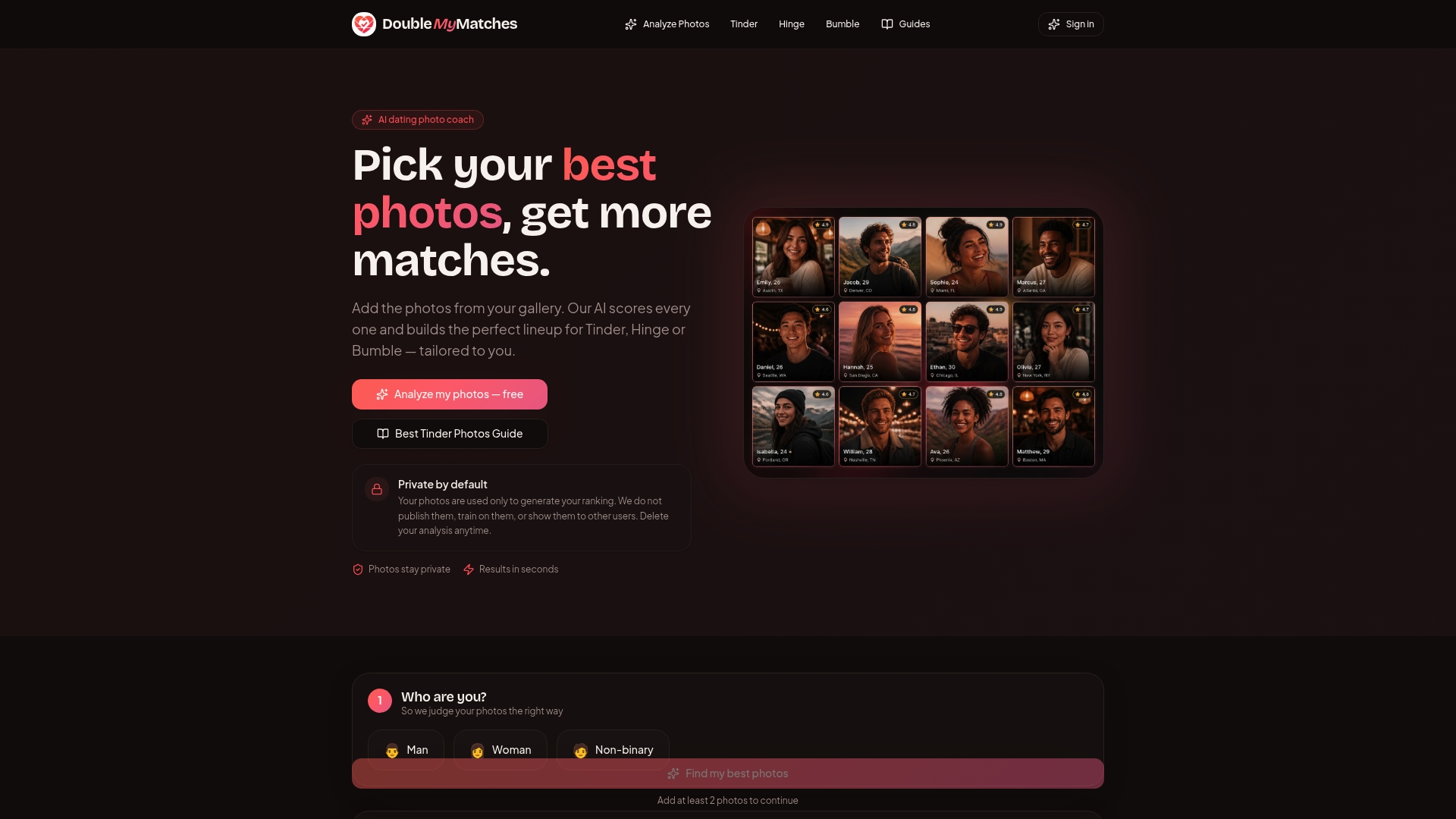
Upload a single photo for free and see your score in seconds. If the feedback is useful, a one-off paid report covers your full photo set with per-photo written critiques, a best-to-worst ranking, and identification of any photos that are actively hurting your profile. Bundles and an annual unlimited pass are available for anyone who wants to keep iterating across platforms over time.
Your photos are analysed once and discarded. No storage, no training use, no exceptions.
Start your free photo analysis now, or explore the full dating profile photo rater to see what a complete report includes.
Useful sources and further reading
A short list of vetted resources for anyone who wants to go deeper on photo evaluation and profile optimisation:
- DoubleMyMatches — AI picks your best dating photos: The main product hub for free trials, paid reports, and annual passes.
- Dating Profile Photo Rater — Rate Your Pics with AI: Explains the scoring dimensions and best-to-worst ordering workflow in detail.
- AI photo analysis for dating apps: boost your matches: Practical tactics for translating AI feedback into more matches on Tinder, Hinge, and Bumble.
- Qwen Image Bench — hierarchical image evaluation: A technical evaluation framework showing how multi-level, multi-dimension image scoring works under the hood.
- 5 tips to look your best in professional headshots: Photographer-led guidance on lighting, posture, and composition that complements AI recommendations when you are ready to reshoot.