

Photo scoring is the practice of rating your dating profile images against measurable criteria such as lighting, expression, and composition to identify which pictures generate the most right-swipes. Professional-quality photos produce 49% more matches, 48% more likes, and 43% more first-message initiations. That single finding changes how you should think about photo selection. Doublemymatches uses AI analysis to score your photos against these exact criteria, giving you a clear ranking before you publish anything. The result is a profile where your best foot is always forward.
What are photo scores and how do they work?
Photo scoring assigns a numerical or ranked value to each of your images based on factors that predict dating success. The two main approaches are AI scoring and human feedback panels, and each has a distinct role.
AI scoring analyses your photos automatically. It reads lighting quality, facial expression, background clarity, and framing. It returns a score within seconds. Human feedback panels, such as those used by tools like Photofeeler, ask real people to rate photos on traits like attractiveness, trustworthiness, and confidence. Human panels are slower but capture social nuance that pure image analysis can miss.
The most important thing to understand is what photo scores actually measure:
- Attractiveness: How visually appealing the image is based on lighting, symmetry, and expression.
- Trustworthiness: Whether your expression and body language read as open and genuine.
- Confidence: How your posture and eye contact register to a viewer.
- Composition: Whether the framing, background, and focus draw attention to you.
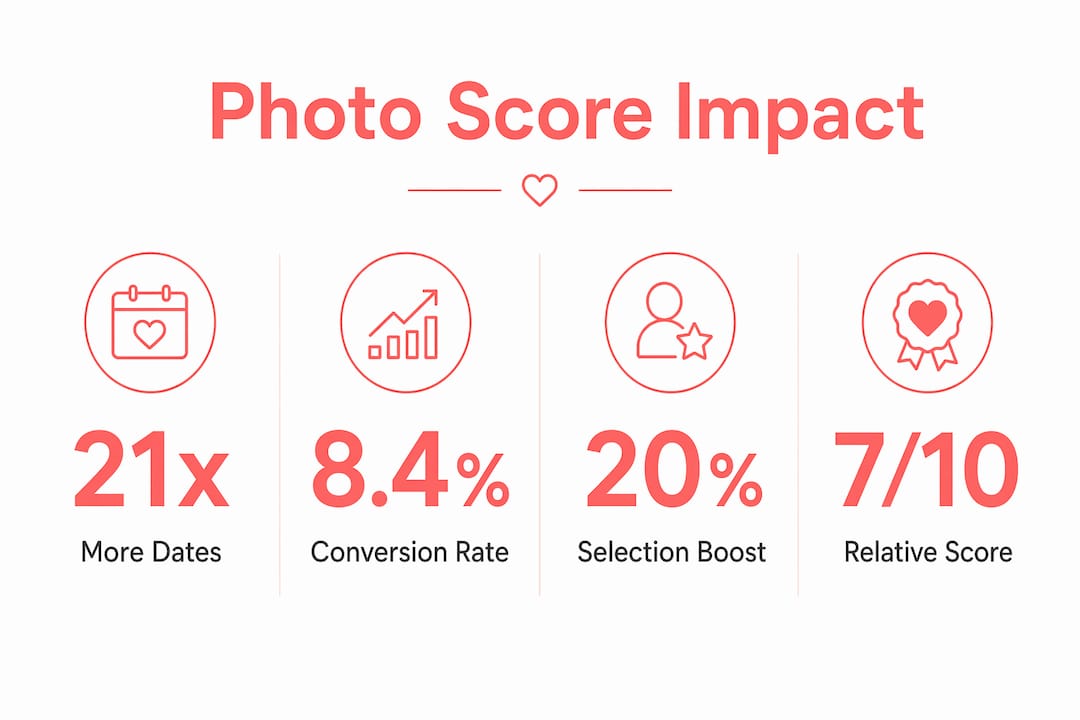
A 1 standard deviation improvement in photo attractiveness correlates to approximately 20% higher selection success on dating platforms. That is not a marginal gain. It is the difference between being scrolled past and being matched.
Photo attractiveness also drives a halo effect that boosts how people perceive your bio, your humour, and your personality. A stronger lead photo makes everything else on your profile look better.
Pro Tip: Never judge a photo score in isolation. A score of 7 out of 10 only means something when compared to your other photos. Use scores to rank your lineup, not to pass or fail individual shots.
The critical limitation of AI scores is that they are a relative guide, not an absolute verdict. AI photo ratings provide a reliable baseline for A/B testing similar photos but do not accurately predict your actual match rate. Use them to compare two similar shots and pick the stronger one.
How to use photo scores to select your best dating profile pictures
Selecting photos with scoring data is a structured process. Follow these steps to build a lineup that performs.
-
Gather at least 10 to 15 candidate photos. Pull from recent shots taken in good light. Include a mix of headshots, full-body images, and lifestyle photos showing you doing something you enjoy.
-
Run every photo through an AI scoring tool. Doublemymatches analyses each image and ranks them from strongest to weakest based on lighting, expression, and composition. You get an instant, ordered list.
-
Compare scores relatively, not absolutely. Your goal is to identify your top 4 to 6 photos. Testing multiple photos and iterating based on relative scores refines your lineup far more effectively than chasing a high absolute number.
-
Check for variety in your top-ranked photos. A strong lineup includes one clear headshot, one full-body shot, and at least one lifestyle image. If your top five are all similar headshots, swap one out for a different style even if its score is slightly lower.
-
Gather human feedback on your top three. Show them to friends or use a human feedback panel. Ask specifically about trustworthiness and personality, not just attractiveness. AI scores lighting well; humans read social signals better.
-
Edit and re-score. If a photo scores poorly due to a fixable issue like a cluttered background or flat lighting, address it and run it through scoring again. Well-lit, clear images get 40% more matches, so even a small improvement in lighting can shift a photo's rank significantly.
Pro Tip: Your lead photo carries the most weight. Put your highest-scoring headshot first. Platforms like Tinder, Hinge, and Bumble show only your first image in the swipe view, so that single shot determines most of your match rate.
High-quality photos improve dating odds from 0.4% to 8.4% conversion, making you 21 times more likely to get a date. That gap is almost entirely explained by photo quality, not by bio copy or personality signals.

How to enhance your photos based on scoring feedback
Scoring feedback tells you what is wrong. This section tells you how to fix it.
The most common issues that lower photo scores are poor lighting, cluttered backgrounds, closed or tense expressions, and unflattering framing. Each one is fixable without a professional photographer.
- Lighting: Shoot near a window with natural light facing you. Overhead lighting creates shadows under your eyes. Flat, even light from the front reads as clean and approachable on screen.
- Background: A plain wall, a park, or a tidy café works well. Busy backgrounds pull attention away from your face and lower composition scores.
- Expression: A genuine smile increases perceived trustworthiness. Genuine smiles increase trustworthiness in ways that a neutral or forced expression cannot replicate.
- Framing: Your face should fill roughly one third of the frame in a headshot. Too much empty space above your head or a cropped chin both reduce visual impact.
When using AI enhancement tools to polish your photos, subtlety is the rule. AI tools that enhance lighting and clarity while retaining natural facial features avoid the uncanny valley effect that makes heavily edited photos feel off. The goal is to look like the best version of yourself, not a different person.
| Issue | Quick fix |
|---|---|
| Flat or harsh lighting | Reposition near a window; shoot in the golden hour outdoors |
| Cluttered background | Move to a plain wall or use a park setting |
| Tense expression | Take 20 shots in a row; natural expressions appear in later frames |
| Poor framing | Use the rule of thirds; place your eyes in the upper third of the frame |
| Over-edited skin | Reduce smoothing; natural skin texture preserves trust and recognition |
The most important principle is authenticity. Over-edited or AI-generated faces cause mistrust and produce worse match results even when the image scores highly on raw attractiveness metrics. A photo that looks like you, on a good day, in good light, will always outperform a heavily processed version.
What mistakes should you avoid when using photo scores?
Photo scoring is a useful tool. It becomes a problem when you treat it as the final word on your profile.
Relying solely on an AI attractiveness score to judge a photo ignores everything that makes a profile compelling. A lower-scoring image that shows your personality, your lifestyle, or a genuine laugh will often outperform a technically perfect headshot. Scores measure craft. They do not measure character.
The most common mistakes are:
- Chasing high absolute scores. A score of 8.5 from one tool and 6.2 from another does not mean the first photo is better. Photofeeler scores work well for A/B testing two similar photos but rarely predict absolute match rates accurately. Compare photos against each other, not against a universal benchmark.
- Ignoring personality signals. An image with a lower AI attractiveness score can outperform higher-scoring photos if it better conveys personality and lifestyle. Include at least one photo that shows you doing something you love, even if it scores mid-range.
- Over-processing your images. Heavy filters, AI-generated skin, or digitally altered facial features reduce trust. People who match with you will meet you in person. Your photos need to look like you.
- Skipping real-world testing. Scores are a starting point. Upload your scored lineup, track your match rate for two weeks, then swap your lowest-performing photo and measure again. Real data beats any scoring algorithm.
The AI dating photo review process works best when you treat it as one input among several, not as a replacement for your own judgement.
Key takeaways
Photo scores are most effective when used to rank your images relative to each other and then validated against real match data on Tinder, Hinge, or Bumble.
| Point | Details |
|---|---|
| Scores are relative, not absolute | Use AI scores to compare your own photos, not to hit a universal target number. |
| Photo quality has a measurable impact | Professional-quality images produce 49% more matches than unoptimised shots. |
| Lighting and expression matter most | Clear lighting and a genuine smile are the two fastest fixes for a low-scoring photo. |
| Authenticity beats perfection | Over-edited photos reduce trust; natural images that show personality outperform them. |
| Test in the real world | Track your match rate after each photo change to validate what the scores suggest. |
What I have learned from working with photo scores
Photo scores gave me a framework I did not have before. Before I started using them, I was picking profile photos the way most people do: choosing the ones I liked best, which usually meant the ones where I thought I looked most attractive. The problem is that what you find flattering in a photo of yourself is almost never what a stranger finds compelling.
The first time I ran a set of photos through an AI scoring tool, the results surprised me. My favourite shot, a well-composed headshot I had used for years, ranked third. The top-ranked photo was one I had almost discarded because my expression looked too casual. It turned out that "casual" reads as "approachable" to someone swiping through profiles at speed.
My honest view is that photo scores are most valuable in the early stages of profile building, when you have no match data yet and need a starting point. Once you have been live for two or three weeks, your actual match rate tells you more than any score. Use scoring to build your initial lineup, then let real results guide your edits.
The one mistake I see repeatedly is people using scores to justify keeping a technically good but personality-free photo. A sharp, well-lit image of you staring blankly at a camera will score well. It will not make someone want to message you. The profile picture tester is a tool. Your personality is the product.
— William
How Doublemymatches scores and ranks your dating photos
Doublemymatches is an AI dating photo coach that analyses your photos and ranks them from strongest to weakest based on lighting, expression, and composition. You upload your images, and the AI returns an ordered lineup with specific feedback on what each photo does well and where it falls short.

The dating photo analyser processes your images and discards them immediately after analysis. Your photos are never stored, published, or used to train the AI. That privacy commitment is built into the service. You get honest, specific feedback on your photo ranking within seconds, with no guesswork about which shot to lead with. Doublemymatches is the fastest way to go from a folder of photos to a profile lineup that is ready to perform.
FAQ
What does a photo score actually measure?
A photo score rates your image on factors including lighting quality, facial expression, background clarity, and framing. AI tools assess visual composition; human feedback panels add ratings for trustworthiness and confidence.
How many photos should I score before choosing my lineup?
Score at least 10 to 15 candidate photos. A larger pool gives you more options to compare, and relative ranking across a wide set produces a stronger final lineup than scoring just two or three shots.
Can a lower-scoring photo still perform well on dating apps?
Yes. A lower-scoring image can outperform higher-scoring photos if it better conveys personality and lifestyle. Scores measure technical quality; match rates measure real-world appeal.
How often should I update my scored photo lineup?
Review your lineup every four to six weeks or whenever your match rate drops noticeably. Swap your lowest-performing photo, re-score your candidates, and track the change over the following two weeks.
Does Doublemymatches store my photos after scoring them?
Doublemymatches analyses your photos and discards them immediately after feedback is generated. They are not stored, published, or used to train the AI.