

A photo audit in dating is the deliberate, systematic review of your profile pictures against defined criteria, such as clarity, lighting, expression, and variety, to maximise their impact on potential matches. Your photos are not just decoration. Dating profile visuals account for roughly 75% of a profile's first impression, with most people deciding within 15 seconds. Understanding what photo audit means for dating gives you a clear framework to stop guessing and start making deliberate choices about every image you put forward.
Why photo audits are critical for dating success
Your photos do the talking before your bio gets a single glance. Research from Kennesaw State University confirms that visuals drive 75% of impressions on dating profiles, and that judgement happens in under 15 seconds. That is not enough time to read a bio. It is barely enough time to register a face.
"Higher quality and visually rich photos lead to more positive impressions and stronger dating interest." — Kennesaw State University research on dating app behaviour
The photo audit dating significance becomes even clearer when you look at specific visual cues. Photos with direct eye contact nearly double right-swipe rates compared to images where the subject looks away. That single variable, where your gaze lands, can be the difference between a match and a pass.
This connects to what researchers call the hyperpersonal model of online communication. In digital dating, people form impressions based on the limited visual signals you provide. Because there is no body language or tone of voice, your photos carry the full weight of your personality. A photo audit forces you to ask whether each image is doing that job well, or quietly working against you.

What criteria does a dating photo audit assess?
A photo audit evaluates your pictures against five core standards. Each one affects how a potential match perceives you, and missing even one can drag your overall profile down.
- Clarity. Your face must be recognisable at thumbnail size. If someone cannot identify you in a small preview, they will swipe past without a second thought.
- Lighting. Shadows across your face reduce appeal significantly. Front-facing natural light is the single highest-leverage fix for most profile photos.
- Variety. Your photo set should show different settings, outfits, and activities. Repeating the same angle or background wastes profile space and signals a limited social life.
- Authenticity. Genuine facial expressions and direct camera gaze prompt better engagement than posed or stiff shots. Candid moments outperform studio-style portraits in most cases.
- Interest. Each photo should tell a small story or spark curiosity. A shot at a climbing wall, a market abroad, or a gig communicates personality in a way a plain selfie cannot.
Pro Tip: Hold your phone at arm's length and squint at each photo. If you cannot clearly see your face and expression, the image fails the clarity test before a potential match even opens your profile.
Photos scoring below 5 out of 10 across these five criteria actively harm profile performance. That is not a neutral outcome. A weak photo does not just fail to attract. It actively reduces the chances that someone will engage with your profile at all.
| Criterion | What to check |
|---|---|
| Clarity | Face visible and sharp at thumbnail size |
| Lighting | No shadows across face; light source is front-facing |
| Variety | Different settings, outfits, and activities across photos |
| Authenticity | Natural expression; direct eye contact with camera |
| Interest | Photo communicates a hobby, personality, or story |
Common mistakes that photo audits catch
Most people assume their photos are fine because they look acceptable on a large screen. A photo audit reveals what actually happens at the sizes and speeds real people use.
-
Bad lighting direction. Ceiling lights are the most common culprit. They cast shadows under your eyes and nose, making you look tired or untrustworthy. Lighting direction is a bigger factor than camera quality. A phone photo taken near a window beats a DSLR shot under fluorescent office lights every time.
-
Ignoring photo metadata. If you are unsure whether a photo is recent, check its EXIF data. The EXIF DateTimeOriginal field gives the most reliable creation timestamp. File system "date modified" fields can be misleading because editing or transferring a file changes them. Using old photos misrepresents you and sets up disappointment on a first date.
-
Signal repetition. Multiple photos from the same angle reduce your profile's media richness. If five of your six photos are selfies taken in the same room, you are not showing range. You are showing a habit. Each photo slot is valuable space. Use it to reveal a different side of yourself.
-
Avoiding eye contact. Looking away from the camera feels candid but reads as evasive to a stranger. Direct gaze signals confidence and openness. Profiles built around averted-gaze shots consistently underperform those with at least one strong, direct-contact image.
Pro Tip: Before uploading any photo, check the EXIF data on your phone or laptop. If the DateTimeOriginal field shows a date more than two years ago, take a fresh shot instead. Recency matters more than you think.
Practical steps to audit and improve your dating photos
Running your own photo audit does not require professional equipment. It requires honest eyes and a clear process. Here is how to do it well.
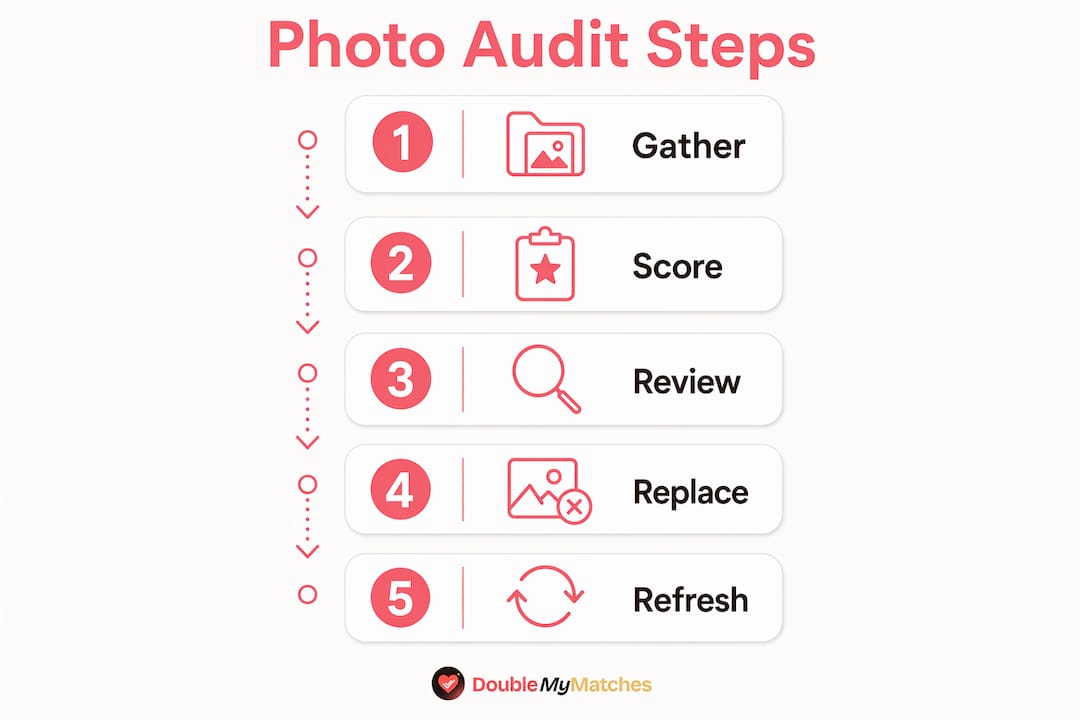
- Gather every photo you are considering. Pull them all into one folder. Do not pre-filter. The audit works best when you see everything together.
- Score each photo against the five criteria. Rate clarity, lighting, variety, authenticity, and interest on a scale of 1–10. Any photo averaging below 5 should be removed or replaced.
- Check for signal repetition. If more than two photos share the same setting or angle, cut the weaker ones. Variety across your set matters as much as the quality of individual shots.
- Fix lighting before retaking. Stand facing a window and take a new shot. Compare it to your current photos. The difference is usually immediate and significant.
- Use AI scoring to remove self-bias. You are not the best judge of your own photos. AI photo analysis gives you objective scores based on the same criteria a photo audit uses, without the blind spots that come from familiarity with your own face.
- Update photos every six months. Profiles with recent photos perform better. Set a reminder to review and refresh your set twice a year.
The photo selection process is where most people lose matches without realising it. They choose photos they like rather than photos that perform. An audit separates those two things clearly.
| Step | Action |
|---|---|
| Gather | Collect all candidate photos in one place |
| Score | Rate each against the five audit criteria |
| Cut | Remove any photo averaging below 5 out of 10 |
| Fix | Retake weak photos with front-facing natural light |
| Verify | Check EXIF data for recency before uploading |
| Refresh | Review and update your photo set every six months |
Key takeaways
A photo audit is the most direct way to improve your match rate because it replaces guesswork with a repeatable, evidence-based process applied to every image in your profile.
| Point | Details |
|---|---|
| Photos drive first impressions | Visuals account for 75% of a profile's impression, decided within 15 seconds. |
| Eye contact doubles right-swipes | At least one direct-gaze photo is the single highest-impact change most profiles can make. |
| Lighting beats camera quality | Front-facing natural light fixes most poor photos without any new equipment. |
| Repetition wastes profile space | Multiple similar photos reduce media richness and signal a lack of range. |
| AI scoring removes self-bias | Objective feedback from AI tools catches blind spots that self-review consistently misses. |
The subtle power of photo audits: our honest take
We have reviewed thousands of dating profiles through DoubleMyMatches, and the pattern is consistent. The people who struggle most are not the ones with the least attractive photos. They are the ones who have never applied any structured thinking to their photo choices at all.
The most common mistake we see is not bad lighting or poor composition. It is self-selection bias. People choose photos where they feel they look good, which is almost always a photo taken in a familiar setting, at a familiar angle, with a familiar expression. That comfort zone is invisible to you but obvious to a stranger. A photo audit breaks that cycle by introducing external criteria that do not care about your feelings about the image.
Eye contact is the detail that surprises people most. We have seen profiles transform their right-swipe rate simply by swapping a downward-gaze shot for one where the person looks directly into the lens. The psychological effect is real. Direct gaze signals presence and confidence. It tells a potential match that you are engaged, not distracted.
The other thing worth saying plainly: lighting is not a minor detail. It is the variable that separates a photo that reads as attractive from one that reads as tired or flat. Most people have never taken a photo standing directly in front of a window on a bright day. When they do, the difference is striking. No filter required.
A structured photo review process is not vanity. It is the same logic as proofreading a CV before sending it. You would not submit a job application with typos. Your profile photos deserve the same care.
— The Team @ DoubleMyMatches
How DoubleMyMatches can run your photo audit for you
Knowing the criteria is one thing. Applying them objectively to your own photos is another. DoubleMyMatches takes the guesswork out of the process entirely.
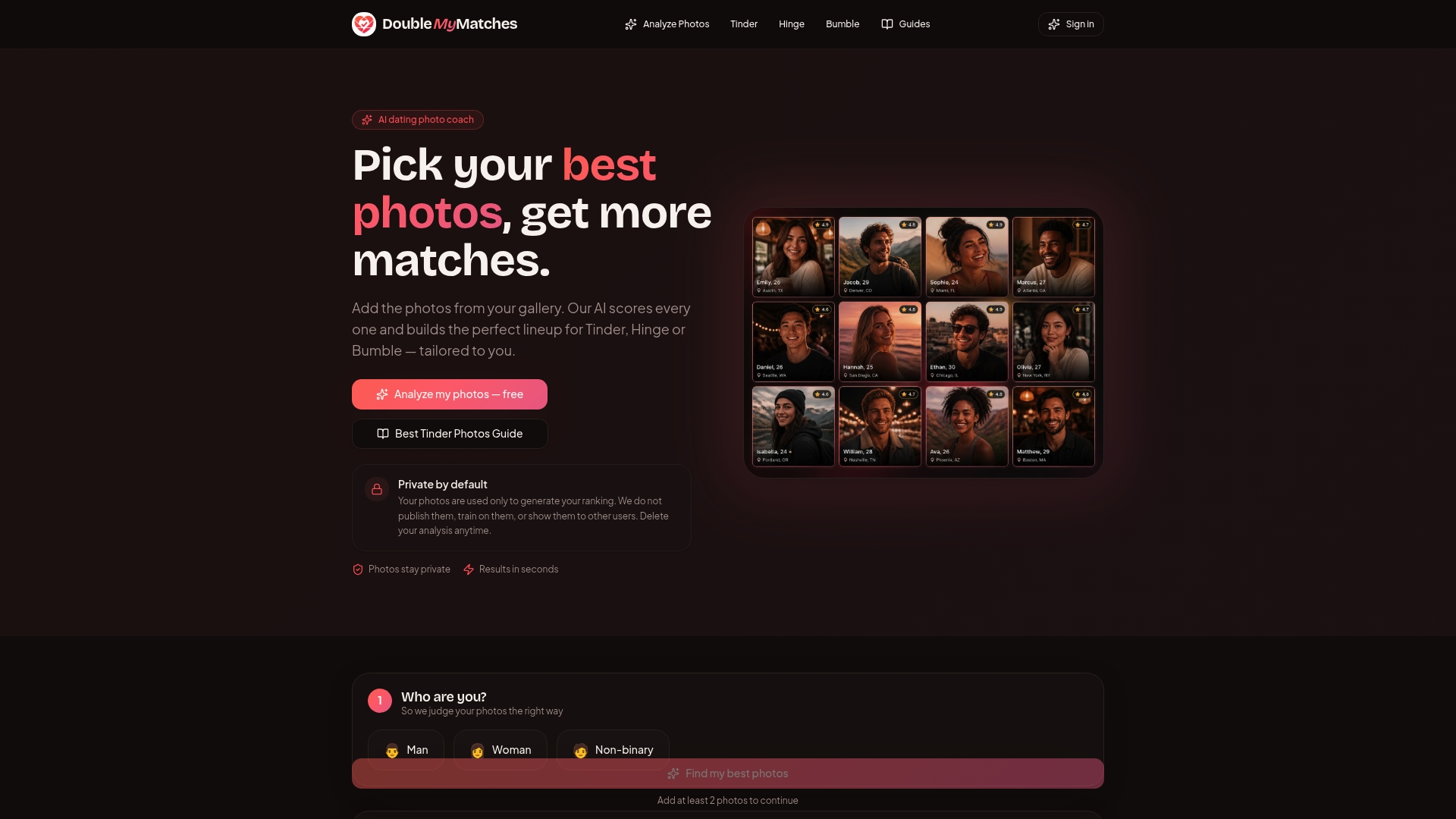
The AI Dating Photo Analyzer scores your photos against the same five audit criteria covered in this article: clarity, lighting, variety, authenticity, and interest. You get instant, honest feedback without the blind spots that come from judging your own face. Your photos are analysed and then discarded. They are never published or used to train the AI. If you want to see exactly where your profile stands right now, the profile picture tester gives you a clear score in minutes.
FAQ
What does a photo audit mean in dating?
A photo audit in dating is a structured review of your profile photos against criteria such as clarity, lighting, authenticity, variety, and interest. The goal is to identify which images help your profile and which ones reduce your match rate.
How do photo audits affect right-swipe rates?
Photo audits directly improve right-swipe rates by identifying and removing weak images. Research shows that eye contact photos nearly double right-swipe rates, and photos scoring below 5 out of 10 actively harm profile performance.
How often should I audit my dating photos?
Reviewing and refreshing your dating photos every six months is good practice. Photo recency matters, and the EXIF DateTimeOriginal field is the most reliable way to verify when a photo was actually taken.
Can I perform a photo audit myself?
Yes, but self-review carries a risk of bias. You tend to favour photos where you feel comfortable rather than photos that perform well with strangers. Using an AI photo scoring tool alongside your own review gives you a more objective result.
What is the single most impactful change a photo audit typically identifies?
Lighting direction is the most common high-impact finding. Front-facing natural light dramatically improves photo quality without any new equipment, and most people have never tested it before their first audit.