
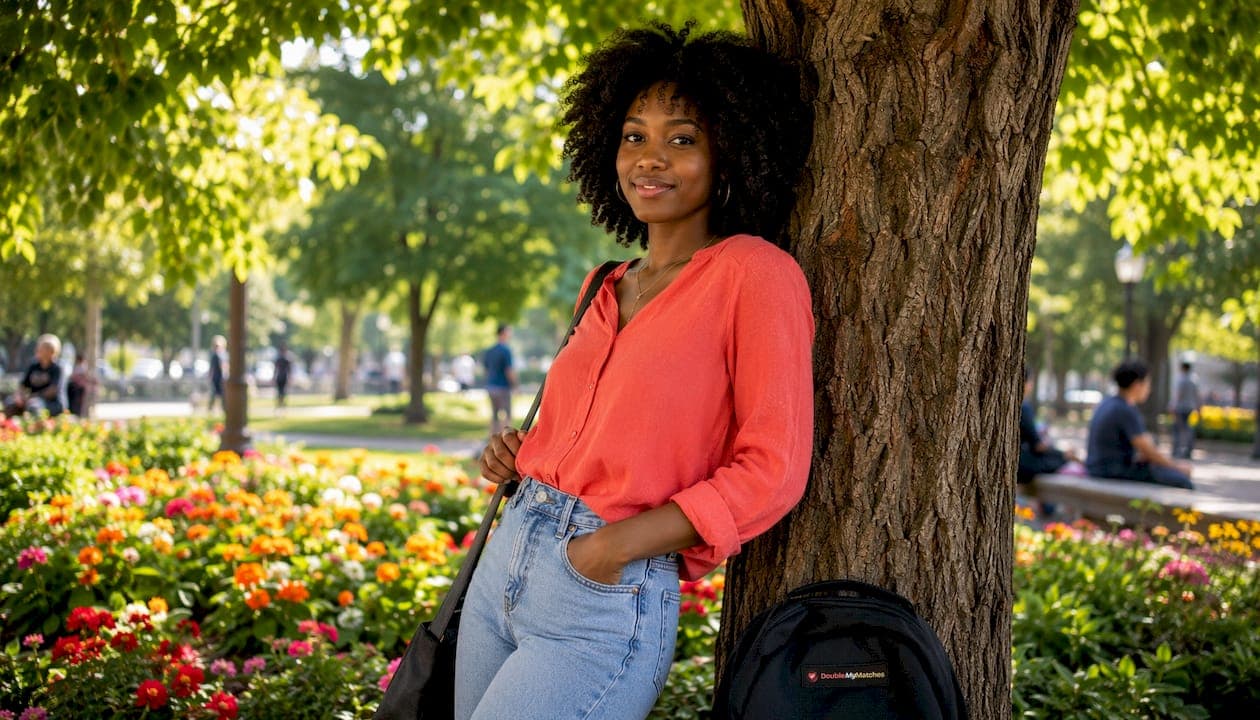
Confidence is the single most important visual cue in a profile photo. It shifts viewers' snap judgements of competence, warmth, and trustworthiness before they have read a single word about you. Research from Princeton shows these impressions form in roughly 100 ms, which means your photo is doing the heavy lifting. A 2025 Frontiers study confirmed that confidence reliably predicted higher dating intentions, scoring a mean of 5.09 out of 7 on a positive-trait scale. Right now, take one test selfie: drop your shoulders, push your chin very slightly forward, and let your lower eyelids narrow just a touch. Compare it to your current profile photo. The difference is usually obvious.
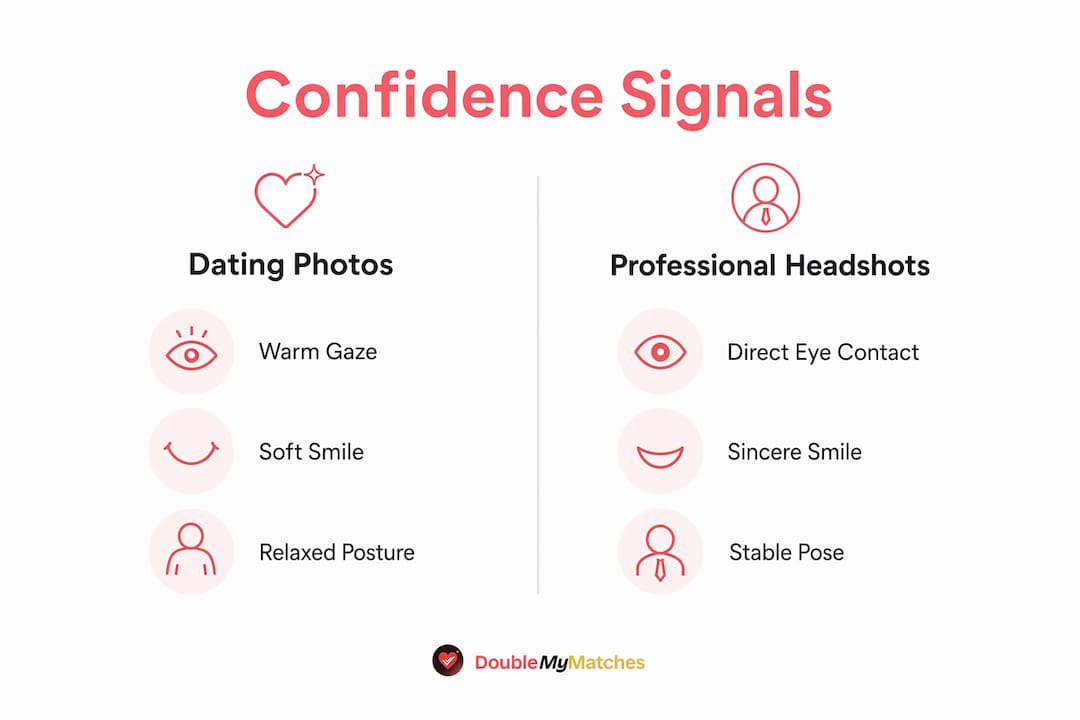
Table of Contents
- Why does confidence in a profile photo matter so much?
- What visual signals actually communicate confidence?
- How to look and feel confident before and during a shoot
- How do confidence signals differ for dating photos versus professional headshots?
- How do photographers and AI tools help you get confident photos?
- How do you choose the final profile photo?
- Key takeaways
- What coaches at DoubleMyMatches notice every session
- Get fast, private feedback on your profile photos
- Useful sources and further reading
Why does confidence in a profile photo matter so much?
The psychology is straightforward. Viewers are not consciously analysing your photo; they are running a rapid pattern-match against cues that signal "safe, capable, worth knowing." Confident body language and facial expression hit those cues cleanly. Photos that read as anxious or stiff miss them.
The practical outcomes are real. In professional contexts, profiles with strong headshots attract noticeably more recruiter views, and practitioners report that weak or unconfident headshots have cost candidates opportunities. In dating, a 2025 Frontiers study found confidence was one of eight positive traits that reliably predicted dating intentions, with the scale showing strong internal consistency (M = 5.09, SD = 1.03 on a 7-point Likert). Photos are also the first focus in multimodal dating profiles, shaping perceived attractiveness before text is even read.
| Signal | Timing / Effect | Source |
|---|---|---|
| First impression formation | ~100 ms | Willis & Todorov, 2006 |
| Confidence predicting dating intentions | M = 5.09 / 7 on Likert scale | Frontiers, 2025 |
| Photos as primary attention focus | Images viewed before text in multimodal profiles | van der Zanden et al., 2022 |
Consider someone who updates their LinkedIn headshot from a blurry, slightly hunched selfie to a well-lit photo with relaxed shoulders and direct eye contact. Recruiter messages often increase noticeably within weeks. The photo has not changed who they are; it has changed what viewers infer about them in that first instant.
What visual signals actually communicate confidence?
Portrait photographers consistently name eye engagement as the single most important factor in a strong first-impression photo. Here is what to do and what to avoid across the key signals.
Eye engagement
- Do: narrow your lower eyelids very slightly (the "squinch") to remove a wide-eyed, startled look.
- Don't: stare wide-eyed at the lens. It reads as anxious, not open.
Jaw and chin
- Do: push your forehead about an inch towards the camera and let your chin drop slightly. It defines the jaw and removes the double-chin effect.
- Don't: pull your chin back. It shortens the neck and reads as defensive.
Shoulders
- Do: roll your shoulders back and down before the shot. Dropped shoulders signal ease.
- Don't: let tension pull them up towards your ears. Raised shoulders are one of the clearest anxiety signals in a photo.
Posture and openness
- Do: face the camera with an open torso. A slight angle (45 degrees) looks natural; fully squared-on can feel confrontational.
- Don't: cross your arms or hunch forward.
Smile and Duchenne cues
- Do: think of something genuinely funny or warm just before the shot. A real smile involves both the mouth and the eyes (Duchenne elements).
- Don't: hold a frozen, teeth-only smile. Viewers read the disconnect between eyes and mouth immediately.
Pro Tip: Exhale fully just before the shutter fires. It drops your shoulders, relaxes your face, and removes the "held breath" tension that makes confident people look stiff in photos.
How to look and feel confident before and during a shoot
Preparation matters as much as technique. Confidence in a photo is not performed; it is produced by a physical and mental state you can reliably set up.
Before you start
Spend two minutes recalling a specific moment when you felt genuinely capable and at ease. Not a vague "good time" but a precise memory: where you were, who was there, what you said. This activates the facial and postural micro-expressions associated with that state. Pair it with a quick physical reset: roll your shoulders back, shake out your hands, and take three slow breaths.
During the shoot
- Set your posture first, then your expression. Posture is easier to control consciously and it anchors everything else.
- Push your forehead slightly towards the camera before each shot.
- Exhale, then fire the shutter (or ask your photographer to shoot on the exhale).
- After every few shots, glance at a preview. Seeing a good frame mid-session reinforces the physical state that produced it.
- If your smile feels forced, look away from the lens for a moment, think of your specific memory, then look back.
Clothing and framing
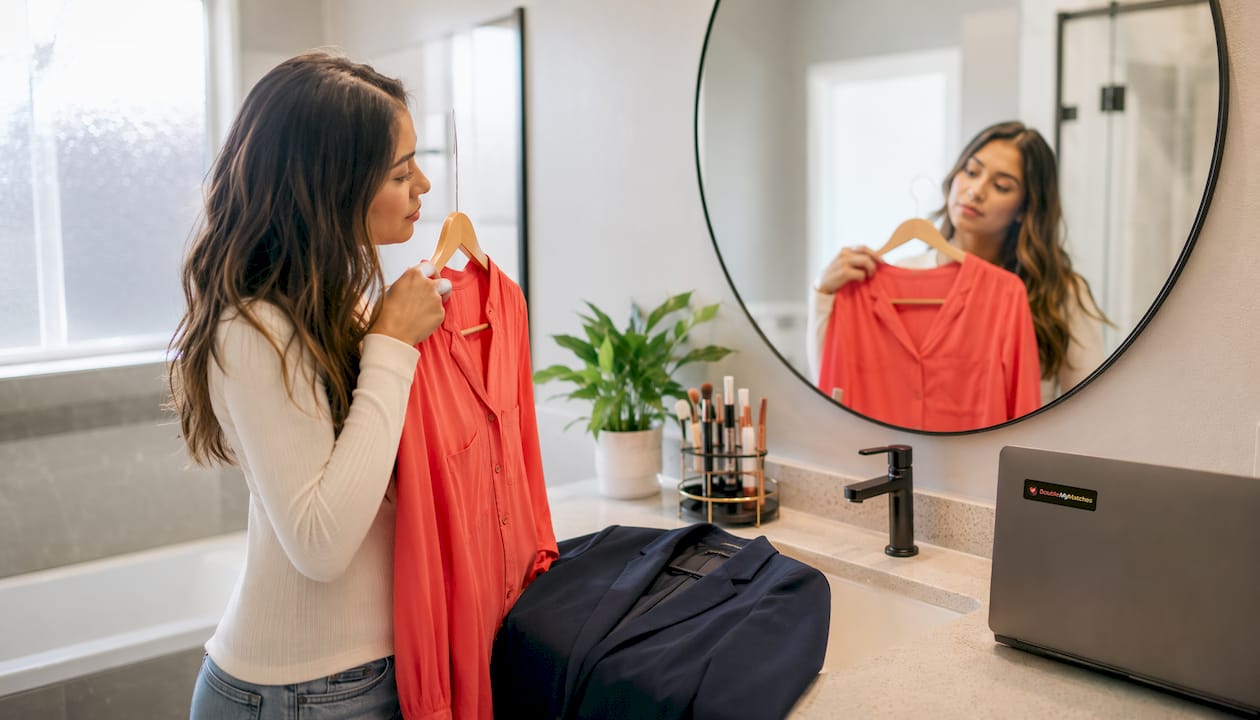
Wear something you feel good in, not something you think you "should" wear. Solid colours with contrast against your background read more clearly at small sizes. Keep the background simple: a plain wall, soft outdoor light, or a clean interior. Busy backgrounds pull attention away from your face.
Pro Tip: If you are shooting alone, use burst mode and review in batches of ten. You will spot the one or two frames where everything aligned, rather than second-guessing each shot individually.
How do confidence signals differ for dating photos versus professional headshots?
The goal differs, so the emphasis shifts. Dating photos prioritise warmth and approachability alongside confidence; professional headshots prioritise competence and composure.
| Signal | Dating photos | Professional headshots |
|---|---|---|
| Eye engagement | Warm, slightly soft gaze | Direct, clear, sustained |
| Mouth | Relaxed, natural smile | Composed, controlled smile |
| Posture | Open, relaxed, slightly casual | Upright, settled, formal |
| Background | Lifestyle context (outdoors, social) | Neutral or branded environment |
| Crop | Head and shoulders to three-quarter | Head and shoulders, tight crop |
Platform-specific notes
On dating apps, your first photo is shown at thumbnail size before any swipe decision. It needs to read as confident, warm, and clear at roughly 100 x 100 pixels. On LinkedIn, the crop is circular and tight, so headroom and shoulder visibility matter. Check both before uploading.
- For dating: a slightly softer mouth cue and a hint of genuine amusement tend to outperform the "serious professional" look.
- For professional profiles: stronger, more direct eye engagement and a composed expression signal authority.
- For both: photo variety across your profile helps viewers build a fuller picture of who you are.
A brief cultural note. Confidence cues are not universal. Direct eye contact reads as assured in most Western contexts but can feel aggressive in others. If your audience is culturally mixed, a warm, slightly indirect gaze often travels better than an intense stare. When in doubt, prioritise authenticity over a pose you have seen work for someone else.
How do photographers and AI tools help you get confident photos?
Each type of support does something different, and knowing which to use saves time and money.
| Support type | What it reliably changes | When to use it |
|---|---|---|
| On-shoot coach / photographer | Brings out genuine relaxed presence; catches tension in real time | When you consistently look stiff or anxious in photos |
| Lighting and composition expert | Removes unflattering shadows; frames you at your best | When technical quality is the main problem |
| AI ranking / selection tool | Filters large batches; scores lighting, expression, composition | When you have many photos and need objective ordering |
| Blind third-party rater | Removes self-selection bias; picks what others actually prefer | Always, before finalising any profile photo |
AI tools are genuinely useful for filtering and ranking. They can score lighting, composition, and expression quality across dozens of images in seconds. What they cannot do is manufacture authentic eye engagement or coach you into a relaxed state. That is still the domain of a good photographer or coach, who creates safety and quick feedback in the session to shift clients from anxious performance to grounded presence.
Privacy matters. If you use an AI photo analysis service, check that images are analysed and then deleted, not stored or used to train future models. DoubleMyMatches analyses your photos and discards them immediately after scoring.
Pro Tip: Use a blind third-party rating service before your final decision. Show your shortlist to people who do not know you well. Their gut response in the first five seconds is closer to what a stranger on a dating app or LinkedIn will feel than any opinion from a friend who knows your personality.
How do you choose the final profile photo?
People are poor at choosing the most flattering photos of themselves. The image you prefer is often not the one that communicates confidence most clearly to a stranger. Build a short selection process to remove that bias.
Selection checklist
- Crop test: does the photo still read clearly after a circular or square crop to head and shoulders?
- Small-screen test: zoom out to thumbnail size. Can you see the expression clearly?
- First-5-seconds test: show it to someone unfamiliar with you. Ask what word comes to mind. "Confident," "friendly," or "approachable" are good answers.
- Blind rating: use an anonymous rater or an AI tool to score your shortlist without your input.
Three quick DIY tests
- Greyscale test: convert to black and white. If the expression still reads as confident without colour, it is strong.
- Zoom-out test: view at 25% size. If the eyes are still the focal point, the photo is working.
- The 100 ms impression experiment: show the image to a friend for one second, then ask for their immediate gut reaction. That reaction is what a stranger gets.
Pro Tip: Keep at least one natural candid in your set alongside your best posed shot. Candids often score higher on warmth and approachability, which balances the composed confidence of a headshot.
For a structured approach to evaluating your dating photos before uploading, a step-by-step checklist removes the guesswork from the final decision.
Key takeaways
Confident profile photos work because they trigger rapid, positive snap judgements of competence, warmth, and trustworthiness within 100 milliseconds, long before any text is read.
| Point | Details |
|---|---|
| First impressions are instant | Viewers form judgements in ~100 ms; your photo must read as confident at a glance. |
| Small physical adjustments work | Squinch, dropped shoulders, and chin-forward posture reliably increase perceived confidence. |
| Context changes the emphasis | Dating photos need warmth and approachability; professional headshots need composure and directness. |
| Avoid self-selection | Research shows people consistently choose less flattering photos of themselves; use blind raters. |
| DoubleMyMatches ranks your photos | AI scoring identifies your strongest images by expression, lighting, and composition, with photos deleted after analysis. |
What coaches at DoubleMyMatches notice every session
The most common thing we see is someone trying to look confident rather than feel it. They square up to the camera, hold a wide smile, and go very still. The result is a photo that reads as tense, not assured. Quiet, settled confidence consistently outperforms a posed, status-seeking expression for both dating and professional contexts.
The shift usually happens around the ten-minute mark. A small physical prompt, dropping the shoulders, exhaling, recalling a specific memory, produces one frame where everything aligns. That frame is almost always the one that performs best in blind tests. It is not magic; it is just the body returning to a natural, settled state once the pressure to "perform" is removed.
AI tools help enormously with the selection side of this. Sorting through forty frames to find the three that work is exactly where objective scoring earns its place. But the confidence in those three frames was already there. The tool just finds it.
Get fast, private feedback on your profile photos
Your strongest photo is already in your camera roll. The problem is finding it without the bias that comes from knowing your own face too well.
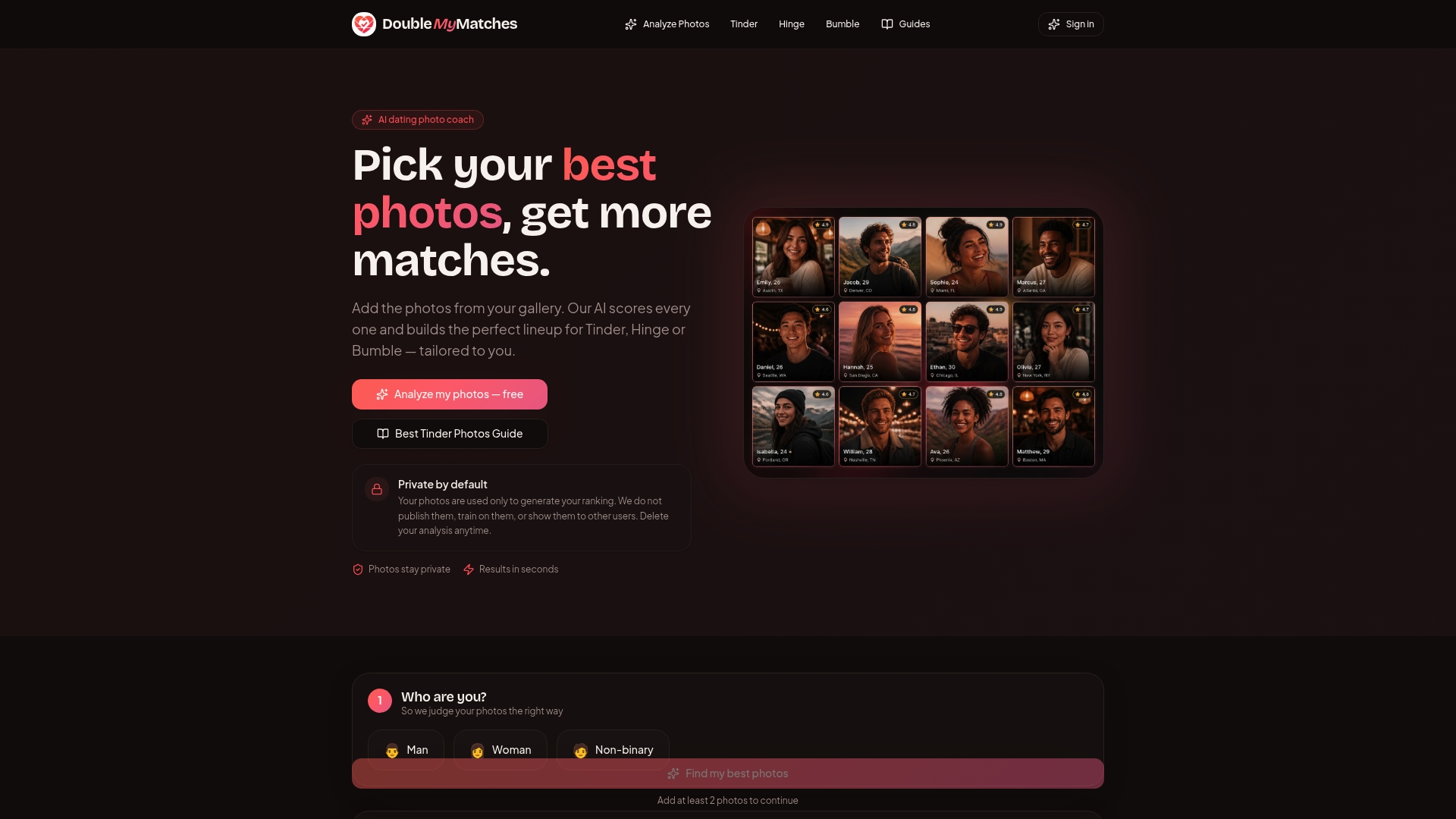
DoubleMyMatches analyses your photos using AI, scores them on expression, lighting, and composition, and ranks them from strongest to weakest. Your images are deleted immediately after scoring; they are never stored, published, or used to train the model. You get a clear, data-driven answer in minutes rather than spending days second-guessing yourself or asking friends who are too polite to be honest. Ready to find your best photo? Analyse your dating photos now and see exactly which image gives you the strongest first impression.
Useful sources and further reading
The claims in this guide draw on a mix of academic research and practitioner guidance. Here is a short list of the most relevant sources, noted by type.
Academic research
- Willis & Todorov (2006), Psychological Science — the foundational rapid-impression study (~100 ms judgements of competence, trustworthiness, and likability).
- van der Zanden et al. (2022), Communication Research — multimodal dating profile study showing photos are the primary attention focus.
- Frontiers in Communication (2025) — confidence as a predictor of dating intentions in an 8-item positive-trait scale.
- Springer Cognitive Research (2017) — the "curse of self" in photo selection; impartial raters choose differently from the subject.
- PMC / Profile Pictures and Life Satisfaction — self-photographs as profile pictures correlate with higher life satisfaction and offline-online self-consistency.
Practitioner guidance
- Headshot Photo: 5 psychology-backed techniques — practitioner summary of squinch, jaw position, shoulder drop, and Duchenne smile techniques.
- Executive Lens: how confidence changes the way you look — studio workflow notes on creating safety and rapid feedback to produce authentic presence.
- Bamford Photography: psychology of a strong first-impression photo — portrait photographer perspective on eye engagement and micro-expression as confidence drivers.