

Photo rating is the process of getting an objective score or crowd feedback on how well an image works for its intended purpose — whether that's a dating profile, a LinkedIn headshot, or a social post. If you're trying to improve your dating photos specifically, the fastest first step is an AI batch rank: upload several photos, get them ordered best to worst, and fix the weakest one. For general social or business images, a small crowd test adds useful context about how strangers perceive you.
TL;DR:
- Use AI ranking when you want instant, private, repeatable feedback on dating photos.
- Use crowdsourced voting when you want to understand how a broad audience perceives you socially or professionally.
- Before uploading anything, run a quick privacy check: does the service delete your images after analysis, and does it explicitly state photos won't be used for model training?
Table of Contents
- How do photo-rating services actually work?
- What do photo-rating systems actually measure?
- When should you use photo rating?
- How do you choose the right photo-rating service?
- How to interpret a critique and fix what's holding your photos back
- What do photo-rating services typically cost?
- How to check what a service does with your photos
- Why DoubleMyMatches works well for dating-photo rating
- Key takeaways
- The score is a tool, not a verdict
- Get your photos ranked with DoubleMyMatches
How do photo-rating services actually work?
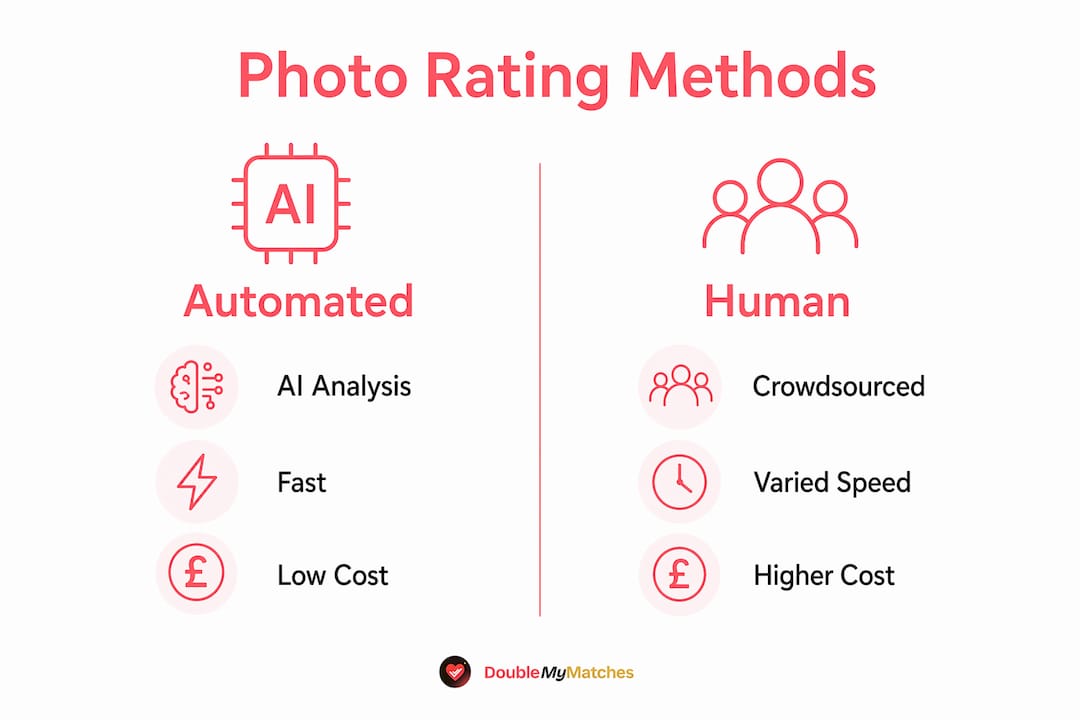
There are three main approaches: AI analysis, crowdsourced testing, and professional critique. Each produces a different kind of output, and knowing the difference helps you pick the right tool.
AI analysis works like this: you upload a photo, the system extracts dozens of variables (sharpness, exposure, facial clarity, background clutter, emotional impact), and returns a score plus an annotated critique. Modern AI models analyse technical and social indicators simultaneously, which means they can flag a background distraction and a flat expression in the same pass. The whole process takes seconds.

Crowdsourced testing routes your photo to a pool of real voters who rate it on specific traits (attractiveness, trustworthiness, professionalism). You get aggregated scores and sometimes short written comments. It's slower — typically hours rather than seconds — but it reflects genuine human first impressions.
Professional critique sits at the other end: a photographer or image coach reviews your photo manually and writes a detailed narrative with bespoke editing suggestions. It's the deepest feedback you can get, but it costs the most and takes the longest.
The most actionable critiques combine numeric scores with annotated overlays and a short bullet list of precise, repeatable fixes — not long essays. A score alone tells you where you stand; an overlay tells you exactly what to change.
| Approach | Speed | Cost | Depth | Repeatability |
|---|---|---|---|---|
| AI analysis | Seconds | Low–medium | Good | High |
| Crowdsourced | Hours | Low–medium | Moderate | Medium |
| Professional critique | Days | High | Excellent | Low |
What do photo-rating systems actually measure?
Most image-scoring tools assess a consistent set of traits, though the weighting varies by platform and use-case. Here's what typically gets scored and why it matters:
- Composition: Is the subject well-framed? Poor framing pushes the eye to dead space and reduces perceived confidence on dating apps.
- Lighting: Natural, even light reads as authentic and warm. Harsh shadows or flat indoor lighting lower trustworthiness scores.
- Exposure: Overexposed or underexposed shots lose detail in the face — the first thing a viewer looks at.
- Subject clarity: Is your face sharp and unobstructed? Blurry or partially hidden faces score poorly across every platform.
- Background clutter: Busy backgrounds create attention leaks — elements that pull the eye away from you and reduce the photo's overall impact.
- Expression: A genuine, relaxed expression scores higher than a forced smile. Authenticity is measurable.
- Trustworthiness / emotional impact: AI models score how approachable and warm you appear, which directly affects right-swipe rates on Tinder and Hinge.
- Professionalism: Relevant for LinkedIn and business headshots — posture, attire, and background all contribute.
Research-grade projects like AstraBert/photo-review score many separate dimensions, including timing and storytelling, which shows just how granular modern image assessment can get.
Low vs high score examples:
Composition: A low score typically means the subject is off-centre with no intentional framing and large areas of empty wall behind them. A high score shows the subject filling roughly a third of the frame, with a clean background that creates natural depth.
Expression: A low score often comes from a closed, tense mouth and downward gaze — common in selfies taken in a hurry. A high score features relaxed eyes, a natural smile, and direct engagement with the camera.
When should you use photo rating?
The right approach depends on your goal. Here's how the use-cases break down.
Dating profiles (Tinder, Hinge, Bumble)
Your goal is more right-swipes. Success means your strongest photo leads your profile and your weakest photos are either replaced or removed. AI batch ranking is the best fit here: it's fast, private, and ties directly to match outcomes. Expect instant scoring, a best-to-worst order, and per-photo feedback on what's dragging each image down.
LinkedIn and business headshots
Here you're optimising for perceived professionalism and trustworthiness. A crowdsourced test works well because you want real human reactions, not just technical scores. AI tools that weight professionalism and attire are also useful. Expect feedback on posture, background, and whether your expression reads as approachable or guarded.
Social posts and personal branding
For Instagram or personal brand content, emotional impact and composition matter most. A quick AI image-scoring pass helps you cull a batch before posting. Authentic, well-lit candid shots consistently outperform over-edited images — excessive retouching can actually reduce perceived trustworthiness scores.
Portfolio selection
Photographers and creatives benefit most from a combination: AI scoring for technical quality (sharpness, exposure, composition) and a professional critique for storytelling and style coherence. Batch ranking helps you identify which images carry a consistent visual identity.
How do you choose the right photo-rating service?
Start with these five criteria before you sign up for anything.
- Scoring granularity: Does the service give you a single number, or does it break down scores by trait (lighting, expression, composition)? Trait-level scores are far more useful.
- Explanation quality: A score without context is nearly useless. Look for annotated overlays or a bullet list of specific fixes.
- Batch ranking: Batch uploads of 3–10 images surface recurring weaknesses that single-image checks miss entirely.
- Audience match: A tool calibrated for dating photos uses different weighting than one built for editorial photography. Make sure the tool matches your goal.
- Privacy policy: Does the service explicitly state images are deleted after analysis and not used for model training? If the policy is silent on this, treat it as an unresolved risk.
Questions to ask before uploading:
- Are my photos deleted after analysis, or stored?
- Are images used to train the AI model?
- Who are the voters in crowdsourced tests, and how large is the pool?
- Is there a free first-photo check or sample critique I can review before paying?
- What is the refund or credit policy if I'm unsatisfied?
Red flags to watch for:
- No privacy policy, or a policy that doesn't mention image retention.
- A numeric score with no explanation of what drove it.
- Crowdsourced tests with very small voter pools (fewer than 20 votes produces unreliable averages).
- No sample critiques visible before payment.
| AI tools | Crowdsourced tests | Professional critique | |
|---|---|---|---|
| What is scored | Technical + social metrics | Perceived attractiveness, trustworthiness, professionalism | Composition, technique, narrative, style |
| Speed | Seconds | Hours | Days |
| Pricing model | Free trial / per-photo / subscription | Per-test credits | Per-session fee |
| Privacy | Varies — check policy | Varies — photos shown to voters | Confidential (direct relationship) |
| Best use-case | Dating profiles, social culling | Business headshots, social perception | Portfolio, editorial, personal branding |
| Feedback detail | Score + overlays + bullet fixes | Aggregated ratings + short comments | Full written narrative + edit suggestions |
For a direct comparison of crowdsourced and AI approaches, this breakdown covers the key trade-offs in detail.
How to interpret a critique and fix what's holding your photos back
Think of your scores as a composition debugger, not a verdict on how you look. The goal is to isolate one variable at a time and test whether changing it moves your score.
Start with the batch ranking. Read the top-to-bottom order and look for the trait that appears in the feedback for your three lowest-ranked photos. That's your recurring weakness — fix it first.
Use this composition checklist:
- Framing: Is your face centred or slightly off-centre with intention? Avoid cutting off the top of your head.
- Background: Is it clean and uncluttered? A plain wall, natural foliage, or a soft-focus street scene all work well.
- Leading lines: Does anything in the background draw the eye toward you, or away from you?
- Rule of thirds: Place your eyes roughly on the upper horizontal third of the frame.
- Headroom: Leave a small gap between the top of your head and the frame edge — too little feels cramped, too much feels distant.
Visual overlays are particularly useful here. They show exactly where the eye is drawn and can reveal attention leaks you'd never spot on your own — a bright window behind you, a cluttered shelf, a second person partially in frame.
Before/after fixes that move scores most:
- Reframe from a tight selfie to a slightly wider shot taken by someone else — subject clarity and composition both improve.
- Swap a busy indoor background for a plain wall or outdoor setting — background clutter scores drop immediately.
- Replace a forced smile with a candid laughing shot — expression and emotional impact scores typically rise.
- Shoot in natural window light rather than overhead artificial light — exposure and trustworthiness scores both benefit.
Pro Tip: Run a controlled A/B test: change one variable at a time (background first, then expression, then lighting), re-upload after each change, and compare scores. This isolates what's actually driving improvement rather than guessing.
Synthesised critiques that average across several photos can also tell you exactly what to reshoot next — the angle, expression, or lighting setup most likely to push your top photo higher.
What do photo-rating services typically cost?
Pricing models vary widely, but most services follow one of four patterns.
Free single-photo check: You upload one image and get a top-line score or short critique at no cost. This is a trust signal — it lets you verify the quality of feedback before committing. Services that offer this, alongside sample critiques visible before payment, are generally more transparent about what you're buying.
Per-photo credits: You pay per image analysed. Good for occasional use or testing a new set of photos after a reshoot. Costs vary by service.
Bundles: A fixed number of analyses sold together, usually at a lower per-photo rate. Useful if you're running multiple test cycles.
Subscriptions or unlimited passes: An annual or monthly fee for unlimited analyses. Worth it if you're actively iterating on your profile over several weeks.
Professional critiques are priced separately and typically cost significantly more than automated options, reflecting the time involved.
| Pricing model | Pros | Cons |
|---|---|---|
| Free single-photo check | Zero risk, instant quality test | Limited depth, no batch ranking |
| Per-photo credits | Flexible, pay only when needed | Can add up across multiple test cycles |
| Bundle | Better value for active testing | Upfront cost, may go unused |
| Subscription / unlimited pass | Best value for ongoing iteration | Overkill for one-off use |
| Professional critique | Deepest feedback available | Expensive, slow, not repeatable at scale |
A reasonable price buys you detailed overlays, batch ranking across multiple photos, and specific bullet-point fixes — not just a number. If a paid service offers only a score with no explanation, it's not worth the money.
How to check what a service does with your photos
Privacy matters more for dating photos than for almost any other image type. You're uploading personal, identifiable images to a third-party server — knowing what happens next is non-negotiable.
Phrases to look for in a privacy policy:
- "Session-only analysis" — images are processed and not retained beyond the current session.
- "No training use" or "images not used to train our models" — your photos won't improve someone else's AI.
- "Images deleted after [X] hours" — a specific deletion window is a stronger commitment than a vague assurance.
- "Encrypted transfer" — your upload is protected in transit.
Practical steps to verify privacy claims:
- Read the privacy policy before uploading, not after. Search for the word "training" and "retain" to find the relevant clauses quickly.
- If the policy doesn't mention image retention, contact support and ask directly. A service that can't answer this question clearly is one to avoid.
- Check whether your photos appear anywhere publicly (some crowdsourced platforms display uploaded images to voters or in leaderboards).
- If you're uncertain, use a disposable email address for your first test.
The specific concern for dating photos is straightforward: these images are tied to your identity and your personal life. A service that stores them indefinitely, or uses them to train models without your knowledge, creates a risk you didn't sign up for. Leading tools explicitly state that images are discarded after analysis and never used for training — that's the standard to hold every service to.
Why DoubleMyMatches works well for dating-photo rating
DoubleMyMatches is built specifically for dating profiles, which means its scoring is calibrated for what actually drives right-swipes on Tinder, Hinge, and Bumble — not generic aesthetic quality.
What you get:
- Instant best-to-worst ranking across your uploaded batch, so you know immediately which photo to lead with.
- Per-photo overlays and feedback that identify exactly what's weakening each image (background clutter, flat expression, poor framing).
- Lineup recommendations — not just a ranking, but guidance on which photos to use together for the strongest overall profile.
- Weak-photo identification — the tool flags photos that actively harm your profile, not just ones that underperform.
- Privacy by design: photos are analysed and discarded. They are not published, not stored, and not used to train the AI.
You can start with a free single-photo analysis to see the quality of feedback before committing to a full report. The paid report covers your full batch with detailed per-photo critiques and a ranked lineup. For those running multiple test cycles, bundle options are available.
Users report meaningful increases in matches after applying the recommended lineup changes — particularly after removing the photos the tool flags as harmful and leading with the highest-ranked image instead.
Key takeaways
AI batch ranking is the fastest, most repeatable way to improve dating photos: upload 3–10 images, fix the weakest recurring trait, and re-test after one controlled change.
| Point | Details |
|---|---|
| Batch ranking beats single checks | Uploading 3–10 photos surfaces recurring weaknesses that a single-image check misses. |
| Privacy check comes first | Confirm images are deleted after analysis and not used for training before uploading any personal photo. |
| Fix one variable at a time | Change background, then expression, then lighting — isolating each change shows what actually moves your score. |
| Score depth matters | A numeric score alone is not enough; look for annotated overlays and specific bullet-point fixes. |
| DoubleMyMatches for dating photos | Offers instant batch ranking, per-photo overlays, lineup recommendations, and a privacy-first one-time analysis. |
The score is a tool, not a verdict
There's a tendency to treat photo ratings as a judgement on attractiveness. That framing is both inaccurate and counterproductive. What a good rating system actually measures is communication — how clearly and warmly your photo conveys who you are to a stranger in under two seconds.
The most useful shift you can make is treating your score as a composition debugger. A low expression score doesn't mean you're unapproachable; it usually means the camera caught you mid-blink or with a tense jaw. A low background score doesn't mean your life is uninteresting; it means a cluttered shelf is stealing attention that should be on your face. Both are fixable in an afternoon.
What we've seen work consistently is the controlled test cycle: one change, re-upload, compare. It removes the guesswork and turns photo improvement into something measurable. The people who get the most out of photo evaluation aren't the ones who obsess over their top score — they're the ones who iterate quickly, fix the obvious issues first, and stop when their strongest photo is genuinely strong.
Privacy is the other thing worth saying plainly: your dating photos are personal. Any service that can't clearly state what happens to your images after analysis doesn't deserve your trust, regardless of how good the scores look.
Get your photos ranked with DoubleMyMatches
Better matches start with knowing which photo to lead with — and right now, you can find out for free. DoubleMyMatches gives you an instant AI score on your first photo at no cost, with full privacy: your image is analysed and discarded, never stored or shared.
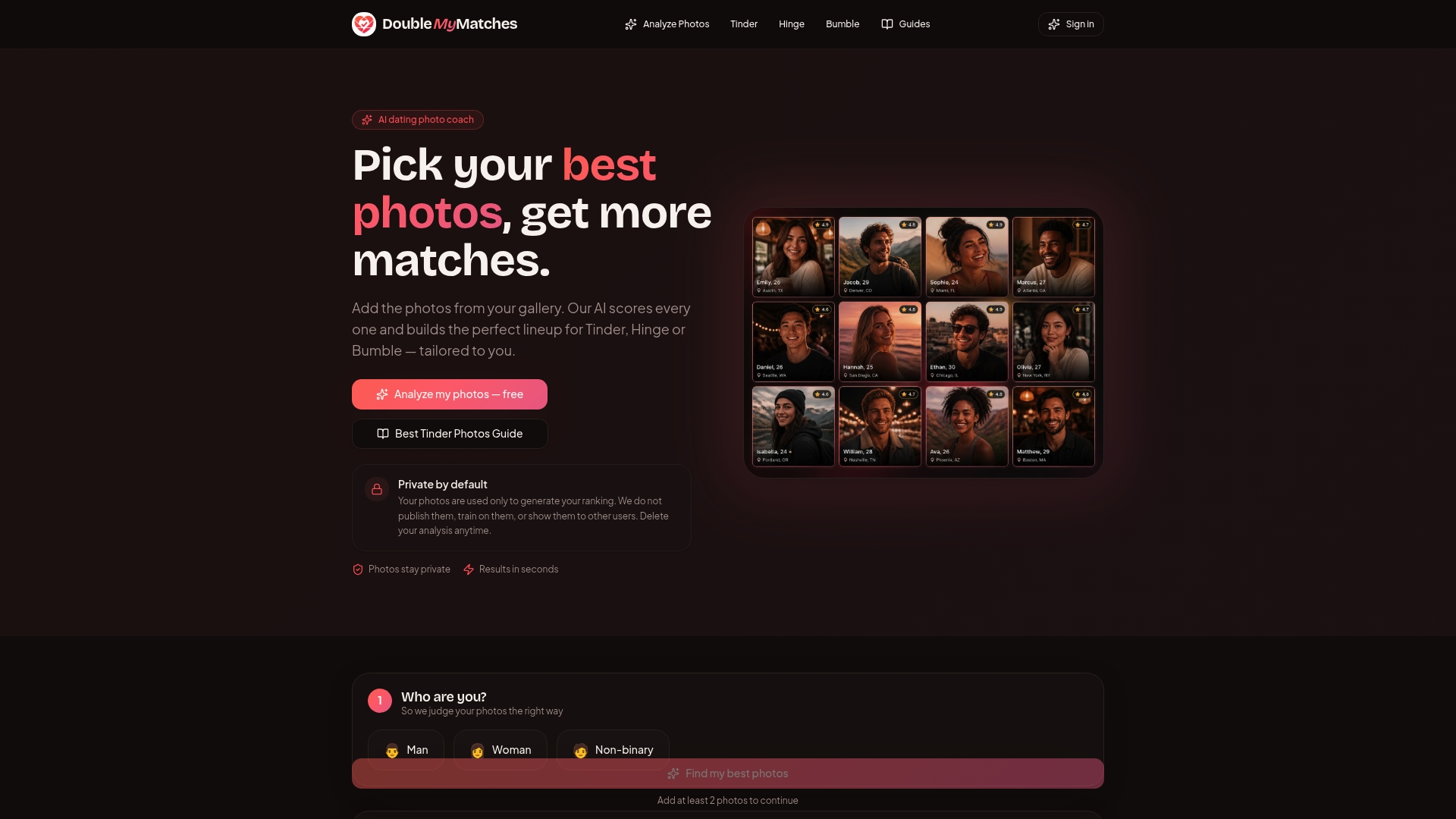
From there, a full report ranks your entire batch from best to worst, flags the photos that are actively hurting your profile, and gives you per-photo feedback with specific fixes. No subscription required — it's a one-time analysis you can run in a single session.
Upload your photos, get your ranked lineup, and see your results today. If you want to go deeper, the batch ranking tool lets you test multiple sets as you iterate.