
Your Hinge gallery wins or loses on two things: a clear, solo headshot in slot one and six genuinely distinct frames that each give someone a reason to comment. That is the role of photo variety on Hinge profiles in a single sentence. Here is what to do right now:
- Swap your lead photo to a solo, front-facing headshot where your eyes are clearly visible and you are smiling naturally.
- Add a full-body shot if you do not already have one — it answers a question viewers have before they ask it.
- Include at least one activity photo that shows you doing something specific (a sport, a hobby, cooking).
- Never open with a group photo — viewers should not have to guess which person you are.
- Fill all six slots. Profiles with more distinct photos tend to generate more likes and comments.
Hinge is built differently from swipe-only apps. To start a conversation, someone must like or comment on a specific photo or prompt. That means every slot is a potential conversation starter, not just decoration. Edit your lead photo first, then work through the rest of the slots using the blueprint below.
Table of Contents
- How does Hinge's photo model shape what viewers do?
- What should each of your six Hinge photo slots do?
- Does the order of your photos actually change your match rate?
- What does 'photo variety' actually mean for a dating profile?
- What photo mistakes are quietly killing your Hinge engagement?
- How to pick and order your Hinge photos in under 30 minutes
- What does the research say about photo variety and sequencing?
- Key takeaways
- Why sequencing matters more than most people realise
- Get your Hinge photos ranked by AI in minutes
- Useful sources
How does Hinge's photo model shape what viewers do?
Hinge's interaction model is the key reason photo order matters so much here. Unlike apps where a swipe covers the whole profile, Hinge requires a viewer to react to a specific photo or prompt to open a conversation. Each slot is effectively a separate hook — a chance for someone to tap and say "I've done that too" or "where was that taken?"
The lead photo carries outsized weight because many viewers never scroll past slot one. Slots 2–6 function as a downstream funnel: they close the match for viewers who were already interested after the first frame. A weak lead photo means most of that funnel never gets seen.
Hinge also uses a machine-learning model called Top Photo, which predicts which image is most likely to earn a like and surfaces it prominently. You keep control of your slot order, but the platform's algorithm is explicitly anchored to that first frame.
Statistic: Profiles with more visually distinct photos tend to generate more likes — and the lead photo determines whether a viewer engages with the rest of the profile at all.
Pro Tip: Run a simple lead-photo test. Upload two strong solo headshots as your lead on separate weeks and compare how many likes and comments each generates. Even one week of data gives you a directional signal.
What should each of your six Hinge photo slots do?
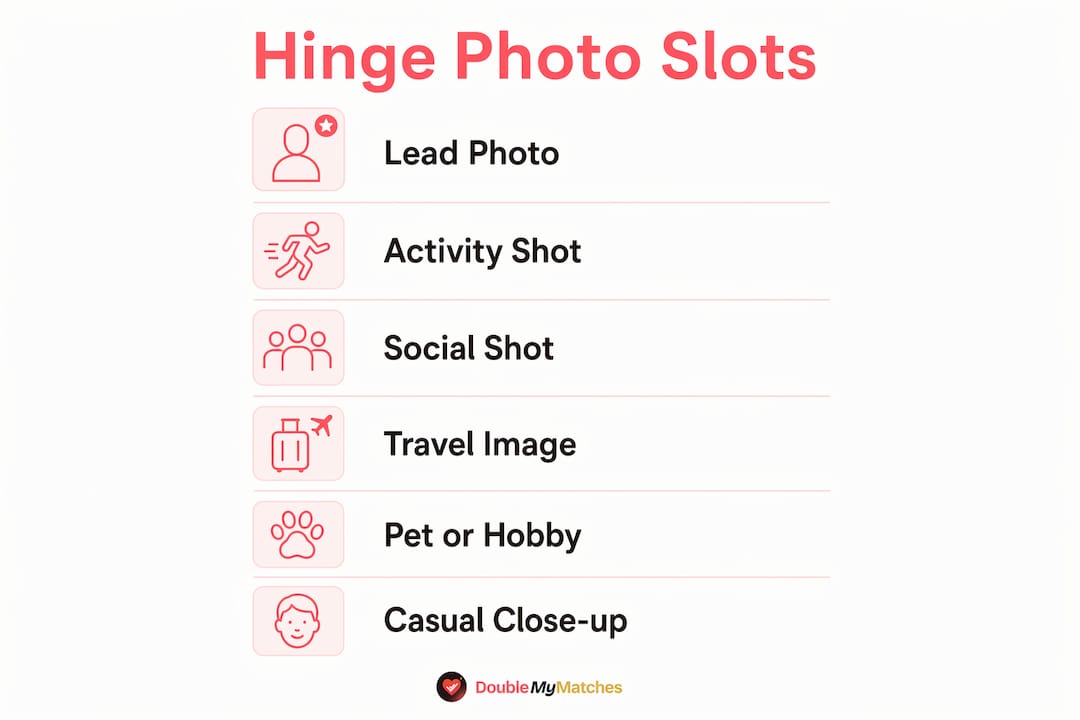
Think of your six slots as six different reasons for someone to start a conversation. Lifestyle and activity shots that give a viewer something specific to react to consistently outperform a gallery of near-identical studio portraits. Here is how to fill each slot with purpose.
- Slot 1 — Lead headshot. A solo, front-facing portrait, head and shoulders, with natural light and a genuine smile. This is your identity anchor. What to avoid: sunglasses, hats, heavy filters, or anyone else in the frame.
- Slot 2 — Full-body shot. Shows your height, build, and how you carry yourself. A candid outdoor frame works better than a posed gym mirror. What to avoid: blurry backgrounds that hide your surroundings entirely, or overly edited physique shots.
- Slot 3 — Activity or hobby shot. You climbing, cooking, playing an instrument, at a gig. This is your single strongest comment magnet. What to avoid: generic gym selfies with no context — they say less than a photo of you mid-climb.
- Slot 4 — Place or travel shot. A recognisable location, a city skyline, a hiking trail, a market abroad. It invites a story-based comment ("I've been there!"). What to avoid: tourist snaps where your face is tiny and the landmark is the star.
- Slot 5 — Second portrait, different mood. A candid laugh, a quieter moment, a different setting from slot 1. It adds depth and shows range. What to avoid: repeating the same pose or outfit from slot 1.
- Slot 6 — Social or storytelling frame. You with friends, at an event, or in a situation that signals your lifestyle. This is your social proof slot. What to avoid: making this your lead — it belongs here, not at the top.
| Slot | Primary purpose | Composition note | Sample caption idea |
|---|---|---|---|
| 1 | Identity clarity | Head-and-shoulders, natural light, eye contact | No caption needed — let the image speak |
| 2 | Reality check | Full body, candid environment | "Sunday morning in [city]" |
| 3 | Comment trigger | Mid-action, clear subject | "Ask me about my sourdough obsession" |
| 4 | Story hook | Location recognisable, face visible | "Best coffee I've ever had — [city]" |
| 5 | Depth and contrast | Different mood from slot 1, candid | Leave blank or a single word |
| 6 | Social proof | Group context, you clearly identifiable | "These lot are the reason I'm always tired" |
Does the order of your photos actually change your match rate?
Yes, and the effect is significant. The optimal sequence follows a simple logic: anchor → reality check → comment hook → place → depth → social proof. That maps directly onto slots 1–6 above. The reason it works is behavioural: the lead photo earns the click, the full-body shot answers the first unspoken question, and the activity and place shots give a viewer two distinct reasons to comment before they reach the social frame.
Sequencing dos and don'ts:
- Do place your group photo last (slot 6), never first.
- Do vary outfits across slots — repeating the same shirt in four photos suggests the gallery is old or limited.
- Do pair your activity photo with a caption prompt that invites a specific question ("Ask me about the worst campsite I've ever stayed at").
- Don't put two near-identical headshots back to back — it wastes a slot and reduces the number of comment hooks.
- Don't hide your eyes in the first three slots. Sunglasses and hats in the lead or slot 2 create identity ambiguity that costs you likes.
- Don't use a photo where you are barely visible in a crowd as anything other than slot 6.
Caption prompts work best when they are tied to a specific photo. A travel shot in slot 4 paired with a prompt about your worst travel disaster gives a viewer two overlapping reasons to open a conversation.
Pro Tip: Swap your current lead with your slot 3 activity photo for one week. Track whether your comment rate goes up or down. That single swap is the fastest A/B test you can run without changing anything else.
What does 'photo variety' actually mean for a dating profile?
Photo variety does not mean uploading six completely different aesthetics. It means a consistent version of you across six distinct scenes and moods. Variety in photographic galleries increases perceived richness and gives viewers more conversation hooks — but only when the images feel like they belong to the same person.
The risk on the other side is image overload. Research on digital photo consumption warns that too many visually disparate images reduce memory and emotional connection. A gallery that jumps between wildly different lighting styles, colour palettes, and moods can feel disjointed, making it harder for a viewer to form a clear impression of you.
The practical sweet spot is cohesive variety: two or three recurring visual anchors (a consistent colour palette in your clothing, similar warm or cool lighting across shots) combined with genuinely different scenes, poses, and moods. You want someone to scroll through all six photos and think "I feel like I know this person" — not "I'm not sure these are all the same individual."
Pro Tip: Before your next photo session or gallery edit, pick two colour anchors for your wardrobe — for example, navy and white — and stick to them across at least four of your six shots. The result is visual cohesion without any two photos looking the same.
What photo mistakes are quietly killing your Hinge engagement?
Most profile problems are not dramatic — they are quiet errors that reduce trust or remove comment triggers without the viewer consciously noticing. Here are the ones that cost the most likes.
Weak lead photo. A blurry, low-light, or heavily filtered first frame signals low effort before a viewer has read a single word of your profile. Common mistakes include group photos as the lead, sunglasses or hats hiding the face, and mirror selfies — all of which reduce identity clarity and lower engagement.
Too few slots filled. Leaving slots empty is a missed opportunity. Each empty slot is a conversation hook that does not exist.
Five near-identical headshots. If every photo is a slightly different version of the same pose in the same room, a viewer has no new information after slot 2. There is nothing to comment on.
Heavy filters or extreme editing. Filters that alter your skin tone, eye colour, or facial structure create a mismatch between your profile and real life. Hinge's model rewards authenticity — viewers sense when something looks off.
Low-resolution images. A pixelated or stretched photo reads as careless. If a photo looks poor at full screen on a phone, do not use it.
Ambiguous social photos as the lead. A group shot where you are not immediately obvious forces the viewer to do work. Most will not bother.
Each of these mistakes operates on the same mechanism: they introduce doubt or ambiguity in the split second a viewer is deciding whether to engage. Removing them is faster than taking new photos — start by auditing what you already have.
How to pick and order your Hinge photos in under 30 minutes
Work through these steps in order. You do not need new photos to make meaningful improvements right now.
- Choose your lead. Pick the clearest solo headshot you own — face fully visible, eyes sharp, natural smile. If none of your current photos qualify, that is your signal to take one this week.
- Add a full-body shot. Scroll your camera roll for a candid outdoor photo where your whole body is visible. It does not need to be posed.
- Find your activity photo. Pick one image of you doing something specific. A sport, a hobby, cooking, a gig — anything that gives a viewer a concrete question to ask.
- Slot a travel or place frame. A photo with a recognisable location in the background. Your face should be clearly visible.
- Add a second portrait. A candid laugh or a quieter moment — different outfit and setting from slot 1.
- Close with a social frame. A group photo or an event shot where you are clearly identifiable. This goes last.
For each photo, ask yourself three quick questions before saving: Is my face readable at thumbnail size? Are my eyes visible? Does this photo give someone a specific reason to comment? If the answer to any of these is no, swap it out.
Pro Tip: For small on-phone edits that preserve authenticity, adjust exposure and crop only. A slight brightness lift and a tighter crop to remove dead space can transform a decent photo into a strong one without touching filters or skin-smoothing tools.
You can also use a dating photo checklist to evaluate each slot systematically before you publish.
What does the research say about photo variety and sequencing?
The evidence behind photo sequencing on dating apps points in a consistent direction. The lead photo determines a very large portion of a profile's success because many viewers never scroll past slot one. Slots 2–6 function as a closing funnel for viewers who were already interested. A strong lead is not optional — it is the gate.
Hinge's own guidance confirms that its Top Photo feature uses a machine-learning model to predict which image is most likely to earn a like, reinforcing the platform's anchor-heavy design. The implication is clear: the algorithm and the viewer's behaviour are aligned. Both weight the first frame heavily.
On variety, photography practice guidance consistently recommends a session that produces eight to ten usable frames — enough to build a strong six-photo lineup with genuine variety across wardrobe and scenes. Profiles built this way, with distinct images rather than near-duplicate headshots, tend to generate greater engagement.
| Signal | Guidance | Source type |
|---|---|---|
| Lead photo weight | Determines a large portion of likes; many viewers do not scroll past slot 1 | Behavioural / platform data |
| Face framing | Face should occupy 55–65% of the lead photo frame for identity clarity | Photography best practice |
| Slot count | Filling all six slots with distinct images increases comment opportunities | Platform and photography guidance |
| Variety vs. repetition | Distinct scenes and moods outperform near-identical headshots | Photography and behavioural research |
Statistic: A face occupying about half to two-thirds of the lead photo frame is the standard recommended by professional dating photographers for identity clarity and immediate recognition.
If you want to test changes systematically, swap one variable at a time (lead photo only, then activity photo only) and track likes and comments over 2–4 weeks before drawing conclusions. Keep a simple note with the date, the change, and the weekly like count.
Pro Tip: When using any AI photo-analysis tool, check that it states explicitly that your images are analysed temporarily and not stored or used to train its model. DoubleMyMatches discards photos after analysis and does not use them for AI training.
One practical privacy step: before uploading photos to any third-party tool, you can use a reverse image search to check whether your images are already circulating elsewhere online.
Key takeaways
A Hinge gallery wins when the lead photo delivers instant identity clarity and every subsequent slot offers a distinct, commentable hook — variety and sequencing together determine your match rate.
| Point | Details |
|---|---|
| Lead photo is the gate | Many viewers never scroll past slot one; a clear solo headshot is non-negotiable. |
| Fill all six slots | Each empty slot is a missed conversation trigger; distinct images outperform near-duplicates. |
| Sequence with purpose | Follow the anchor → reality check → hook → place → depth → social order for best results. |
| Cohesive variety wins | Keep a consistent visual identity across different scenes; avoid random mismatch that causes image overload. |
| DoubleMyMatches speeds this up | The AI ranks your photos by lighting, expression, and composition so you know which to lead with and which to swap. |
Why sequencing matters more than most people realise
There is a tendency to treat a Hinge profile like a photo album — upload your best-looking pictures and hope for the best. The sequencing question gets skipped entirely. That is a mistake, and the data backs it up.
What we observe repeatedly is that a single lead-photo swap, moving from a group shot or a sunglasses photo to a clear solo headshot, produces a noticeable lift in likes within days. The rest of the profile has not changed. The person has not changed. Only the first frame has. That tells you something important: viewers are making a decision in the first second, and the lead photo is the only thing they are using to make it.
The subtler point is about commentability. Hinge's model is not just about getting a like — it is about starting a conversation. A gallery of six strong-but-silent headshots gives a viewer nothing to say. An activity photo, a travel shot, a social frame — these are the images that generate the "wait, is that [place]?" or "I do that too" messages that actually lead somewhere. Variety is not an aesthetic preference. It is a functional requirement of the platform.
The advice to test systematically before over-editing is worth taking seriously. Change one thing, wait a week, measure. Most people either change everything at once or nothing at all. Neither approach tells you what actually worked.
Get your Hinge photos ranked by AI in minutes
Knowing the theory is one thing. Knowing which of your actual photos to lead with is another. DoubleMyMatches analyses your Hinge photos against the factors that matter most — lighting, expression, composition, and commentability — and ranks them so you know exactly which image belongs in slot one and which to move or replace.
It is faster and more objective than asking friends, and your photos are analysed temporarily and then discarded. They are never published or used to train the AI. If you want a quick, privacy-safe way to validate your lead photo choice and check your slot order before your next edit session, the AI dating photo analyser gives you a ranked result in minutes. You can also rank your photos from best to worst to settle the sequencing question once and for all.
Useful sources
- First Photo on Hinge: The One Rule That Decides Your Match Rate — covers lead-photo behavioural data and why slot one is anchor-heavy on Hinge.
- What is Top Photo? — Hinge Help — Hinge's official explanation of how its machine-learning model surfaces the strongest lead image.
- Best Hinge Profile Photos: What Actually Works in 2026 — Photography Shark Studios — practical photography guidance on building a six-photo lineup with genuine variety.
- Best Hinge Profile Pictures: 6 Types That Get Matches — TruShot — slot-by-slot breakdown of photo types and why distinct images outperform near-duplicates.
- Ten Professional Profile Photo Mistakes to Avoid — dpix — UK-based guide to common profile photo errors including group-as-lead and hidden-face mistakes.
- Why diverse photos are essential for headshots, branding, and dating — Irene Abdou Photography — explains how variety across scenes and moods increases perceived richness and conversation hooks.
- Exposed to a deluge of digital photos — The Conversation — research-backed piece on image overload and why visual cohesion aids memory and emotional connection.